Pulled From the Top
Read the transcript of “Pulled From the Top”
Film transcript: Pulled From the Top
A coast redwood lifts water more than one hundred metres, with no heart or other pump organ. Where does the force come from? Plant biologists track water with one number, its water potential Pure water at atmospheric pressure is set at zero.
Dissolve a solute in open water, and the number drops below zero. Water crossing a membrane moves toward lower water potential. Now line up a plant, with illustrative values. The soil sits a little below zero, the root lower, the leaf lower still. The air sits far below them all. So water runs downhill all the way. The biggest drop by far is from the leaf to the dry air.
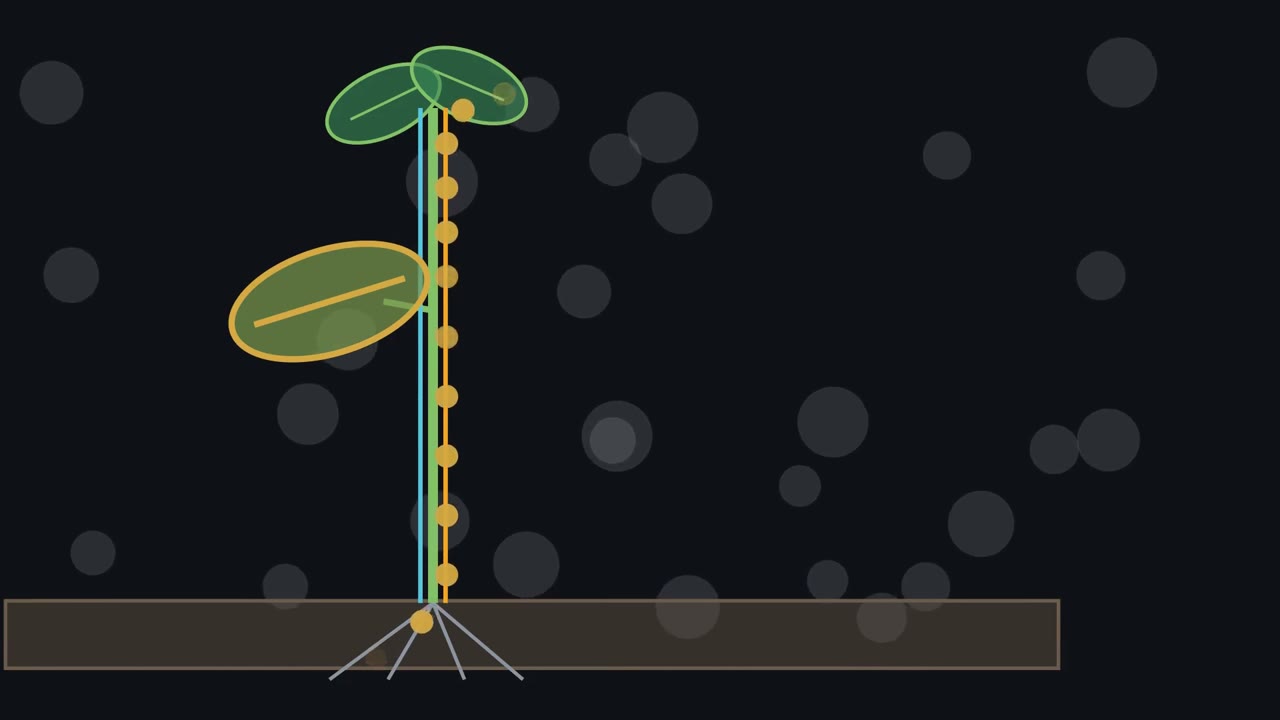
Inside a leaf, water evaporates from the wet walls of the mesophyll cells. These inner cells do photosynthesis. The vapour diffuses out to the drier air. As water leaves, the water still held in the tiny pores of the walls is held more tightly. Its pressure falls below zero. That is tension, a pull. Negative pressure means the water is stretched, not squeezed.
Picture a sealed syringe full of water, its plunger pulled back. If no bubble forms, the water pulls on the plunger instead of pushing. Why does the pull not just snap the water? Water molecules cling to each other through hydrogen bonds. This cohesion lets a thin column in a narrow tube be pulled like a rope.
The tubes are xylem cells called tracheids and vessel elements. They are dead when they work, with their contents gone. They leave a hollow pathway from root to leaf. Henry Dixon and John Joly proposed this in the 1890s. Evaporation pulls, cohesion passes the pull down, and the column stays under tension. Height adds a cost. Each metre takes about 0.01 MPa more tension, just to hold a still column. At the top of a 110 m redwood, gravity alone adds over 1 MPa. Roots can push water too, a little. If xylem water were pushed from below, what would happen when you cut it on a sunny afternoon?
Pushed water would spurt out. It does not. Cut the xylem of a transpiring tree and air is drawn in. The water was under tension. So the force comes from the top. Evaporation lowers the pressure in the leaf, and the water column below is pulled up toward it. Water leaves for lower water potential, and the dry air is lowest of all. So the xylem is pulled, not pushed.
A coast redwood lifts water more than 100 m with no heart or other pump organ. Where does the force come from?
Continue in the lesson: Moving Water and Sugar in Plants →
3:16 · Free, with captions and a transcript. The lesson has the full text, the questions and the sources.
More films from this lesson
How this film was made. Narration: written from this lesson's text and read by an AI narrator voice (Kokoro, af_heart). Animation: AI-generated in code (Manim) by Claude, a schematic with no drawn molecular structures. Captions come from the narration script. See something wrong? Report it.