What Becomes a Tree?
Read the transcript of “What Becomes a Tree?”
Film transcript: What Becomes a Tree?
A seed can become a huge tree while the soil hardly shrinks. What becomes the wood? Watch one tiny seed beside a growing trunk. The tree gains layer after layer. The soil gauge barely moves. Something outside the soil must supply most of that new material.
Start by sorting matter from energy. Matter has mass and can become part of the tree. Energy can move or change form, but it does not become wood. Sunlight reaches the leaf as radiant energy. It powers the building, the way electricity runs a factory's machines without becoming part of the product. Water enters through roots and moves upward.
Carbon dioxide enters leaves from the air. Light arrives at those leaves too. The plant uses the light energy to build sugar from carbon dioxide and water. Oxygen leaves as another product. The word equation is a summary, not one single step. Now predict. Which paths carry matter that can enter the trunk? Which path carries only energy? Follow each colour before the tree grows again.
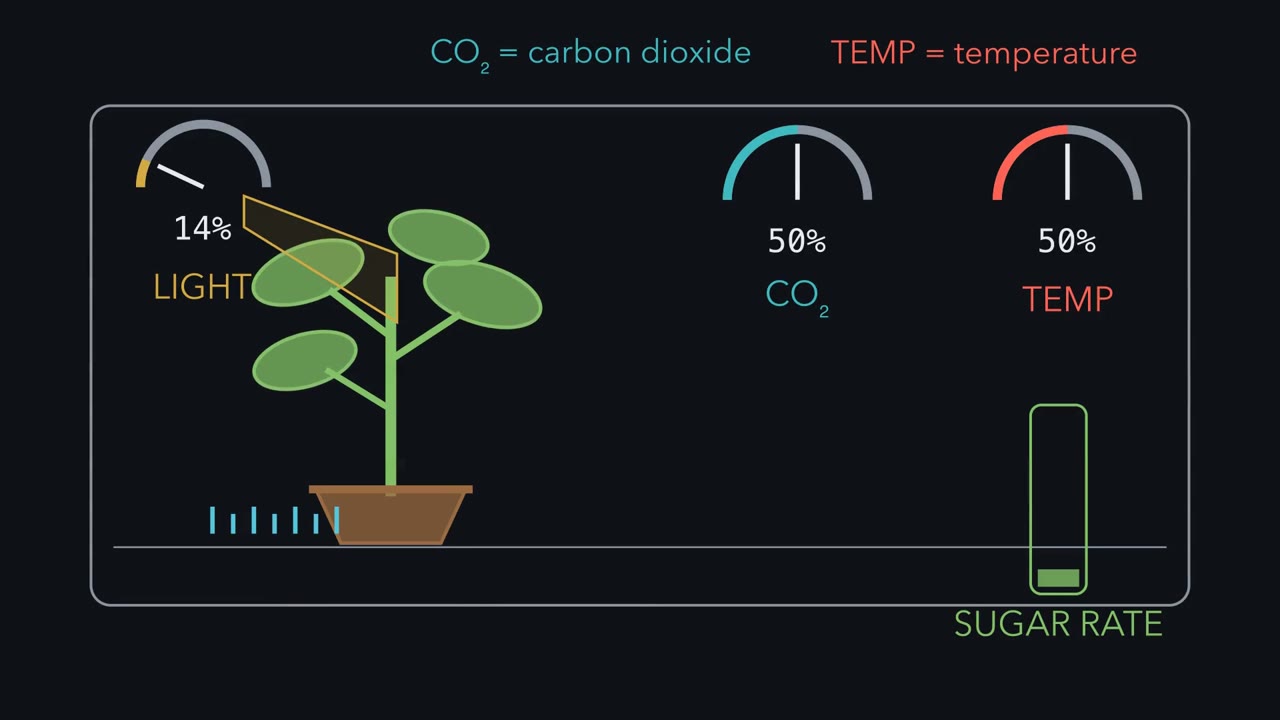
The teal carbon dioxide and blue water paths carry matter. The gold light path carries energy. Light powers sugar-building from carbon dioxide and water; conditions limit its speed. The first half explains what can become wood. The second half reminds us that building cannot always run faster. In plants and algae, this work happens inside chloroplasts. Chloroplasts are green parts of some cells, mostly in leaves. Chlorophyll inside them captures radiant energy.
Roots, which sit in darkness, usually have no chloroplasts. Photosynthetic bacteria do the work without chloroplasts. Sugar does not have one destination. Some is used now as cells release energy for living. Some is linked into starch and stored. Some is rebuilt into wood and new leaves. Each route starts with the same green sugar block made in the leaf. That stored chemical energy can move through a food web. A rabbit eats clover, and a fox eats the rabbit. Both depend on energy captured by a producer.
Almost every food web begins this way. A few communities use chemical energy instead of light. Return to the tree. Its soil did not need to become the trunk. Matter arrived mainly as carbon dioxide, with water also supplying atoms.
Light supplied the energy for building sugar. Light supplies the energy; carbon dioxide and water supply the matter. The plant then used that sugar to make living material and feed other life.
How can a tiny seed become a giant tree without the soil shrinking by the same amount?
Continue in the lesson: Photosynthesis Feeds the World →
3:26 · Free, with captions and a transcript. The lesson has the full text, the questions and the sources.
More films from this lesson
How this film was made. Narration: written from this lesson's text and read by an AI narrator voice (Kokoro, af_heart). Animation: AI-generated in code (Manim) by Claude, a schematic with no drawn molecular structures. Captions come from the narration script. See something wrong? Report it.