Three Doors
Read the transcript of “Three Doors”
Film transcript: Three Doors
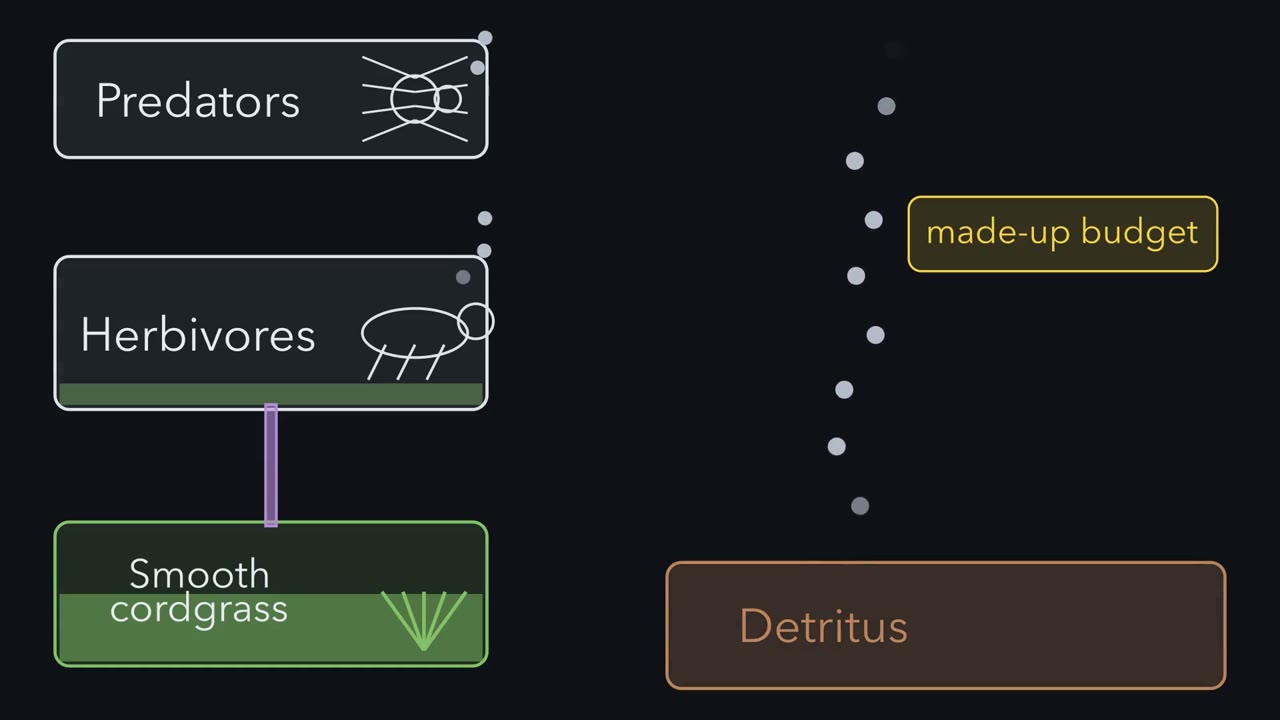
Plants on one square metre fix 12,000 kilojoules in a year. Why does so little of that energy reach the animals at the top? These numbers come from a made-up budget for one year. Each one is a rate, energy per square metre per year. That is production. It is a flow, like deposits into an account, not the balance at one moment. The plants' total fixation is called gross primary production The plants respire part of it just to stay alive. In this budget it is half, and that half leaves as heat. What remains is net primary production It is all the energy left for everything else, to eat or to store. Now follow it up one feeding step, to the herbivores.
At this step, every kilojoule has three ways out. Call them doors. The herbivores could eat most of the plants' production, or only a little of it. Which do you expect? Only a little, here less than a third. The rest is never eaten. It dies and drops through the brown door, into detritus. Detritus is dead matter that feeds bacteria, fungi and animals that eat it. Of what the herbivores eat, much passes straight through, as feces. That goes out the brown door too, into the same detritus. Of what they absorb, a large part is respired just to keep them alive. It leaves through the grey door, as heat. What is left becomes new herbivore tissue and offspring.
That is the herbivores' production, passed up from the plants. Predators can eat it, but they do not eat all of it. Each door sets a fraction, drawn as a valve on the pipe. One is the share eaten. One is the share absorbed. One is the share made into tissue. The three valves in a row give the share that reaches the herbivores. It is the product of the three fractions, called the trophic transfer efficiency. Nothing vanishes along the way. The three doors together account for every kilojoule that this step received. In this budget, the books close. At every step up, the same three doors open again. So the fractions multiply, and production shrinks fast up a food chain.
This holds for rates over one period, in one currency, while consumers eat no more than the production below them. Energy never returns to the plants. It is stored for a while, or leaves as heat.
In a made-up budget, plants on one square metre fix 12,000 kilojoules a year and the top predators make 40. Where did the rest go?
Continue in the lesson: Energy Flow and Productivity →
3:05 · Free, with captions and a transcript. The lesson has the full text, the questions and the sources.
More films from this lesson
How this film was made. Narration: written from this lesson's text and read by an AI narrator voice (Kokoro, af_heart). Animation: AI-generated in code (Manim) by Claude, a schematic with no drawn molecular structures. Captions come from the narration script. See something wrong? Report it.