The Loop Inside the Line
Read the transcript of “The Loop Inside the Line”
Film transcript: The Loop Inside the Line
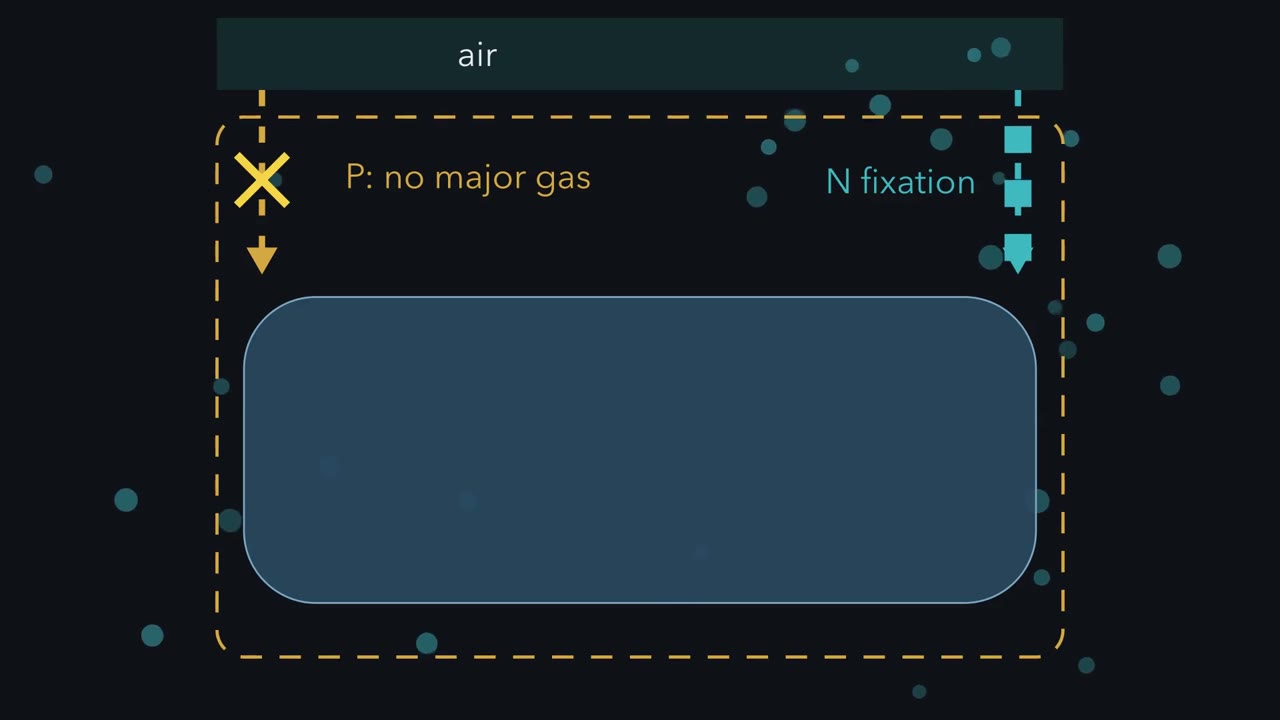
Where does the nitrogen in a cut forest's stream come from? Cut a forest, keep it from growing back, and its stream carries far more nitrogen than before. Nobody added fertiliser, and the logs stayed where they fell. To find the source, keep accounts, the way a bank does. First, draw a line around the valley. Inside the line, nitrogen sits in pools, such as the soil and the trees. A pool is like a bank balance. A flux is a transfer, like a deposit or a withdrawal. Here nitrogen crosses the line in two ways. From the air, rain and snow deposit 8 kg per hectare each year. Microbes fix 6 more. It leaves in two ways. The stream carries 3 away, and microbes release 2 to the air as gas.
The store changes only by what crosses the line. Change in stock = inputs − outputs. This forest gains 9 kg of nitrogen per hectare each year. The line and the year must be stated before any adding. But most nitrogen never crosses the line at all. Decomposers release it from dead leaves as ammonium. Trees take it up, grow leaves, and drop them again. That loop moves about 90 kg per hectare each year. Here it is the biggest flux in the valley, far bigger than all the inputs together. Yet the counter never sees it. Nitrogen leaving one pool in the loop enters another pool inside the same line. In the sum, those transfers cancel. Cancelling is bookkeeping.
It does not mean the loop is small. Now cut the trees, and keep new plants from growing. Does the loop simply stop, or does it go somewhere? It goes somewhere. Decomposers keep releasing nitrogen, but no roots take it up. Microbes turn the extra ammonium into nitrate, which soil holds weakly. So the loop breaks open and spills across the line. Nitrate pours out in the stream, and the counter turns negative. Likens, Bormann and colleagues saw this at Hubbard Brook, in New Hampshire. The stream from their cut watershed carried far more nitrate and calcium than the uncut one. Rain brought in no more nitrogen than before. The forest's own recycled nitrogen was leaving.
A store changes only across its boundary, and here the broken loop crossed it.
Cut a forest, leave the logs where they fall and keep it from growing back. Nobody adds fertiliser, yet its stream starts carrying far more nitrogen. Where does that nitrogen come from?
Continue in the lesson: Nutrient Cycling →
3:02 · Free, with captions and a transcript. The lesson has the full text, the questions and the sources.
More films from this lesson
How this film was made. Narration: written from this lesson's text and read by an AI narrator voice (Kokoro, af_heart). Animation: AI-generated in code (Manim) by Claude, a schematic with no drawn molecular structures. Captions come from the narration script. See something wrong? Report it.