Press play to start at .
Gates, Two Locks, and Plugs
From the film
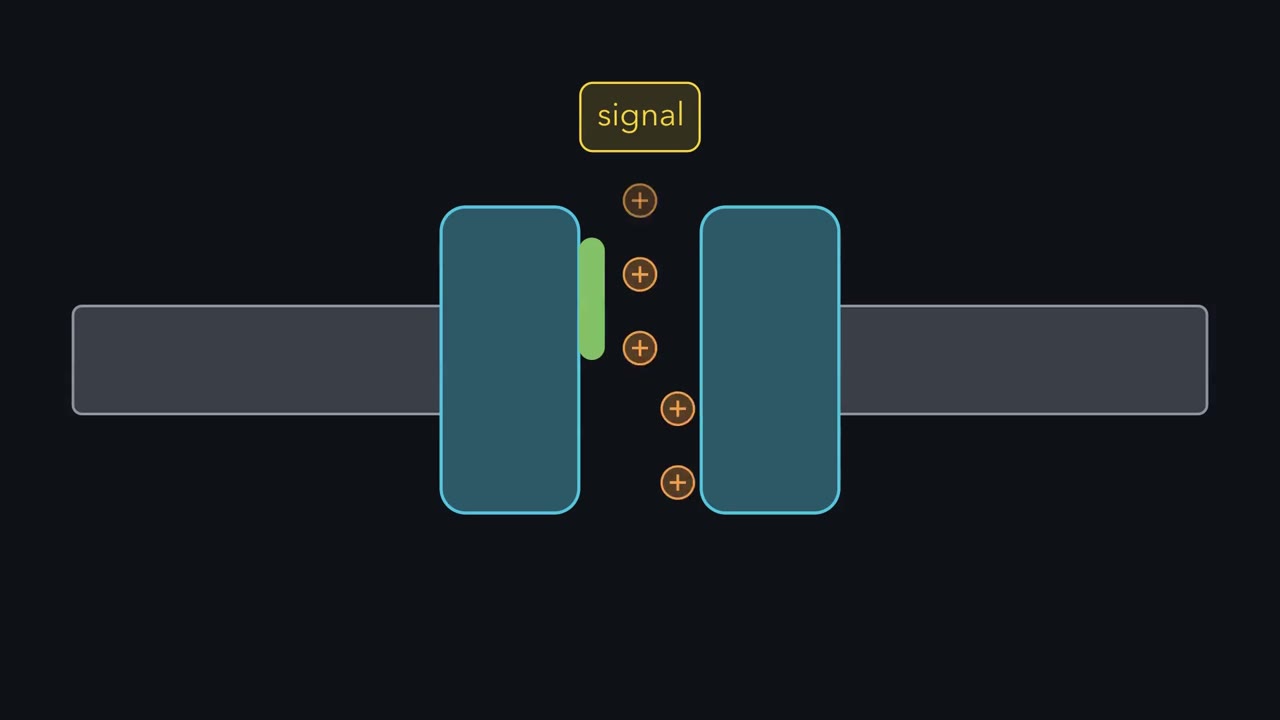
- Signals open the gate, and pore blocks control whether ions pass.
- Channel gates answer three main keys: chemical ligands (outside or inside the cell), membrane voltage acting on charged S4 helices, or physical stimuli such as heat.
- The NMDA receptor requires glutamate (with a co-agonist) to open its gate and depolarisation to drive Mg2+ out of its pore, so strong conduction needs two coincident events.
- Tetrodotoxin plugs the outer mouth of nerve and muscle voltage-gated sodium channels, while ketamine enters and blocks open NMDA pores and also reduces how often they open.
Read the transcript of “Gates, Two Locks, and Plugs”
Film transcript: Gates, Two Locks, and Plugs
Tap a sentence to play from there.
- 0:00 In the first film, an open channel spent ion gradients to swing membrane voltage in a millisecond. So what opens that gate?
- 0:10 And how can a second lock or a plug stop ions passing?
- 0:17 A signal acts by opening the gate, so the gate is what makes a channel a receptor.
- 0:23 Gates answer three main keys.
- 0:26 The first key is a chemical ligand.
- 0:29 A neurotransmitter docks outside the channel, twisting the gate open so ions flow.
- 0:35 Other channels answer messengers inside the cell instead.
- 0:39 The second key is membrane voltage itself.
- 0:44 Voltage-gated Na+, K+, and Ca2+ channels carry four voltage sensors.
- 0:50 Each sensor holds a helix called S4, studded with positive charges.
- 0:56 Membrane voltage creates an electric field.
- 0:59 Depolarise the cell, and that field pushes S4 outward, pulling the gate open.
- 1:05 That lets voltage-gated Na+ channels feed back on themselves.
- 1:11 Entering Na+ depolarises the membrane further, opening more channels in a fast pulse, the nerve impulse.
- 1:19 The third key comes from the outside world.
- 1:22 A physical stimulus, such as heat, can open a sensory channel’s gate directly.
- 1:28 Some receptors conduct strongly only when two events coincide.
- 1:33 At synapses, the junctions between nerve cells, the NMDA receptor sits beside AMPA glutamate receptors.
- 1:42 With glutamate bound, plus glycine or D-serine, its gate opens.
- 1:48 Yet Mg2+ ions wait outside.
- 1:51 Now hold the neuron at rest, electrically negative inside, while glutamate opens that receptor’s gate.
- 1:59 Pause and predict.
- 2:01 Why does almost no current flow through this open channel?
- 2:10 Mg2+ is positive, so the negative inside pulls it into the open pore, where it sticks and blocks flow.
- 2:19 Now let nearby glutamate receptors open.
- 2:23 Na+ enters and depolarises the membrane.
- 2:26 With the inside less negative, the pull weakens and Mg2+ is driven back out.
- 2:33 Na+ and Ca2+ pour in.
- 2:35 So two events must coincide: glutamate released, and the cell already depolarised.
- 2:41 Because a channel is a hole, toxins and drugs can plug it.
- 2:47 Tetrodotoxin lodges in the outer mouth of nerve and muscle Na+ channels, so Na+ cannot enter and no impulse starts.
- 2:56 Ketamine enters an open NMDA pore to block it from within.
- 3:01 It also makes the channel open less often.
- 3:05 Together, gates and pore blocks turn simple holes into sharp switches.
- 3:10 Ligands, voltage, or physical stimuli open the gate.
- 3:15 Then voltage-sensitive Mg2+, a toxin, or a drug determines whether ions get through.
- 3:22 Signals open the gate, and pore blocks control whether ions pass.
Ion channels: the same idea, other levels
A level is a place to start, not a rank. If this loses you, the rung below teaches the same idea, told more simply.
Graduate · the level you chose
Ion Channels as Receptors · this lesson
Open a gate and ions flow: Nernst potential sets direction, filter picks potassium.
Cell Signaling · about 21 min · film 3:31 · 3 practice questions
College, upper level · the level you chose
Membranes: The Impermeable Sheet That Builds Itself
A 1000 to 1 preference is only 17.8 kJ/mol; carbonyl oxygens replace water.
Biochemistry · about 43 min · 8 practice questions
Next door
- Nerve signals: The Spike and Its Puzzles · 2:20 · College: going further A nerve pulse is the opening and closing of sodium and potassium channels in a set order.
- Force-gated channels: Which Protein Carries the Poke? · 2:44 Some channels open when the membrane is stretched, which is how touch and hearing begin.
- Synapses: The Muscle Proposes, the Nerve Disposes · 2:51 At a synapse, transmitter binding opens channels in the next cell, passing the message along.
- Calcium signaling: How a Cell Makes a Calcium Signal · 3:28 Opening a calcium channel lets a little calcium into a cell where almost none is normally free, which sends a fast signal.
More films from this lesson
Continue in the lesson: Ion Channels as Receptors →
Free, with captions and a transcript. The lesson has the full text, the questions and the sources.
How this film was made. Narration: an AI narrator voice (Kokoro, af_heart) reading narration written from this lesson's text. Animation: AI-generated in code (Manim) by Claude, a schematic with no drawn molecular structures. Captions come from the narration script. See something wrong? Report it.