The Signal Opens a Hole
Read the transcript of “The Signal Opens a Hole”
Film transcript: The Signal Opens a Hole
How can a cell answer a signal in about a millisecond? Most receptors hand their message to something else, such as a G protein or a kinase. An ion channel hands it to nothing. The signal opens a hole, ions pour through, and the voltage across the membrane changes. One open channel lets about ten million ions cross every second, so which way do they go?
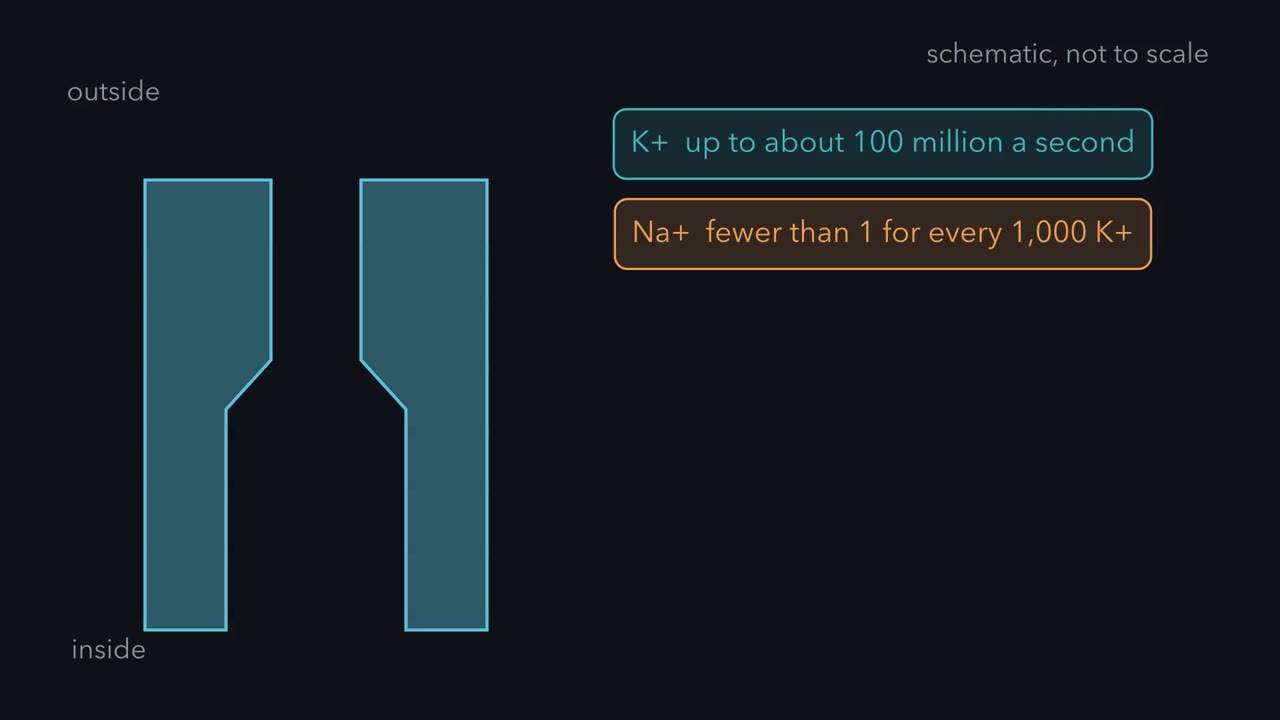
Two kinds of protein move ions across a membrane. A pump binds its ions and changes shape to carry them, uphill if it spends ATP. A channel is a pore with a gate, which a transmitter, a voltage, or heat can open. Once it is open, ions run downhill at around ten million a second, while a pump manages a few hundred. So pumps build the gradients slowly, and channels spend them fast.
Downhill has two parts: a push from the difference in concentration, and a pull from the voltage across the membrane. Take sodium. A cell keeps it mostly outside, and the inside of a resting neuron sits near minus −70 mV. For each ion, there is one voltage at which push and pull balance. That is its equilibrium potential, E, and for sodium it is about plus +60 mV.
A cell keeps potassium mostly inside. With typical concentrations, E for potassium is about minus −90 mV. An open channel drags the voltage toward the E of the one ion it passes. So the direction of flow follows from one subtraction. The driving force is the membrane voltage minus E. At minus −70 mV, sodium is 130 mV away from its E. So it rushes in, and the cell depolarises, meaning its voltage becomes less negative. Potassium is only 20 mV from its E. So it leaks out gently, and pulls the voltage back down.
Very few ions need to cross to change the voltage. So the concentrations barely shift, and nothing has to be made. The voltage is the message. So keep this rule: the signal opens a hole, and the gradient does the rest.
A chilli pepper and a hot stove open the same protein. How does its message reach your brain in milliseconds?
Continue in the lesson: Ion Channels as Receptors →
2:18 · Free, with captions and a transcript. The lesson has the full text, the questions and the sources.
More films from this lesson
How this film was made. Narration: an AI narrator voice (Kokoro, af_heart) reading narration written from this lesson's text. Animation: AI-generated in code (Manim) by Claude, a schematic with no drawn molecular structures. Captions come from the narration script. See something wrong? Report it.