Which Protein Carries the Poke?
Read the transcript of “Which Protein Carries the Poke?”
Film transcript: Which Protein Carries the Poke?
Poke a cell, and a current flows. In 2010, nobody knew which protein carried it. How would you find out? Coste and colleagues used a cultured mouse cell line called Neuro2A. It gave a reliable current when poked. A separate glass probe pressed on the cell. A patch pipette recorded the whole-cell current. They silenced candidate genes one at a time, with short interfering RNA. Then they asked which loss reduced the current. One candidate stood out. Knocking down a gene called Fam38A sharply reduced the current. The current shrinks when this gene is silenced. What have you shown? And what have you not shown?
You have shown the gene is required, for that current, in that cell line. You have not shown its protein is the channel. A required protein could be an accessory subunit. The real pore could be made of something else. Next, they put the gene into other cultured cells. The renamed gene, Piezo1, gave those cells mechanically activated currents. So did a related gene, Piezo2. The two currents had different kinetics. Ion substitution pointed to a non-selective cation current for Piezo2. And its current inactivated quickly. Inactivation means the current decays while the stimulus is held. Keep that word. It returns at the end. Notice the logic. Silencing showed the gene is necessary.
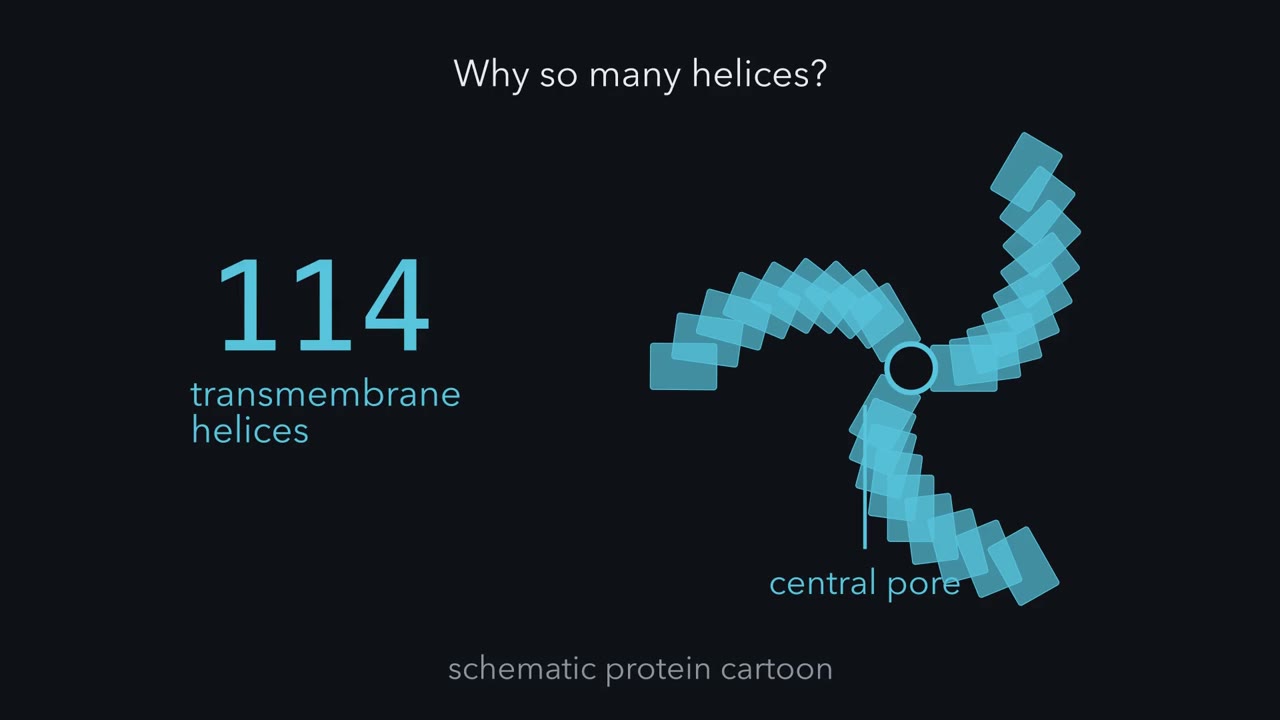
Expression showed it is sufficient. Neither showed that it forms the pore. The authors said so. They kept open the possibility that Piezo proteins were subunits of some other channel. Necessity, sufficiency and pore identity are three separate claims. Each needs its own experiment. The 2010 paper earned two. Later work earned the third. In 2012, purified Piezo1 formed ion channels in artificial bilayers and liposomes. Structures then placed the pore. The channel's carboxy-terminal domains line a central ion pore. So the protein is the channel. Now a stranger question. Why build so much protein around one central pore? Required, sufficient, and the pore itself.
Three claims, three experiments.
Mouse PIEZO2 threads 114 transmembrane helices through the membrane to build one ion channel, and its pore sits at the centre. Why would a channel need so much protein around one pore?
Continue in the lesson: Piezo Channels and the Physics of Force →
2:44 · Free, with captions and a transcript. The lesson has the full text, the questions and the sources.
More films from this lesson
How this film was made. Narration: an AI narrator voice (Kokoro, af_heart) reading narration written from this lesson's text. Animation: AI-generated in code (Manim) by Claude, a schematic with no drawn molecular structures. Captions come from the narration script. See something wrong? Report it.