Films · Developmental Neuroscience
The Muscle Proposes, the Nerve Disposes
Read the transcript of “The Muscle Proposes, the Nerve Disposes”
Film transcript: The Muscle Proposes, the Nerve Disposes
A newborn mouse that lacks the muscle kinase MuSK cannot breathe. Its motor axons reach the diaphragm. So why does no junction form? A synapse is not built whenever an axon touches a target. At a mature junction, the acetylcholine receptors are packed under the nerve ending. Along the rest of the fibre, they are sparse. So building a junction is a sorting problem. Where do the receptors go, and who tells them?
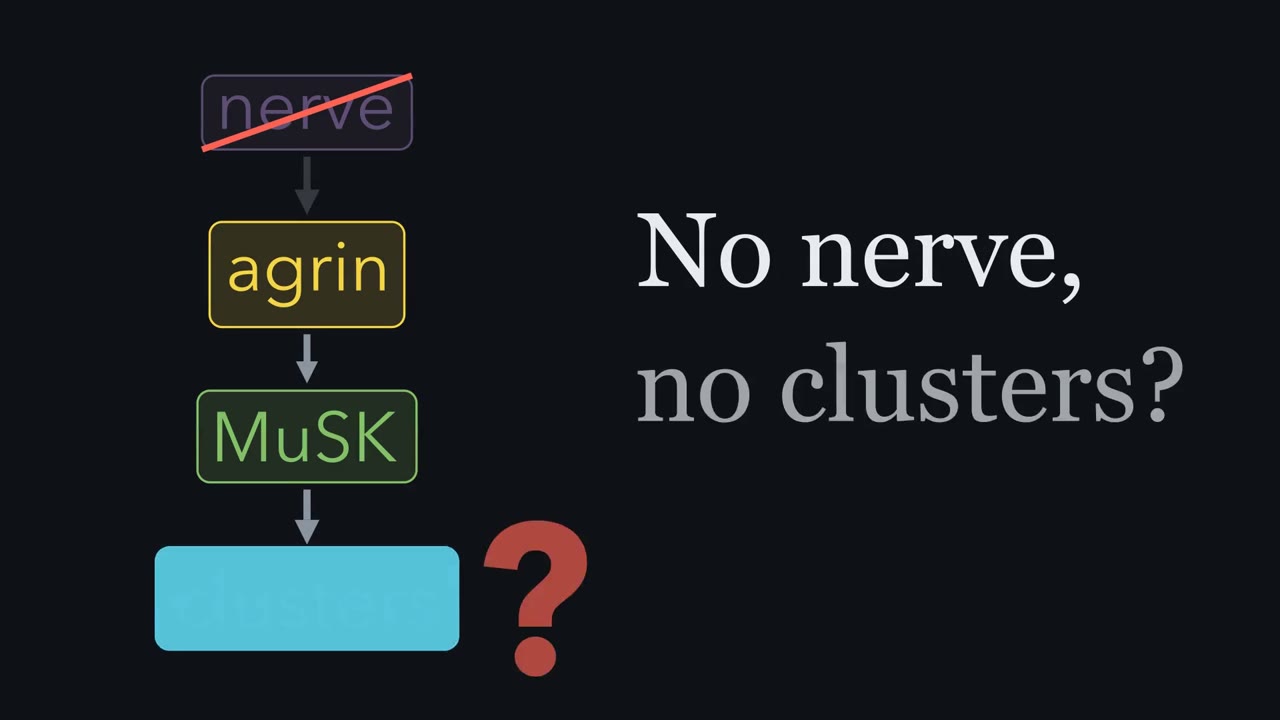
The first clue came from frog muscle, in 1978. Fibres and nerve terminals were made to degenerate. Empty sheaths of basal lamina were left. Regenerating axons returned to the old synaptic sites. The basal lamina remembered where the synapse had been. McMahan's group searched the electric organ of the ray Torpedo. In 1987 they named the protein agrin. Motor neurons send their own form of agrin into the basal lamina. Mice lacking MuSK, a muscle receptor tyrosine kinase, make no junctions. Agrin acts through a complex that contains MuSK. Yet MuSK alone does not bind agrin. What kind of molecule would you look for?
A protein on the muscle surface that binds agrin and joins MuSK. That protein is Lrp4. Cells that are not muscle bind neural agrin once they are given Lrp4. Inside the muscle, Dok7 binds activated MuSK and boosts it. Rapsyn, a scaffold under the membrane, holds the receptors together. The chain runs: neural agrin, Lrp4, MuSK with Dok7, rapsyn, then clustered receptors.
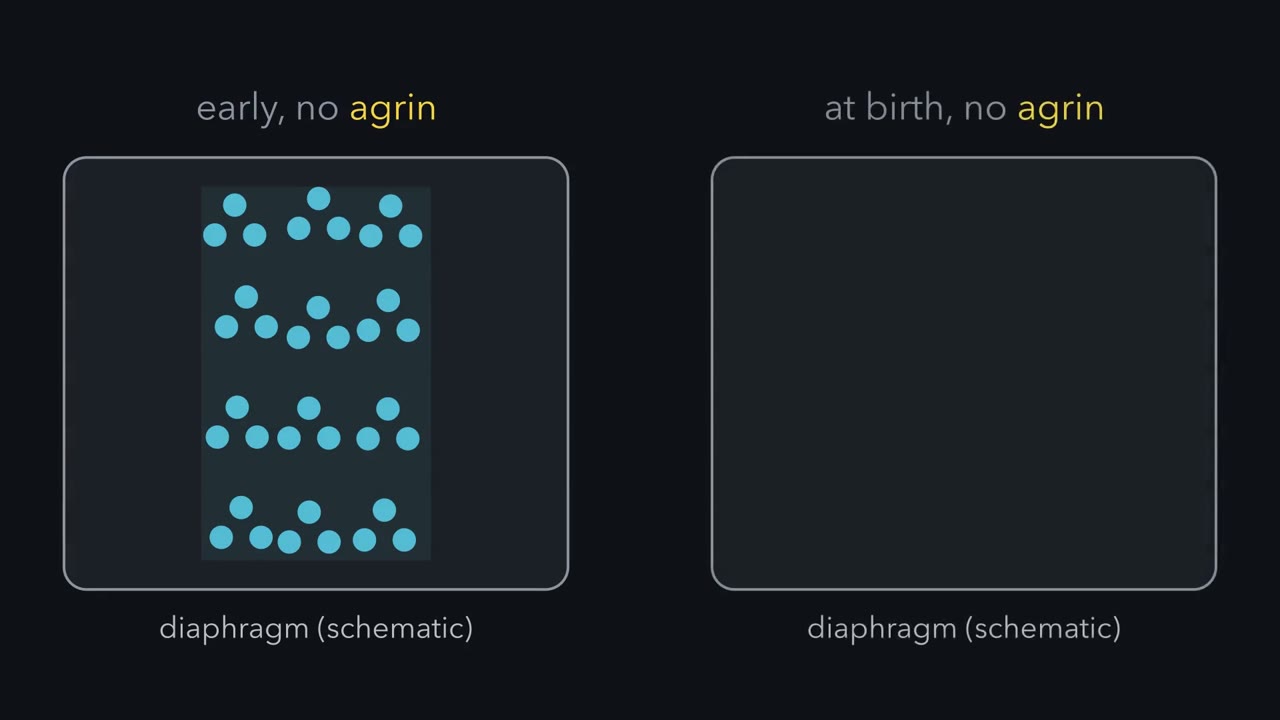
Remove MuSK or Dok7, and no junctions form. Without rapsyn, receptors are made but never clustered. Remove agrin, and fewer, smaller clusters remain. Hold on to that odd result. Here is the idea for this lesson. The muscle proposes; the nerve disposes. The muscle builds clusters with its own machinery. The nerve decides which stay. Agrin, held under the terminal, raises MuSK activity there and protects those clusters. Acetylcholine disperses the rest. Takeaway: without MuSK, the muscle cannot build clusters, so no junction forms. When it can build, the nerve decides which clusters stay.
A mouse without the muscle kinase MuSK dies at birth: its motor axons reach the muscle, but no junction forms.
Continue in the lesson: Building the Neuromuscular Junction: Agrin, Lrp4 and MuSK →
2:51 · Free, with captions and a transcript. The lesson has the full text, the questions and the sources.
More films from this lesson
How this film was made. Narration: an AI narrator voice (Kokoro, af_heart) reading narration written from this lesson's text. Animation: AI-generated in code (Manim) by Claude, a schematic with no drawn molecular structures. Captions come from the narration script. See something wrong? Report it.