How a Cell Makes a Calcium Signal
Read the transcript of “How a Cell Makes a Calcium Signal”
Film transcript: How a Cell Makes a Calcium Signal
How can a cell signal with an ion it cannot make or destroy? Cyclic AMP can appear, carry information, then disappear. Calcium atoms remain calcium atoms throughout a response. The puzzle is therefore not how to build the messenger. It is how to change the calcium that proteins can reach.
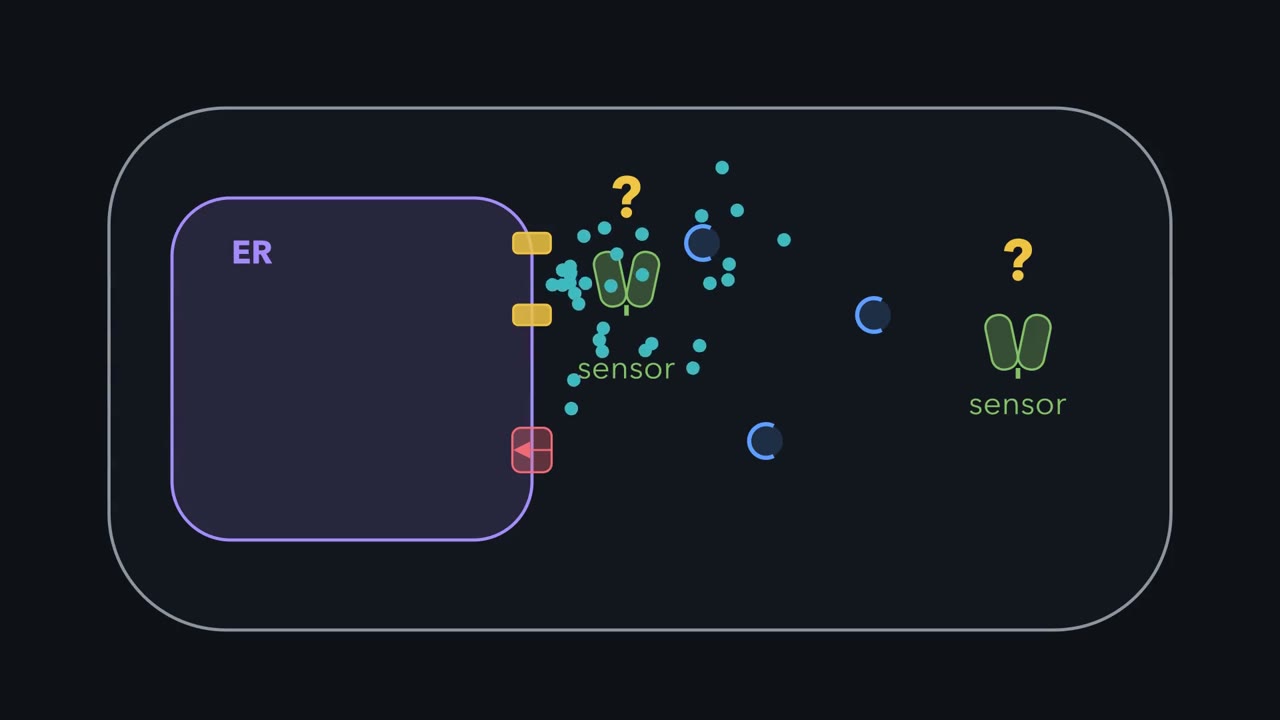
A resting cell keeps free calcium scarce in its cytosol. Calcium is crowded outside and stored inside the endoplasmic reticulum. Coral pumps maintain that separation by moving calcium away from the cytosol. The result is stored potential: many ions are waiting across membranes, while few remain free beside cytosolic proteins. A channel does not push calcium or spend fuel. It opens a path, and the existing gradient drives calcium through. Gold channel doors separate, and teal ions enter the cytosol. The free-calcium gauge rises immediately. A protein near that opening now encounters calcium that was unavailable a moment earlier. Now predict. Which machine can raise free cytosolic calcium immediately: opening a channel, or speeding a pump?
Follow one teal ion. Decide whether each machine brings it toward cytosolic proteins or carries it away. Ask which direction the calcium moves, not which machine is larger. Opening the channel raises the cytosolic pool. Speeding the pump lowers it. That gives two functional teams. Channels are on mechanisms because they admit calcium to the cytosol. Pumps, exchangers, and buffers are off mechanisms because they remove calcium from the free pool. These names describe direction, not molecular shape or energy source. Calcium signals begin and end by moving calcium, not changing it. During a rise, entry outruns removal. When channels close, the off machinery wins again.
Buffers bind some ions quickly. Pumps return others to the store or outside, restoring the low free concentration that makes another rise noticeable. The source can be outside the cell or inside its store. Either route changes the same measured quantity: free calcium in the cytosol. Which channel opens determines where the rise begins. How long it stays open helps determine the rise's timing. Movement creates a pattern that downstream proteins can read. So the signal is not a newly manufactured substance. It is a controlled redistribution of an existing ion. The gradient makes opening fast. The off machinery makes recovery possible.
Together they turn calcium movement into a brief, repeatable change in what cytosolic proteins can encounter.
How can the same calcium ion trigger contraction, secretion or gene expression without making the cell respond everywhere at once?
Continue in the lesson: Calcium: The Messenger Kept at Arm's Length →
3:28 · Free, with captions and a transcript. The lesson has the full text, the questions and the sources.
More films from this lesson
How this film was made. Narration: written from this lesson's text and read by an AI narrator voice (Kokoro, af_heart). Animation: AI-generated in code (Manim) by Claude, a schematic with no drawn molecular structures. Captions come from the narration script. See something wrong? Report it.