Press play to start at .
Two Taps on One Filter
From the film
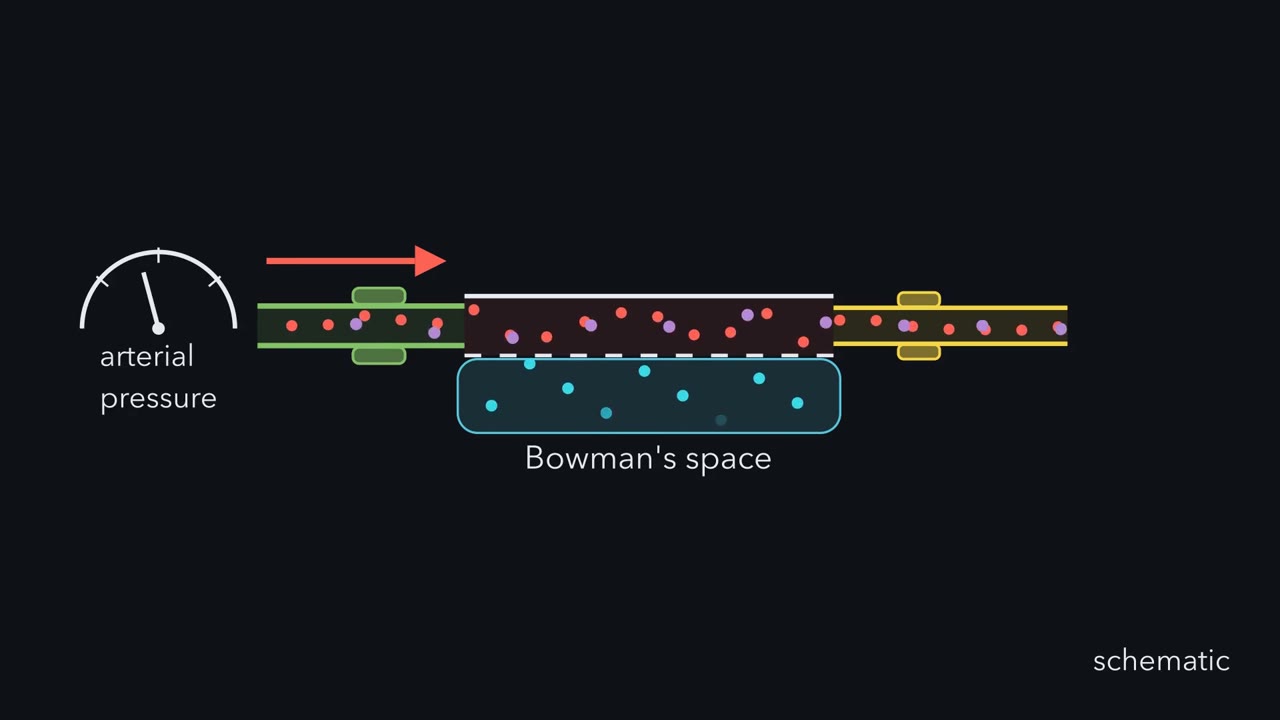
- Water and small solutes cross the glomerular wall freely, but plasma protein mostly stays behind.
- Fluid filters wherever capillary pressure, less Bowman's-space back-pressure, beats the pull of the protein left behind.
- Filtration depends on how high the pressure is and on how much plasma flows through.
- The total resistance of the two arterioles sets the flow; the efferent share sets the pressure in the filter.
- A mild efferent squeeze raises filtration slightly, a hard one lowers it from its peak, and the filtration fraction rises throughout.
Read the transcript of “Two Taps on One Filter”
Film transcript: Two Taps on One Filter
Tap a sentence to play from there.
- 0:00 Each kidney filter sits between two tiny vessels.
- 0:05 Squeeze the one that drains it, and filtration can rise or fall.
- 0:10 Which, and why?
- 0:14 The filter is a glomerulus, a tuft of capillaries cupped in Bowman's capsule.
- 0:21 Plasma is pushed out through a wall of three layers.
- 0:24 Water and small solutes pass freely.
- 0:28 Plasma protein mostly stays behind.
- 0:31 Filtrate leaves its protein behind.
- 0:34 So the plasma flowing on carries the same protein in less water.
- 0:39 Along the capillary, the protein grows more concentrated.
- 0:44 Picture two lines along the capillary.
- 0:47 The push is the capillary's pressure, less a small back-pressure in Bowman's space.
- 0:54 Between two arterioles, it stays nearly flat.
- 0:57 The pull is the protein, holding water in.
- 1:01 It starts lower and rises.
- 1:04 Fluid filters wherever the push beats the pull.
- 1:07 If enough water leaves, the pull rises to meet the push before the far end.
- 1:13 Beyond that point, nothing filters.
- 1:17 In mildly water-deprived rats, the pull typically caught up.
- 1:21 Whether human glomeruli do is unknown.
- 1:25 So filtration depends on two things.
- 1:28 How high the pressure is.
- 1:31 And how much plasma flows through, which slows the concentrating of the protein.
- 1:36 Blood enters through the afferent arteriole and leaves through the efferent arteriole. Picture a hose: a tap near the spigot, a nozzle at the far end, and a leaky stretch between.
- 1:49 Here is the one idea.
- 1:51 The two arterioles set both pressure and flow.
- 1:55 Their total resistance sets the flow.
- 1:58 The efferent share of that resistance sets the pressure left in the filter.
- 2:04 So the afferent moves pressure and flow the same way.
- 2:08 The efferent moves them opposite ways.
- 2:11 Now squeeze the efferent arteriole harder, and harder again.
- 2:15 The pressure in the filter keeps climbing.
- 2:19 Does filtration keep climbing with it?
- 2:26 Not forever. Each squeeze also cuts the flow.
- 2:32 With less plasma passing, the protein concentrates sooner, so the pull catches up earlier. And the pressure can never exceed arterial pressure, so its gain levels off.
- 2:44 So a mild squeeze raises filtration slightly.
- 2:48 A hard squeeze lowers it from its peak.
- 2:51 Throughout, a larger share of the plasma is filtered: the filtration fraction rises.
- 2:57 That is the answer to the opening puzzle.
- 3:01 Filtering needs push to beat pull.
- 3:04 The arterioles' combined resistance decides how much plasma arrives.
- 3:10 Where that resistance sits decides how hard it is pushed.
The kidney: the same idea, other levels
A level is a place to start, not a rank. If this loses you, the rung below teaches the same idea, told more simply.
College, upper level · the level you chose
Glomerular Filtration and Renal Blood Flow · this lesson
Two arterioles set filtration: GFR about 125 mL per min, filtration fraction 0.2.
Physiology · about 30 min · film 3:18 · 8 practice questions
Tubular Transport, Segment by Segment
NKCC2, NCC and ENaC doors: block one and calcium and potassium shift.
Physiology · about 33 min · film 3:04 · 6 practice questions
College, a first course · the level you chose
Filter 180 litres of plasma, take back about 99%: the nephron's ledger.
Organismal Biology · about 20 min · film 3:26 · 6 practice questions
Play the ladder · 4 films, about 13 min, from a first college course to upper-level college. Each film waits for you to press play.
Next door
- Water and salt balance: Two Loops, One Ratio · 3:22 The kidney is the organ that fixes how much water and salt leaves the body, so fluids stay steady.
- Acid-base balance: Acid-Base Balance The kidney removes acid and rebuilds bicarbonate, which keeps blood pH near 7.4.
- Red blood cells: Blood Cells, Hematocrit and Clotting The kidney senses oxygen in the blood and tells the bone marrow how many red cells to make.
More films from this lesson
Continue in the lesson: Glomerular Filtration and Renal Blood Flow →
Free, with captions and a transcript. The lesson has the full text, the questions and the sources.
How this film was made. Narration: written from this lesson's text and read by an AI narrator voice (Kokoro, af_heart). Animation: AI-generated in code (Manim) by Claude, a schematic with no drawn molecular structures. Captions come from the narration script. See something wrong? Report it.