Press play to start at .
Two Loops, One Ratio
From the film
- Plasma sodium concentration is body solute over body water, so it reports water rather than sodium content.
- A litre of water drunk spreads through all the body water and lowers sodium concentration, though no sodium leaves.
- When plasma grows more concentrated, osmoreceptor neurons fire faster, raising vasopressin and thirst.
- Vasopressin moves aquaporin-2 into the collecting duct membrane facing the urine, so water returns to blood.
- Once the water loop catches up, each 140 mmol or so of sodium kept carries about 1 L outside the cells.
Read the transcript of “Two Loops, One Ratio”
Film transcript: Two Loops, One Ratio
Tap a sentence to play from there.
- 0:00 Drink a litre of water quickly, and your plasma sodium concentration dips for a while. No sodium left your body.
- 0:10 Sweat out a litre, and it rises, though sweat carries sodium out.
- 0:15 Why?
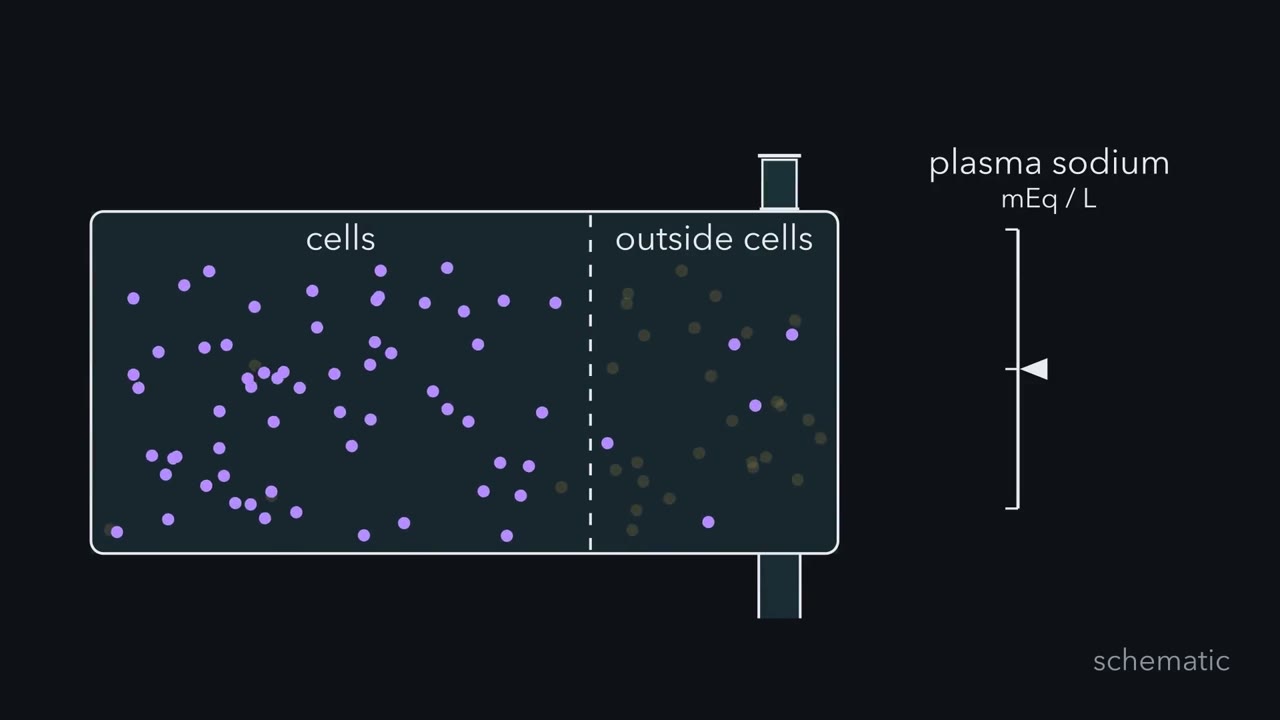
- 0:18 Take a 70 kg adult with 42 litres of body water, 14 of them outside the cells.
- 0:26 Cells hold their water mainly with potassium, the fluid outside mainly with sodium.
- 0:32 Plasma sodium sits at 140 mmol per litre: a ratio, solute over water.
- 0:39 Water crosses cell membranes easily, so a litre you drink spreads through all 43 litres.
- 0:46 With the same solute, the concentration falls to about 137.
- 0:52 Only about a third of a litre stays outside the cells.
- 0:56 Sweat is far weaker than plasma.
- 0:59 Its sodium varies widely; take 50 mmol per litre.
- 1:04 It removes water out of proportion to solute, so the concentration rises to about 142.
- 1:12 A loop guards this ratio.
- 1:15 Osmoreceptor neurons in the lamina terminalis, at the front of the brain, sense it.
- 1:21 When plasma grows more concentrated, water leaves them, and they fire faster.
- 1:27 Their signal raises vasopressin.
- 1:30 In the collecting duct, vasopressin binds V2 receptors.
- 1:35 Aquaporin-2 water channels move into the membrane facing the urine.
- 1:41 Water returns to the blood.
- 1:43 Without the hormone, urine can fall near 50 mOsm per kg.
- 1:49 Short of water, it reaches about 1,000 to 1,200.
- 1:54 The same neurons drive thirst, which replaces water already lost.
- 1:59 Here is the one idea.
- 2:02 In a healthy adult, plasma sodium concentration is body solute divided by body water. The water loop holds that ratio steady by adding or removing water.
- 2:14 So the concentration reports water.
- 2:18 Let the body keep an extra 140 mmol of sodium, about 8 g of salt.
- 2:25 Once the water loop catches up, where does the gauge settle?
- 2:34 Back at 140. The water loop holds back water until the ratio is restored.
- 2:41 At that strength, 140 mmol fills one litre, all outside the cells, where sodium stays.
- 2:49 So sodium content sets the volume outside the cells.
- 2:53 A second loop guards it.
- 2:56 It senses how well the arteries are filled, and sets how much sodium the kidney excretes.
- 3:02 Two loops, two quantities.
- 3:05 Water fixes the concentration; sodium, carrying its water, fixes the volume.
- 3:12 A low sodium reading means too much water for the solute, with body sodium low, normal or high.
Water and salt balance: the same idea, other levels
A level is a place to start, not a rank. If this loses you, the rung below teaches the same idea, told more simply.
College, upper level · the level you chose
Water, Sodium and Potassium Balance · this lesson
A litre of water lowers plasma sodium; two loops: vasopressin and renin.
Physiology · about 30 min · film 3:22 · 6 practice questions
College, a first course · the level you chose
Osmoregulation and Nitrogenous Waste
Marine and freshwater fish, a urea shark and a cormorant: one budget, four answers.
Organismal Biology · about 23 min · film 3:09 · 3 practice questions
Play the ladder · 3 films, about 9 min, from a first college course to upper-level college. Each film waits for you to press play.
Next door
- Osmosis: Water Goes Where the Solute Stays · 3:16 Water moves toward more dissolved stuff across membranes, which is the pull animals have to balance.
- Regulators, conformers: Two Animals on One Plot · 3:18 · Starting college An animal that holds its body fluids steady while the water around it changes is a regulator.
More films from this lesson
Continue in the lesson: Water, Sodium and Potassium Balance →
Free, with captions and a transcript. The lesson has the full text, the questions and the sources.
How this film was made. Narration: written from this lesson's text and read by an AI narrator voice (Kokoro, af_heart). Animation: AI-generated in code (Manim) by Claude, a schematic with no drawn molecular structures. Captions come from the narration script. See something wrong? Report it.