Filter Far More, Take Most Back
Read the transcript of “Filter Far More, Take Most Back”
Film transcript: Filter Far More, Take Most Back
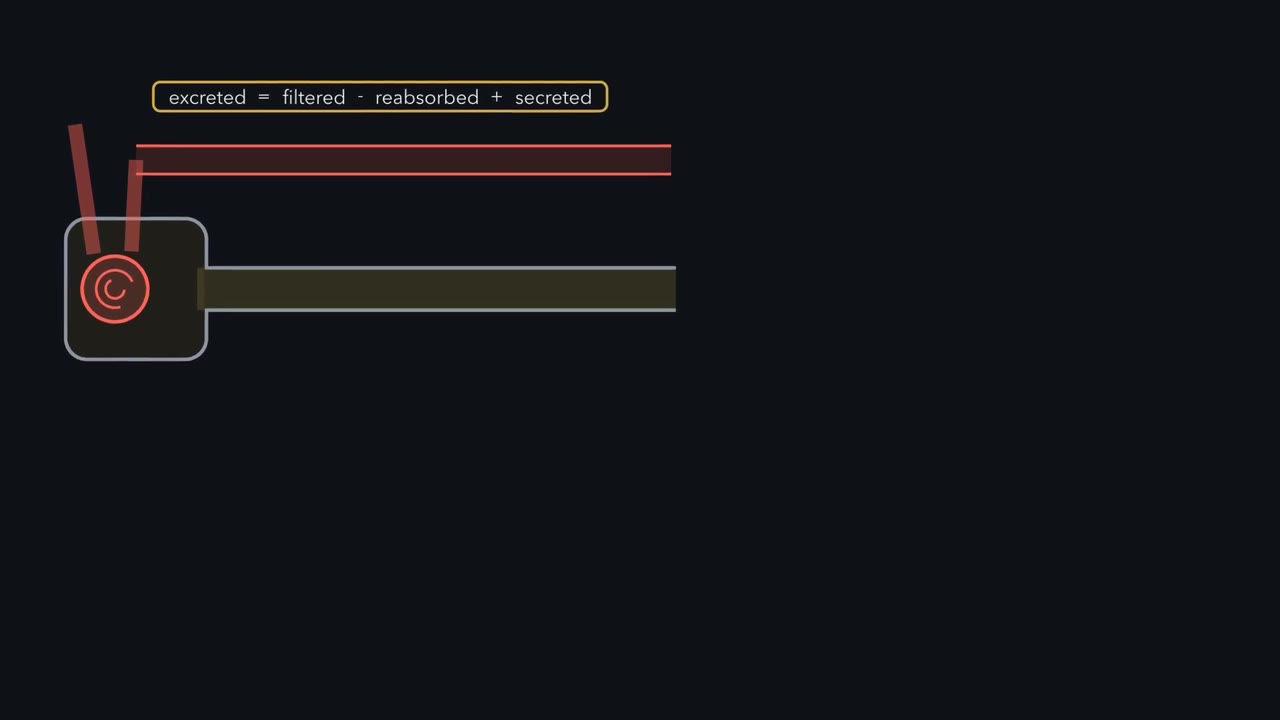
Every day, your kidneys filter about 180 litres of plasma. Yet you pass only one or two litres of urine. Why would an organ filter so much more than it lets go? The kidney's working unit is the nephron: a filter attached to a long tube. Blood enters a knot of capillaries, the glomerulus, through the afferent arteriole. It leaves through the efferent arteriole. Blood pressure pushes plasma through a barrier into Bowman's capsule, the cup around the capillaries. This fluid is the filtrate. It carries water, salt, glucose and urea, but no blood cells and very little protein. From here on, the tube does two jobs. It takes substances back into the blood.
That is reabsorption. It also adds substances from the blood. That is secretion. So keep a ledger. What leaves in urine is what was filtered, minus what was taken back, plus what was added. Run three substances through the same ledger. First, glucose. It is filtered at about its level in plasma. The proximal tubule, the first stretch of tube, normally takes almost all of it back. Almost none is left to leave. Next, sodium. The proximal tubule takes back about 60 to 70% percent of the filtered sodium, and water follows it. Later stretches of the tube take back more. Only a small share is left to leave. Last, some drugs. They are filtered, and the proximal tubule also secretes them into the tube. So more of the drug can leave than was filtered.
Now water, the biggest entry of all by volume. Of everything filtered each day, about 99% % comes back to the blood. So the filter does not set how much urine you make. The take-back does. Suppose the tube took back 98% % of the water instead of 99%. Would urine rise by about 1%, % or by much more? Pause and decide.
Much more: urine about doubles. What leaves is a thin sliver of a huge flow. Shift the take-back slightly, and that sliver changes a lot. A healthy kidney does not leave this to chance. When filtration rises, the proximal tubule takes back about the same share. Hormones make the fine adjustments in the last stretches, mainly the collecting duct. So the kidney filters a lot, and the take-back largely sets how much water you lose. Glucose, sodium, a drug and water all fit one ledger: filtered, minus taken back, plus added.
Your kidneys filter about 180 litres of plasma a day. Why filter so much only to take almost all of it back?
Continue in the lesson: The Kidney →
3:17 · Free, with captions and a transcript. The lesson has the full text, the questions and the sources.
More films from this lesson
How this film was made. Narration: written from this lesson's text and read by an AI narrator voice (Kokoro, af_heart). Animation: AI-generated in code (Manim) by Claude, a schematic with no drawn molecular structures. Captions come from the narration script. See something wrong? Report it.