Press play to start at .
Stretch, Salt and a Steady Filter
From the film
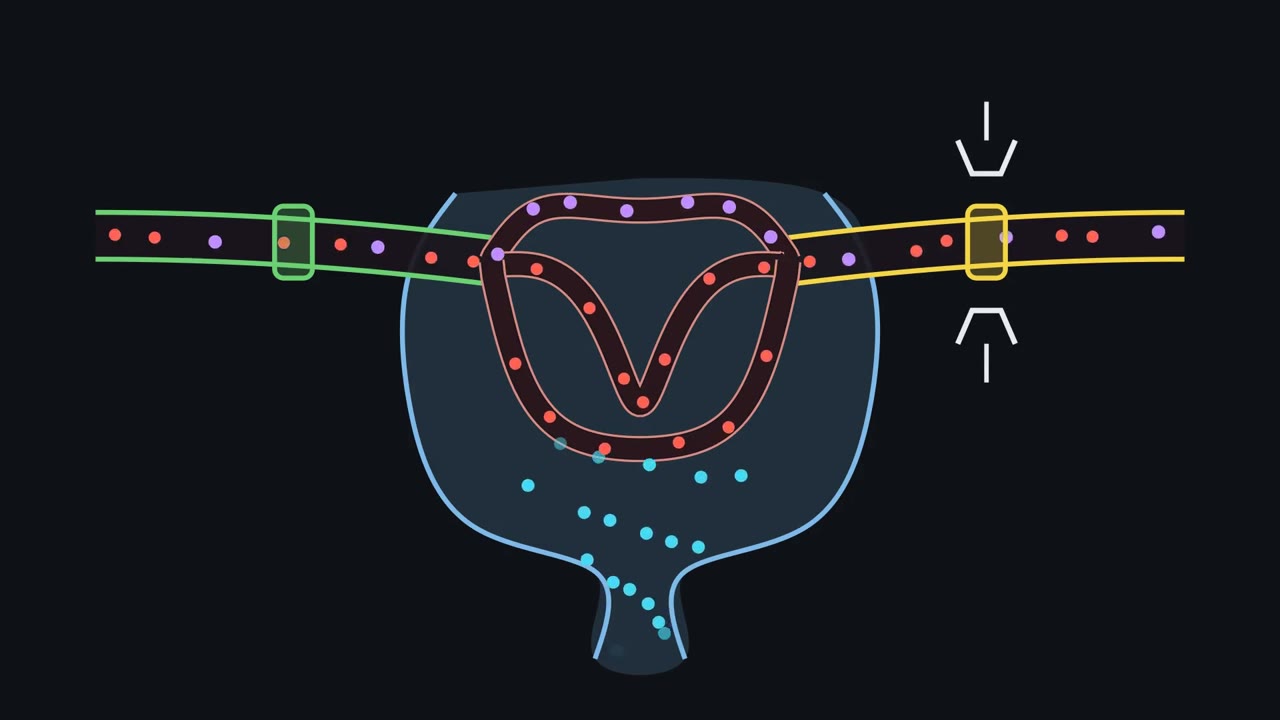
- In mammals, kidney blood flow and filtration stay nearly constant over perfusion pressures of about 80 to 180 mmHg.
- In the myogenic response, stretch makes arteriole smooth muscle depolarize and contract; what senses the stretch is still debated.
- In tubuloglomerular feedback, more salt at the macula densa constricts the afferent arteriole, and less salt dilates it.
- Both mechanisms act mainly on the afferent arteriole, upstream of the filter.
- In diabetes, more sodium and glucose taken back upstream leaves less salt for the macula densa, and filtration rises; what dominates this is still open.
Read the transcript of “Stretch, Salt and a Steady Filter”
Film transcript: Stretch, Salt and a Steady Filter
Tap a sentence to play from there.
- 0:00 Two tiny arterioles set the kidney filter's pressure and its flow.
- 0:05 But the arterial pressure feeding them changes.
- 0:09 How does filtration stay nearly steady?
- 0:14 In mammals, kidney blood flow and filtration stay nearly constant.
- 0:20 That holds over perfusion pressures of about 80 to 180 mmHg.
- 0:27 On a graph, it is a long, nearly flat stretch.
- 0:31 This is autoregulation.
- 0:34 Two mechanisms do most of it, both acting mainly on the afferent arteriole.
- 0:39 The first reads stretch.
- 0:42 When rising pressure stretches the arteriole's smooth muscle, the muscle depolarizes. Calcium inside it rises, and it contracts.
- 0:52 This is the myogenic response, which Bayliss described in arteries in 1902.
- 0:59 What senses the stretch is still debated.
- 1:02 The second reads the tubule instead.
- 1:05 Each tubule comes back to touch its own glomerulus.
- 1:10 There, at the end of the thick ascending limb, sits a plaque of cells, the macula densa. So the fluid leaving the loop can adjust filtration upstream.
- 1:20 More salt (NaCl) arriving there constricts the afferent arteriole.
- 1:26 Less salt dilates it, and renin-secreting cells in the arteriole wall release renin.
- 1:33 This is tubuloglomerular feedback.
- 1:36 Salt enters the macula densa cells through a carrier called NKCC2.
- 1:42 When more arrives, the cells release ATP.
- 1:45 Adenosine made from it acts on A1 receptors.
- 1:50 The afferent arteriole constricts, so the filter's pressure and filtration fall.
- 1:55 Here is the one idea.
- 1:58 Two signals, stretch and salt, do most of the steadying.
- 2:03 Stretch is read in the arteriole wall, salt in the tubule.
- 2:07 Both act mainly on one valve upstream of the filter, the afferent arteriole.
- 2:13 Diabetes puts the salt loop to a test.
- 2:16 High plasma glucose raises filtered glucose.
- 2:20 The proximal tubule takes back more of it, with sodium, through a carrier called SGLT2. So less salt reaches the macula densa.
- 2:31 What happens to filtration?
- 2:38 It rises. With less salt arriving, the afferent arteriole dilates.
- 2:45 Pressure in the filter climbs, and filtration with it.
- 2:49 This is hyperfiltration.
- 2:52 Whether blunted feedback or other upstream dilation dominates is still open.
- 2:58 So the filter is steadied mostly at its inlet.
- 3:02 The arteriole wall reads the pressure, and the tubule reads the salt.
- 3:07 Both answers come back to the same upstream valve, across that wide range of pressures.
Kidney autoregulation: the same idea, other levels
A level is a place to start, not a rank. If this loses you, the rung below teaches the same idea, told more simply.
College, upper level · the level you chose
Glomerular Filtration and Renal Blood Flow · this lesson
Filtration holds steady from 80 to 180 mmHg: stretch and salt sensors.
Physiology · about 30 min · film 3:17 · 8 practice questions
Next door
- The myogenic response: Smooth muscle force is a balance · 2:42 The kidney's incoming small artery narrows when pressure inside it rises, which is the first part of this control.
- Local blood flow: Resistance, Compliance and Local Blood Flow Other organs also adjust their own small arteries, though they aim at the tissue's needs, not at filtering.
- Kidney and blood pressure: Two Clocks for Pressure · 3:15 Over days the kidney sets blood pressure by the salt it sends out, a slower control than autoregulation.
More films from this lesson
Continue in the lesson: Glomerular Filtration and Renal Blood Flow →
Free, with captions and a transcript. The lesson has the full text, the questions and the sources.
How this film was made. Narration: an AI narrator voice (Kokoro, af_heart) reading narration written from this lesson's text. Animation: AI-generated in code (Manim) by Claude, a schematic with no drawn molecular structures. Captions come from the narration script. See something wrong? Report it.