Press play to start at .
The Sodium That Flows On
From the film
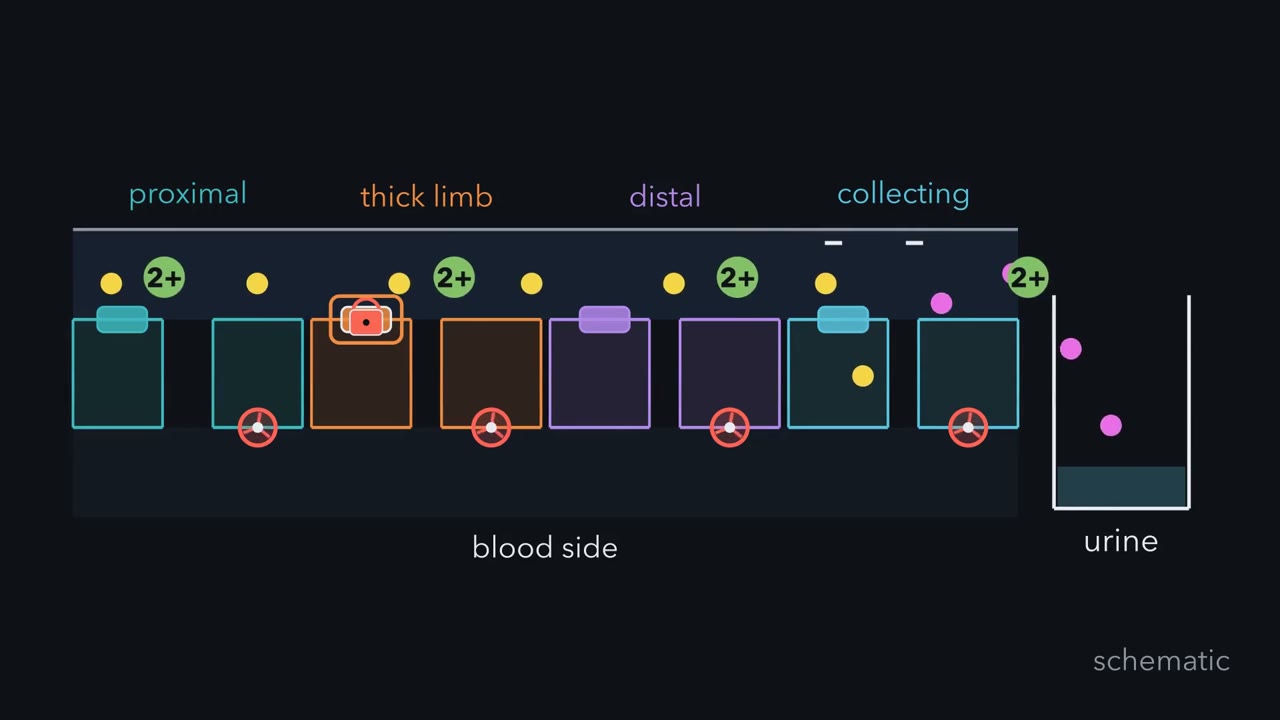
- Every nephron segment takes sodium back through its own apical door, facing the tubular fluid.
- All of those doors run on the same basolateral sodium-potassium pump, which keeps sodium low inside the cells.
- In rounded human estimates, the proximal tubule takes about 65 percent of filtered sodium, the thick limb about 25, the distal convoluted tubule about 5 and the collecting duct about 3.
- Block the thick limb's door, NKCC2, and up to about a quarter of filtered sodium flows on toward ENaC.
- ENaC lets sodium in alone, so the lumen goes negative and more potassium is secreted through ROMK; aldosterone adds to this.
Read the transcript of “The Sodium That Flows On”
Film transcript: The Sodium That Flows On
Tap a sentence to play from there.
- 0:00 A kidney tubule pulls sodium back all along its length.
- 0:04 Close one sodium door near the middle, and more potassium leaves in the urine, farther down. Why potassium?
- 0:15 Filtered fluid flows along the tube.
- 0:19 Each stretch takes sodium back through its own door.
- 0:23 The door sits on the apical side, the side facing the fluid.
- 0:27 Every door runs on the same engine.
- 0:31 On the basolateral side, facing the surrounding tissue, the sodium-potassium pump exports sodium. That keeps sodium low inside, so it flows in.
- 0:42 Along the tube, the doors change.
- 0:45 The proximal tubule uses NHE3 and SGLT2.
- 0:50 The thick ascending limb uses NKCC2.
- 0:54 The distal convoluted tubule uses NCC.
- 0:58 The collecting duct uses ENaC.
- 1:01 They take very different shares.
- 1:04 In rounded human estimates, the proximal tubule takes back about 65% % of filtered sodium. The thick limb takes about 25.
- 1:15 The distal convoluted tubule takes about 5, and the collecting duct about 3.
- 1:21 Each door brings sodium in its own way, so a different drug can block each one.
- 1:27 Furosemide, a loop diuretic, blocks NKCC2 in the thick limb.
- 1:32 Block that door, and up to about a quarter of filtered sodium flows on.
- 1:38 The segments downstream normally take back only about 8% % between them.
- 1:44 That extra sodium flows on to ENaC, in the late distal tubule and collecting duct.
- 1:51 And ENaC lets sodium in alone, with no partner ion.
- 1:56 So positive charge is leaving the fluid, with nothing to balance it.
- 2:01 What happens to the charge of the fluid left behind?
- 2:10 It goes negative. That negative lumen drives potassium out of the cell and into the urine. It leaves through a potassium channel called ROMK.
- 2:22 Here is the one idea.
- 2:25 Every segment has its own sodium door, and every door runs on one pump.
- 2:31 Block an upstream door, and the sodium it misses reaches ENaC.
- 2:36 More potassium is secreted.
- 2:39 How much potassium depends on how much extra sodium and flow arrive.
- 2:44 And aldosterone, raised by sustained salt loss, adds to the effect.
- 2:49 So a sodium door is never only about sodium.
- 2:54 Whatever it misses, the tube downstream has to handle, and potassium pays the price.
The kidney: the same idea, other levels
A level is a place to start, not a rank. If this loses you, the rung below teaches the same idea, told more simply.
College, upper level · the level you chose
Glomerular Filtration and Renal Blood Flow
Two arterioles set filtration: GFR about 125 mL per min, filtration fraction 0.2.
Physiology · about 30 min · film 3:18 · 8 practice questions
Tubular Transport, Segment by Segment · this lesson
NKCC2, NCC and ENaC doors: block one and calcium and potassium shift.
Physiology · about 33 min · film 3:04 · 6 practice questions
College, a first course · the level you chose
Filter 180 litres of plasma, take back about 99%: the nephron's ledger.
Organismal Biology · about 20 min · film 3:26 · 6 practice questions
Play the ladder · 4 films, about 13 min, from a first college course to upper-level college. Each film waits for you to press play.
Next door
- Water and salt balance: Two Loops, One Ratio · 3:22 The kidney is the organ that fixes how much water and salt leaves the body, so fluids stay steady.
- Acid-base balance: Acid-Base Balance The kidney removes acid and rebuilds bicarbonate, which keeps blood pH near 7.4.
- Red blood cells: Blood Cells, Hematocrit and Clotting The kidney senses oxygen in the blood and tells the bone marrow how many red cells to make.
More films from this lesson
Continue in the lesson: Tubular Transport, Segment by Segment →
Free, with captions and a transcript. The lesson has the full text, the questions and the sources.
How this film was made. Narration: written from this lesson's text and read by an AI narrator voice (Kokoro, af_heart). Animation: AI-generated in code (Manim) by Claude, a schematic with no drawn molecular structures. Captions come from the narration script. See something wrong? Report it.