Press play to start at .
Wired to the Sun
From the film
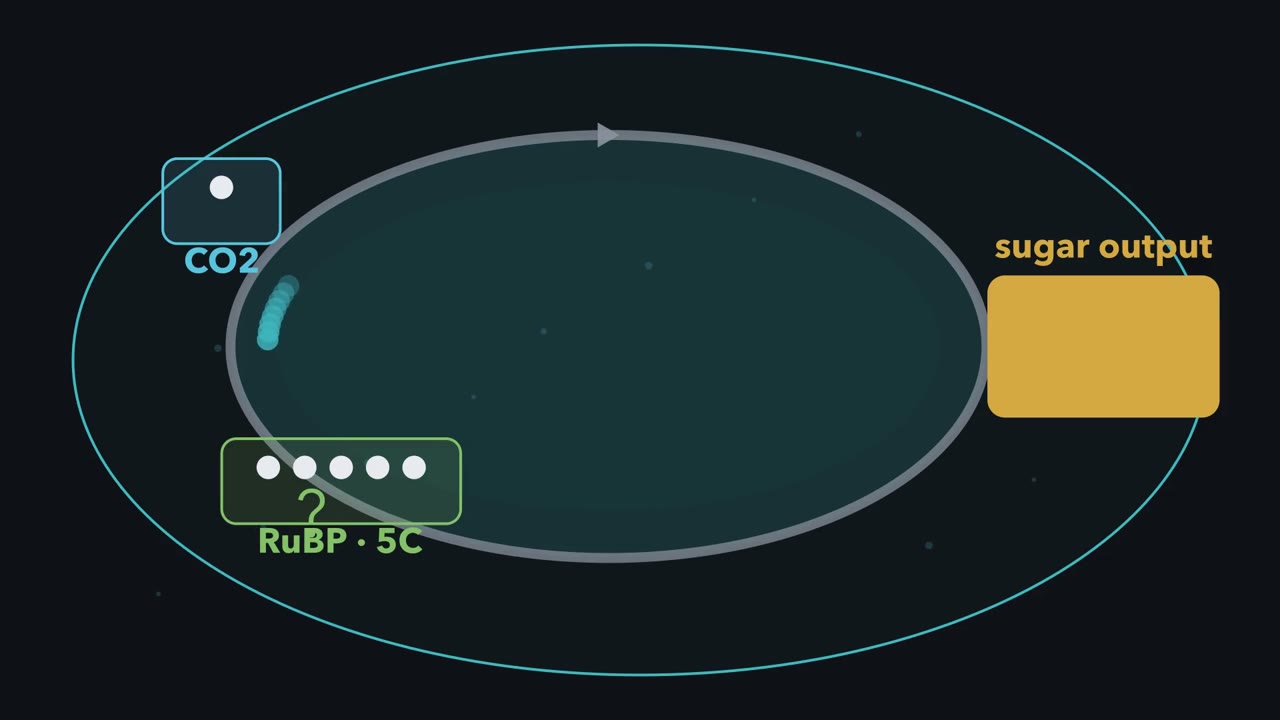
- If the Calvin cycle ran at night, it would build sugar while another pathway burns it: a futile cycle.
- In the light, protons are pumped from the stroma into the thylakoid lumen, and stromal pH rises from about 7 to 8; in the textbook account, magnesium ions also flow into the stroma.
- A separate CO₂ forms a carbamate on a Rubisco lysine that holds a magnesium ion, so one CO₂ switches Rubisco on and a different one is fixed.
- Thioredoxin, reduced by electrons from Photosystem I's ferredoxin, breaks a sulfur bridge in four Calvin enzymes so they take their active shape.
- At nightfall thioredoxin is re-oxidized, the bridges reform and the cycle stalls: the sugar factory is wired to the sun.
Read the transcript of “Wired to the Sun”
Film transcript: Wired to the Sun
Tap a sentence to play from there.
- 0:00 Each CO2 fixed costs 3 ATP and 2 NADPH.
- 0:06 The light reactions pay that bill.
- 0:09 Now the sun sets. At night, the chloroplast makes NADPH by burning sugar.
- 0:16 So why doesn't the loop spend it to build sugar right back?
- 0:23 Suppose it did. The loop would build sugar while another pathway burns that same sugar. That is a futile cycle.
- 0:33 So light itself flips the loop's switches, through three signals in the stroma.
- 0:38 Signal one starts at the thylakoid.
- 0:41 In the light, it pumps protons from the stroma into the lumen, the space inside it.
- 0:47 Pump after pump, protons leave the stroma.
- 0:51 Watch the stroma as the protons go, one after another.
- 0:56 Does the stroma's pH fall, or does it rise?
- 1:04 It rises, from about seven to eight.
- 1:08 Signal two, in the textbook account, is magnesium.
- 1:12 Magnesium ions flow from the lumen into the stroma to balance the charge.
- 1:17 Both signals act on Rubisco.
- 1:20 A separate CO2 first joins a lysine on the enzyme, forming a carbamate.
- 1:27 The carbamate then holds a magnesium ion, and that pair builds the working active site.
- 1:33 High pH helps the lysine react, and more magnesium completes the pair.
- 1:39 So one CO2 switches Rubisco on, and a different one gets fixed.
- 1:45 A Rubisco that is not switched on clamps onto RuBP so tightly it shuts itself down.
- 1:52 An ATP-burning chaperone, Rubisco activase, pries the sugar loose.
- 1:57 Signal three is the most elegant.
- 2:01 Photosystem one, driven by light, makes reduced ferredoxin.
- 2:06 Through a reductase, ferredoxin then makes reduced thioredoxin.
- 2:11 In four Calvin enzymes, thioredoxin breaks a sulfur-to-sulfur bridge between two cysteines. Freed, each enzyme can take its active shape.
- 2:22 One of them spends the ATP that rebuilds RuBP.
- 2:27 Here is the rule. Each switch is thrown by a change that light itself makes in the stroma. So the loop builds sugar only while the light reactions run.
- 2:38 At nightfall, the light reactions stop, and thioredoxin is re-oxidized.
- 2:44 The sulfur bridges reform, the enzymes switch off, and the cycle quietly stalls.
- 2:50 So the plant has wired its sugar factory to the sun.
- 2:55 It builds while daylight pays the bill, and it rests through the dark.
Photosynthesis: the same idea, other levels
A level is a place to start, not a rank. If this loses you, the rung below teaches the same idea, told more simply.
College, upper level · the level you chose
Photosynthesis: The Light Reactions
Two photon-driven lifts carry electrons from water to NADPH, and make ATP.
Biochemistry · about 24 min · film 3:18 · 3 practice questions
The Calvin Cycle: Fixing Carbon from Thin Air · this lesson
Rubisco fixes carbon dioxide, and the ATP and NADPH bill adds up.
Biochemistry · about 24 min · film 3:08 · 3 practice questions
High school · the level you chose
Track each atom from carbon dioxide and water into sugar and oxygen.
Biology · about 40 min · film 3:19 · Virginia BIO.2e
Grade 7 · the level you chose
Photosynthesis Feeds the World
A tree is built mostly from air: the willow that proved it.
Life Science · about 40 min · film 3:26 · Virginia LS.4 a, LS.4 b
Ages 5 to 10 · the level you chose
Grow seedlings in a cupboard and on a windowsill, then compare.
A grown-up runs this one; its safety notes are in the guide.
Biology Together · about 30 min · film 3:38 · Virginia 1.4 a, K.7 a, 4.2 a, 4.2 b
Play the ladder · 5 films, about 16 min, from grade 7 to upper-level college. Each film waits for you to press play.
Next door
- Cellular respiration: Metabolism: Basic Concepts and Design Respiration takes the sugar apart again to get the energy out.
- Food webs: Three Doors · 3:05 · College: the core Every food chain starts with the sugar a producer makes.
- The carbon cycle: The Loop Inside the Line · 3:02 · College: the core Photosynthesis is the door carbon uses to leave the air.
- Water in plants: Pulled From the Top · 3:16 · Starting college The leaf pores that let carbon dioxide in also let water out.
More films from this lesson
Continue in the lesson: The Calvin Cycle: Fixing Carbon from Thin Air →
Free, with captions and a transcript. The lesson has the full text, the questions and the sources.
How this film was made. Narration: an AI narrator voice (Kokoro, af_heart) reading narration written from this lesson's text. Animation: AI-generated in code (Manim) by Claude, a schematic with no drawn molecular structures. Captions come from the narration script. See something wrong? Report it.