Physiology · Skim version
Water, Sodium and Potassium Balance
Read the full lesson → Skim the whole course →
The guiding idea
A litre of water can lower plasma sodium concentration without changing total body sodium by a single millimole.
Plasma sodium concentration reports body water relative to body solute, not the amount of sodium the body holds.
-
Water sets the concentration; sodium sets the volume
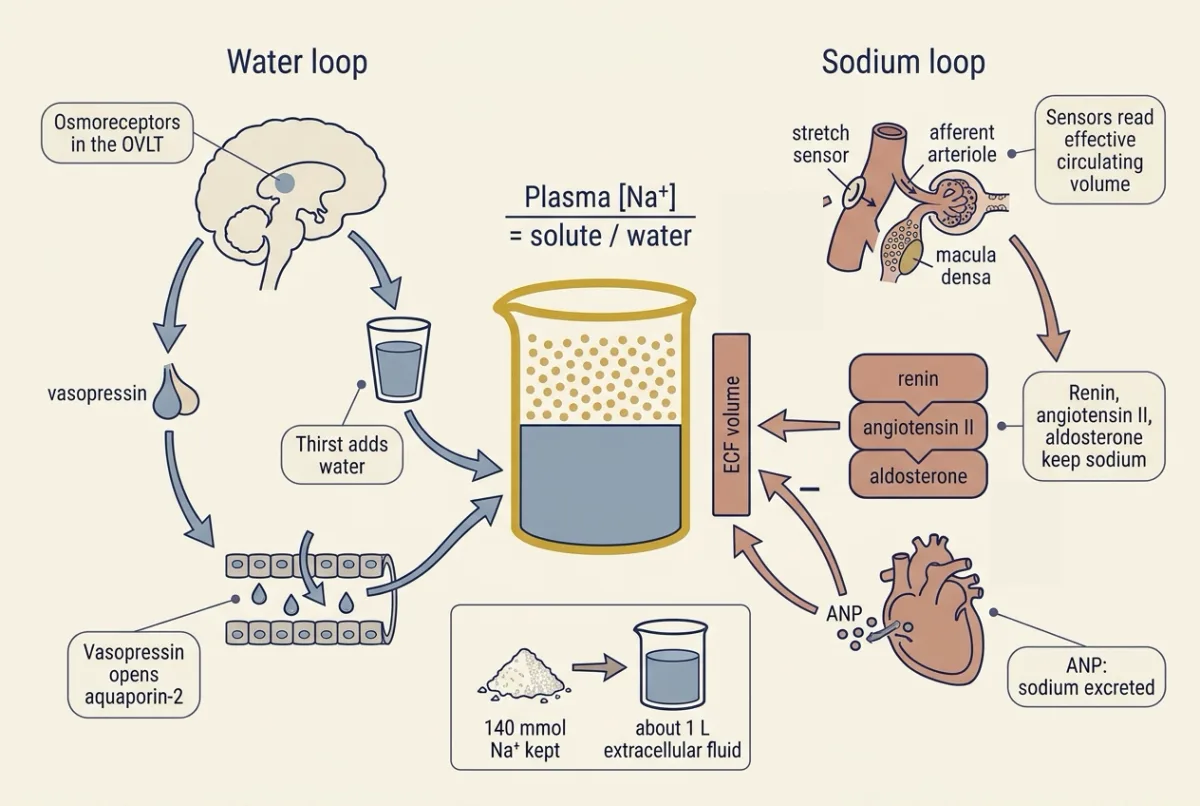
The water loop holds plasma sodium concentration steady by adding or removing water; once it has, each 140 mmol or so of sodium kept carries about 1 L of extracellular fluid, so the sodium loop sets volume. In a healthy adult a sodium concentration reports water, and a weight change sustained over days reports sodium, if potassium is steady. AI-generated illustration -
Vasopressin opens the collecting duct, and thirst replaces the water
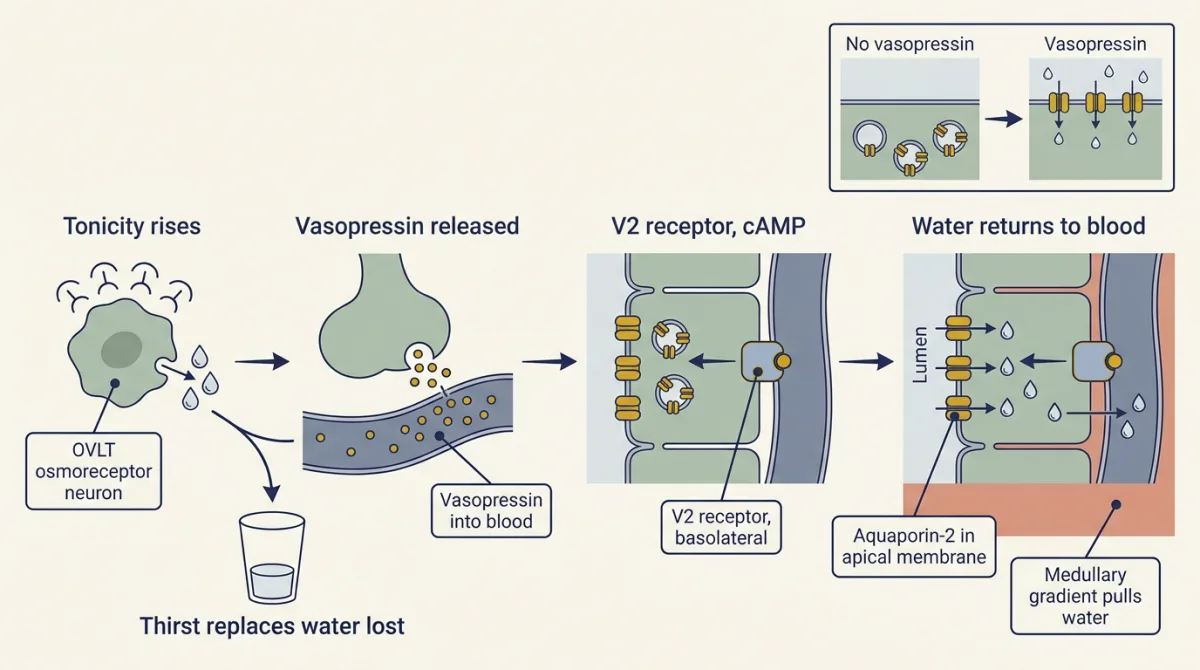
Rising tonicity fires OVLT neurons, vasopressin reaches V2 receptors on the collecting duct, and aquaporin-2 moves into the apical membrane so water returns to blood; vasopressin cuts renal water loss, and thirst replaces the water already lost. AI-generated illustration -
Free-water clearance splits urine into two parts
-
The sodium loop sets volume, and aldosterone escapes
-
Potassium is shifted in minutes and excreted over hours
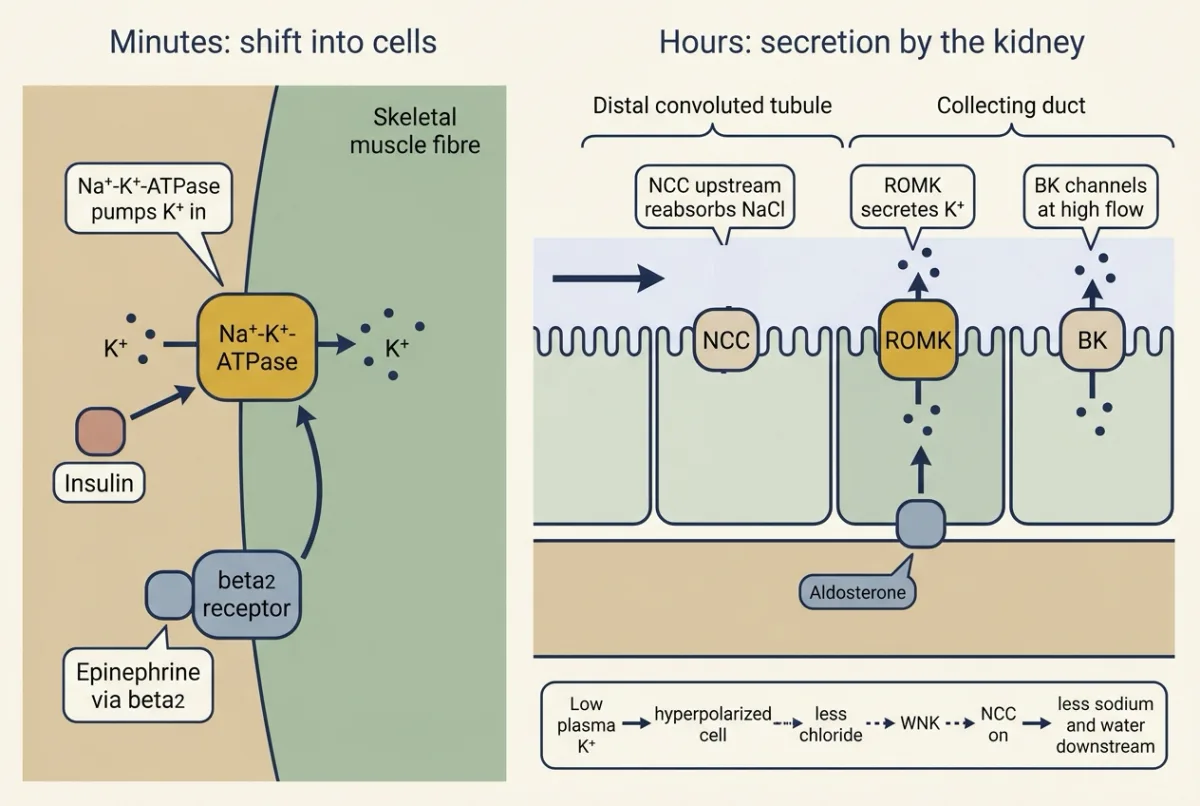
Potassium is defended first by moving into muscle in minutes, driven by insulin and beta2 stimulation of the Na+-K+-ATPase, then by secretion in the distal nephron over hours, set by aldosterone and by sodium and water delivery; the voltage-and-chloride sensing that switches NCC rests on experimental models. AI-generated illustration -
Going deeper
Where this lesson fits
Before thisReview first
- Body Water and Its CompartmentsThis course · Lesson 1
You need the compartment volumes and the sodium, potassium and water ratio from there to follow every litre example here.
- Tubular Transport, Segment by SegmentThis course · Lesson 16
Collecting-duct water and sodium handling, and distal potassium secretion, build on the segment-by-segment transport described there.
- Glomerular Filtration and Renal Blood FlowThis course · Lesson 15
Macula densa sensing and renin release from the afferent arteriole are taken from there, along with filtered potassium load.
After thisStudy next
- Acid-Base BalanceThis course · Lesson 18
Potassium shifts with mineral-acid and organic-acid loads are explained further once you can work the bicarbonate buffer.
- The Adrenal Cortex and MedullaThis course · Lesson 20
The aldosterone paradox and cortisol versus aldosterone receptor action take the mineralocorticoid story further.
- Calcium, Phosphate and BoneThis course · Lesson 22
It applies the same filter, reabsorb and hormone-control logic to another ion held in narrow limits.
Elsewhere on the siteFilms, simulations and method films in other courses
- Which Way Does the Water Go?Film · Organismal Biology
It shows how water moves toward higher osmolality, the basis of why sodium concentration tracks water.
- Filter Far More, Take Most BackFilm · Organismal Biology
It shows urine as what is filtered minus what tubules take back, which free-water clearance builds on.
Suggested by an AI model from the lessons themselves, then checked. How we use AI