Ecology and Evolution · Skim version
How to Test an Evolutionary Explanation
Read the full lesson → Skim the whole course →
The guiding idea
A drought killed most of an island's finches, and the survivors had bigger beaks. Is that evolution yet?
A nonrandom difference in survival shows selection, not yet evolution.
From the film: Three Claims in One Drought
- The 1977 drought on Daphne Major sorted the finches: survivors had larger beaks than the population before it.
- That gap measures selection through survival; if the survivors breed about equally, it is the selection differential S. It is not yet shown to be evolution.
- For one trait, the breeder's equation R = h² × S predicts how far the chicks' average moves: only part of the way, a fraction h² of S.
- If heritability were zero and the environment stayed the same, the chicks' average would not move, however strong the selection.
- Selection happened, the trait is inherited, the offspring changed: each claim needs its own evidence.
From the film: Changing the Cause on Purpose
- Comparing natural sites shows an association, because the sites differ in more than one way.
- Moving guppies from one source into a reach with a different predator changed the setting on purpose.
- About 11 years later, the moved guppies matured later and larger, the predicted direction.
- An experiment can test a cause, but this one is still one stream and one introduction, and the new reach differed in more than its predator.
- When a past event cannot be rerun, historical inference tests rival explanations against the traces it left.
-
Claim 1: selection happened
-
Claim 2: the trait is inherited
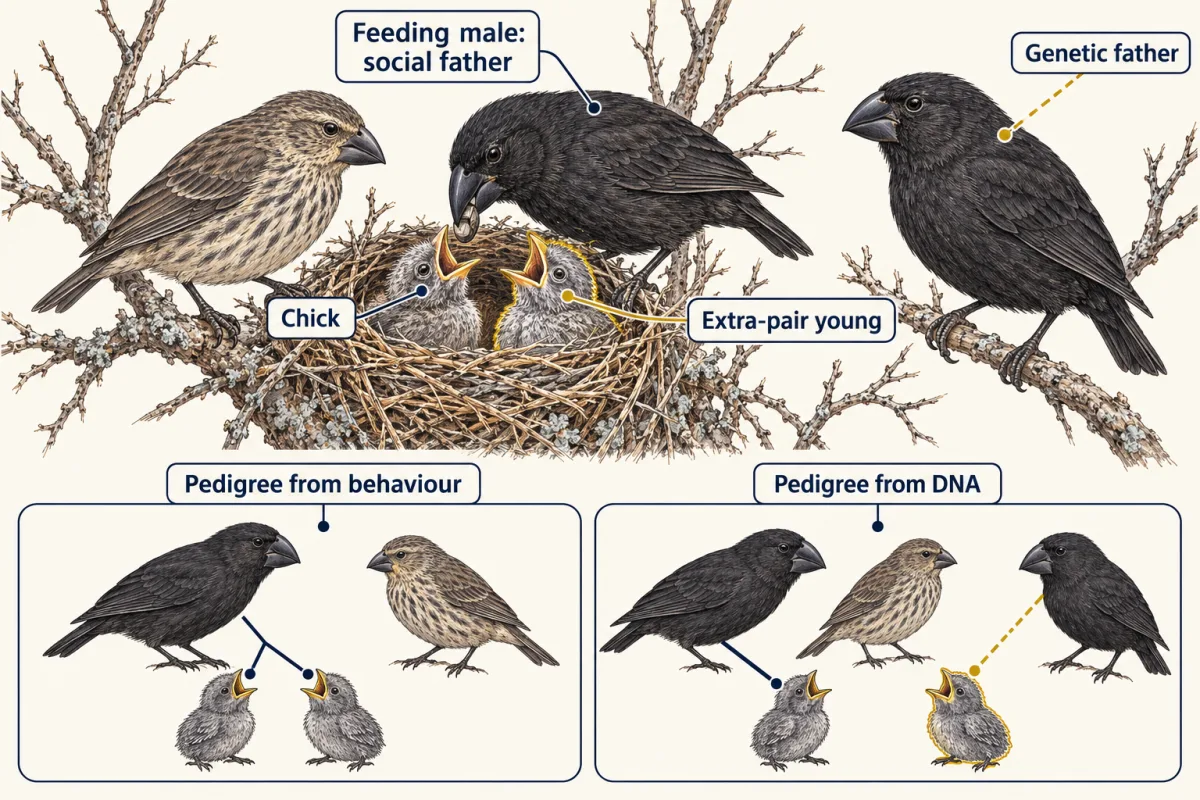
The natural shortcut is to take the birds feeding a chick as its parents. Keller and colleagues checked it with DNA: some offspring were extra-pair young, whose social father was not the genetic father, and removing them raised the father-offspring estimates of inheritance by 21 percent on average. AI-generated illustration -
Claim 3: the offspring changed
-
The direction of selection can reverse
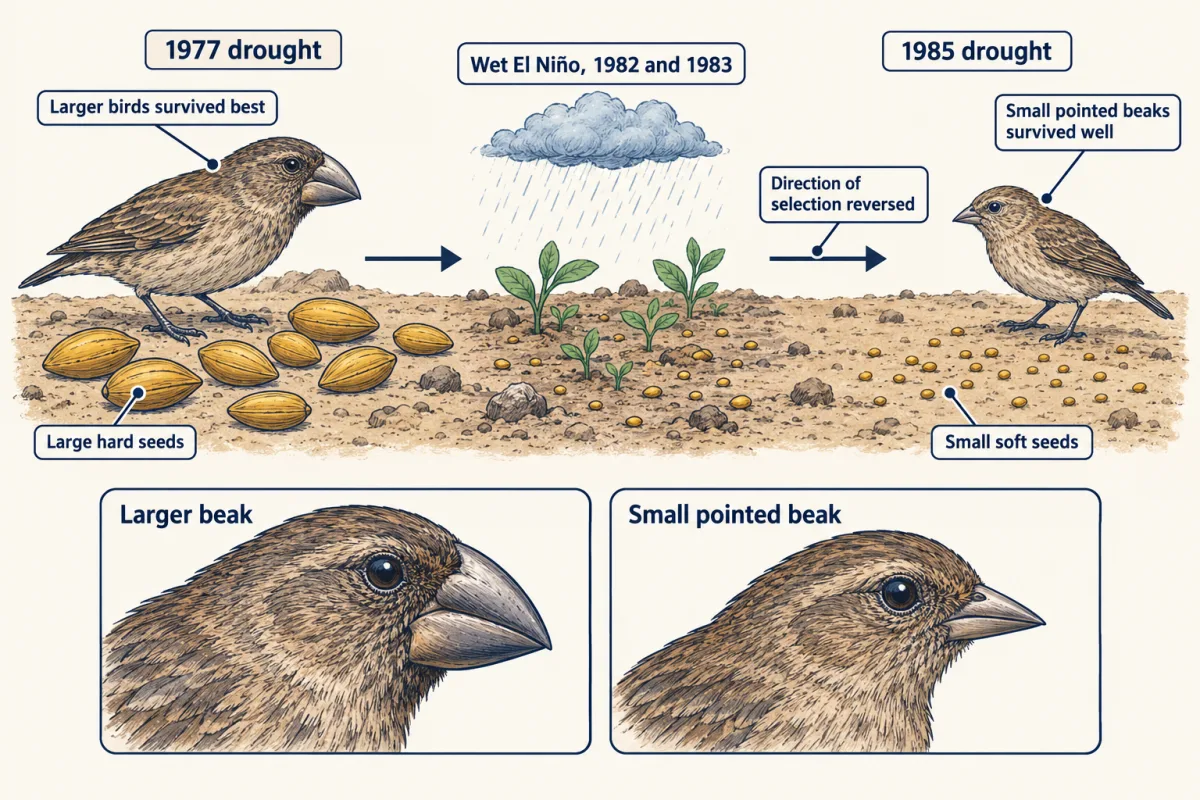
The same island, two droughts, opposite outcomes. In 1977 the food left was dominated by large hard seeds and larger birds survived best; after the wet El Niño of 1982 and 1983 it was dominated by small soft seeds, and in 1985 small birds with pointed beaks survived disproportionately well. AI-generated illustration -
Three kinds of evidence, and what each can carry
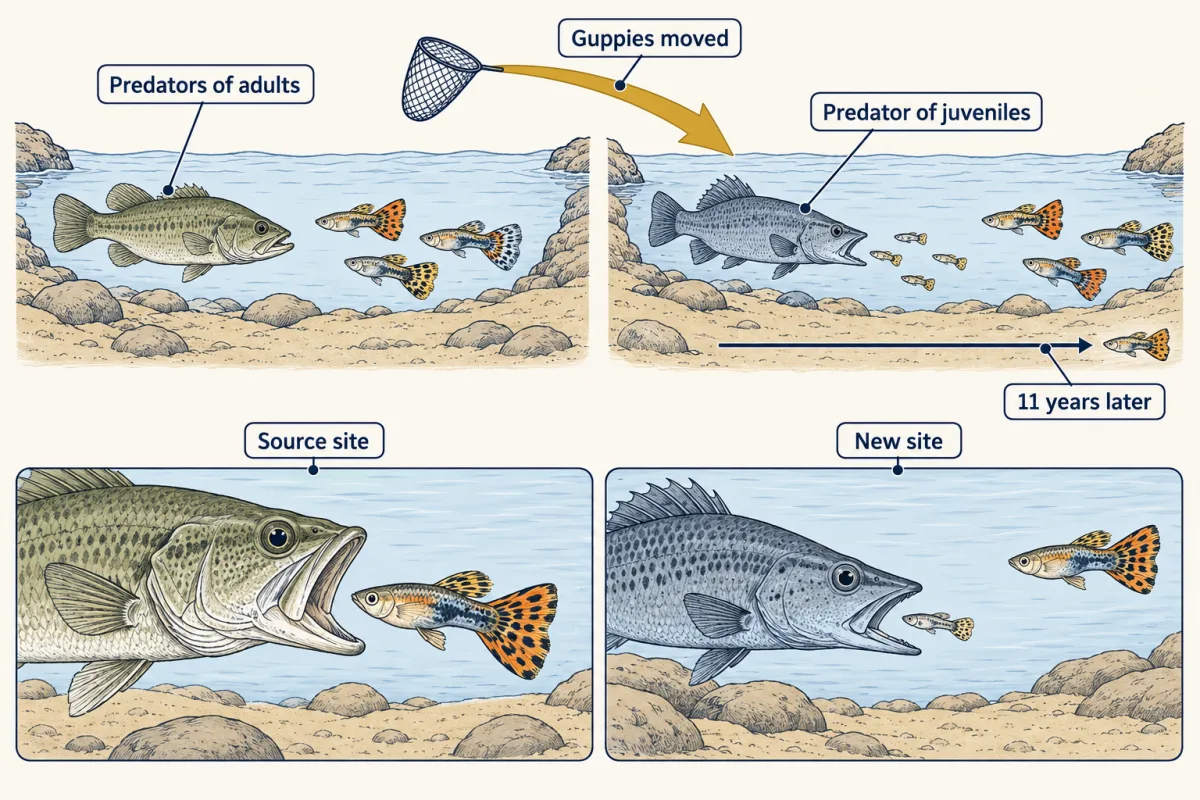
One source population, moved into a reach whose predator eats juveniles: the change of setting was made on purpose. The design tests that change; because the new reach also differed in more than its predator, it does not by itself isolate the predator. AI-generated illustration -
What a dataset cannot show
-
Going deeper
Where this lesson fits
Before thisReview first
- Natural Selection in ActionLife Science · Grade 7
You need its account of how survival differences among varied individuals shift a population before this lesson separates selection from evolution.
- Variation and SurvivalBiology · High school
It shows that selection acts on inherited variation, which this lesson then tests with heritability and the breeder's equation.
After thisStudy next
- Natural Selection in Ecological ContextThis course · Lesson 3
It applies the selection-versus-response distinction to moths, where the environment sets the direction of selection.
- Drift, Gene Flow and Competing ExplanationsThis course · Lesson 4
It tests rival explanations for a change in a population, using the evidence kinds set out here.
- Life Histories and Evolutionary Trade-offsThis course · Lesson 10
It uses selection and inheritance to explain trade-offs, including a trait's response to selection.
Elsewhere on the siteFilms, simulations and method films in other courses
- Variance partition: genes, environment and heritabilitySimulation · Genetics and Molecular Biology
It shows how heritability is calculated as a share of variation, which sets the h² in the breeder's equation.
- Beetles and new coloursSimulation · Life Science
It shows how new genetic variants arise, the raw material for selection to act on.
Suggested by an AI model from the lessons themselves, then checked. How we use AI