Ecology and Evolution · Skim version
Speciation: How Barriers to Gene Flow Evolve
Read the full lesson → Skim the whole course →
The guiding idea
Two monkeyflowers can be crossed by hand, yet they almost never exchange genes in the wild. What barriers hold them apart, and how did adapting to different places and pollinators build those barriers?
A new species forms when barriers that reduce gene flow evolve between populations that once interbred, and several partial barriers, whose leaks multiply, can together block nearly all of it.
From the film: Leaks That Multiply
- A reproductive barrier is anything that reduces gene flow between populations.
- When barriers act one after another and independently, each one blocks only the gene flow left by earlier barriers.
- The fractions that get through multiply, so several partial barriers can block nearly all gene flow.
- Barriers before the zygote are prezygotic; barriers after it, such as hybrids that fail to survive or are sterile, are postzygotic.
- In the monkeyflowers, most of the isolation comes before any hybrid forms.
From the film: Isolation Follows Ecology
- Divergent selection favours different traits in different habitats.
- Selection acts on individuals and builds no barrier on purpose; isolation that arises as a side effect of adaptation is called ecological speciation.
- In stickleback mating trials, fish of the same form from different lakes showed no strong isolation, while fish of different forms were strongly isolated.
- When isolation repeats with the environment, lake after lake, drift alone is unlikely and divergent selection is the likely cause.
- In the monkeyflowers, adaptation to elevation and to pollinators is itself the barrier.
-
Measuring barriers, and why their leaks multiply
-
Kinds of barrier: before and after the zygote
-
How barriers evolve: divergent selection
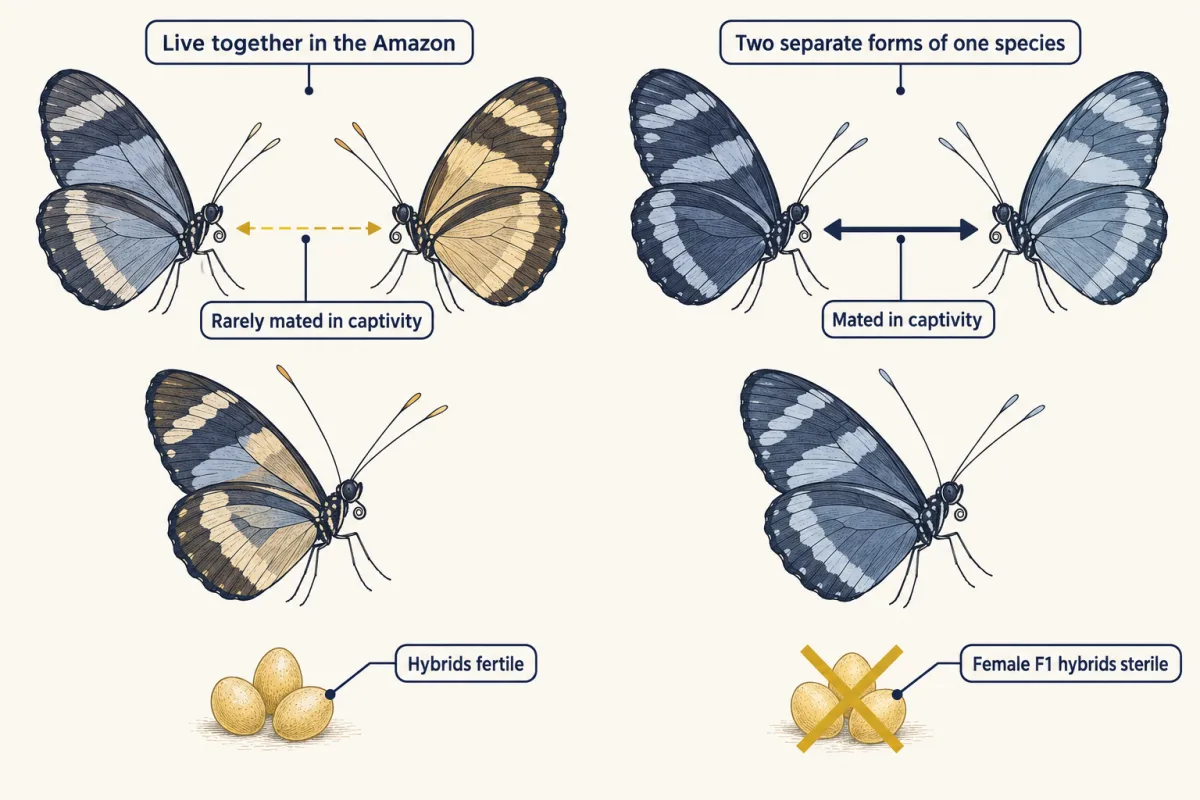
Heliconius elevatus and H. pardalinus butleri fly together in the Amazon and rarely mated in captivity, but their hybrids were fertile. Two separate forms of H. pardalinus mated, yet their female first-generation (F1) hybrids were sterile. Sterile hybrids are one kind of barrier, not a requirement for being a species. AI-generated illustration -
Geography and mechanism are separate questions
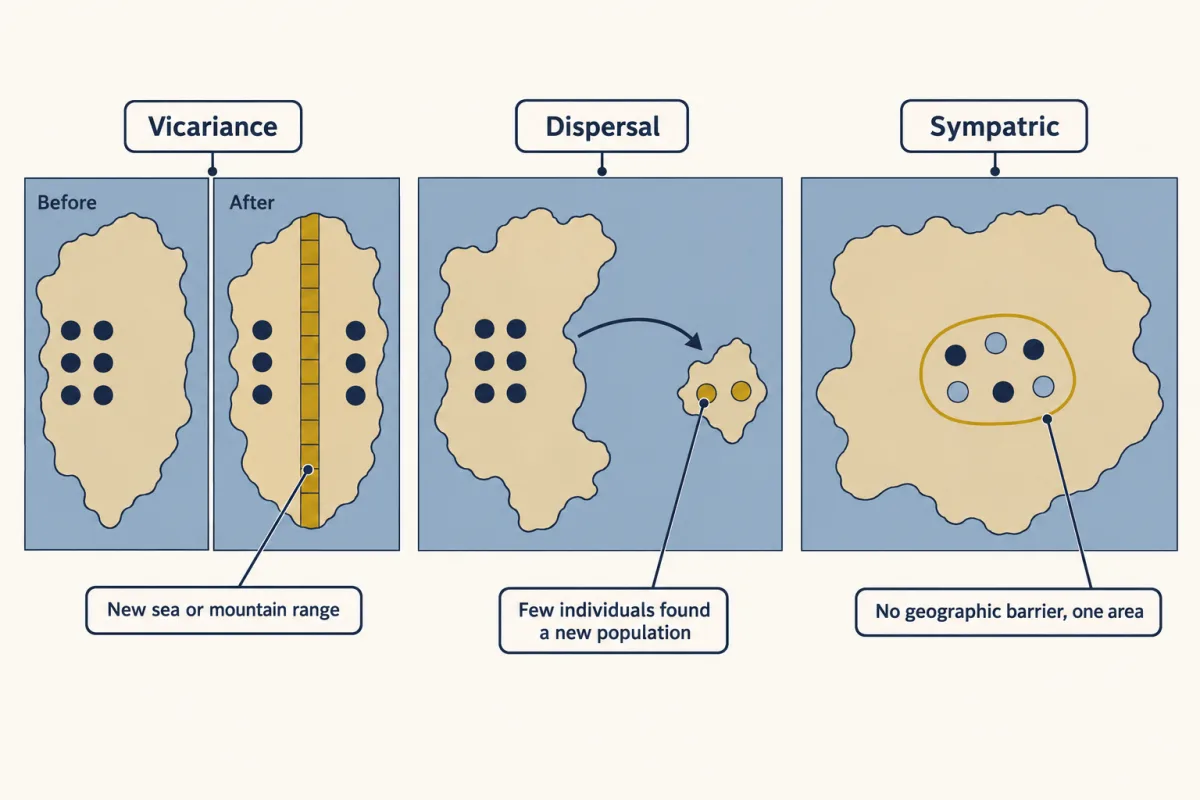
Allopatric speciation needs the populations apart, by vicariance (a new barrier divides one population) or dispersal (a few individuals found a new one elsewhere); sympatric speciation happens within one area. All three answer where, not how the barriers arose. AI-generated illustration 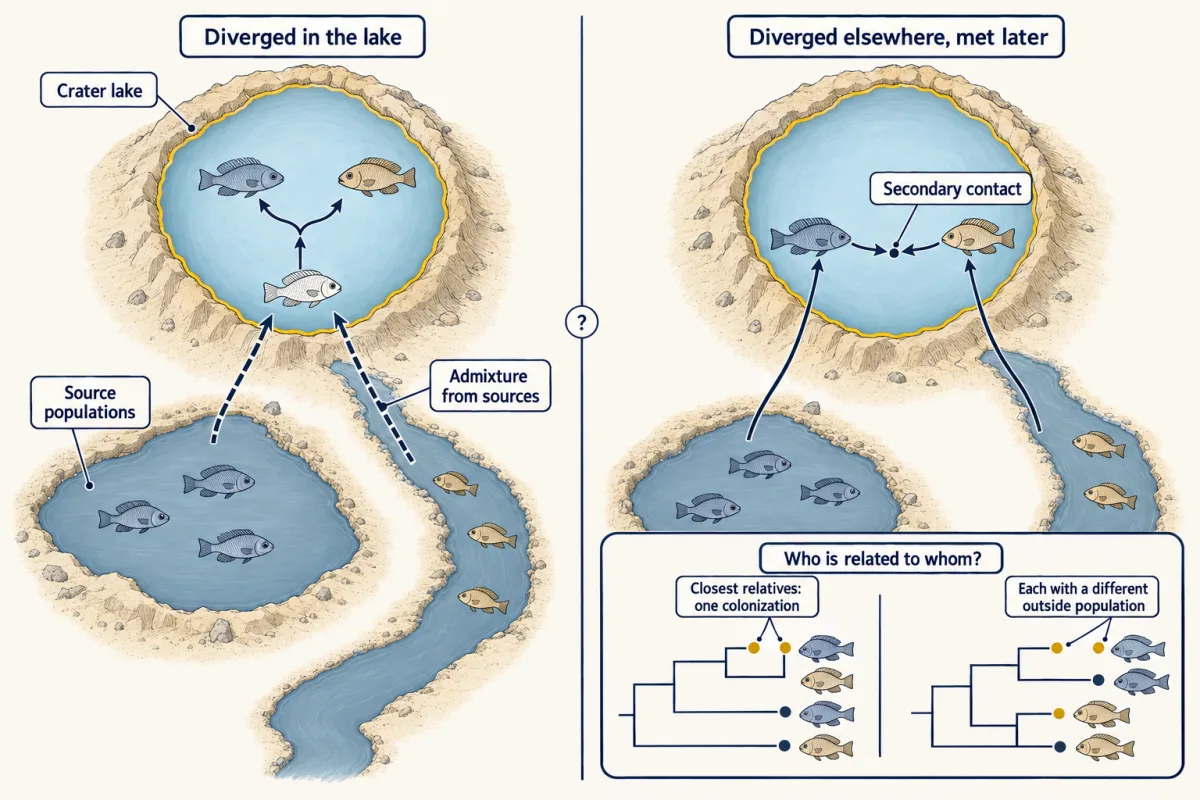
Two cichlid species in one crater lake could have diverged there or arrived separately and met later (secondary contact), so living together proves neither. Comparing who is related to whom, with source populations sampled, helps tell the histories apart; in Nicaraguan crater lakes the analyses supported divergence beginning in sympatry, with some admixture from outside. AI-generated illustration -
Polyploidy: isolation in one step
-
What counts as a species: criteria as evidence
-
Going deeper
Where this lesson fits
Before thisReview first
- Natural Selection in Ecological ContextThis course · Lesson 3
You need how selection favours different traits in different environments to see barriers arising as a side effect of adaptation.
- Drift, Gene Flow and Competing ExplanationsThis course · Lesson 4
Gene flow and drift are used here as the processes that barriers reduce and that compete as explanations.
- Reading Phylogenetic TreesThis course · Lesson 2
The monophyly criterion for species is read from a tree, so you need to know how trees show ancestors and descendants.
After thisStudy next
- History of Life: Transitions, Extinctions and RadiationsThis course · Lesson 8
Radiations and extinctions are the large-scale results of speciation producing many new lineages.
- Mutualism, Parasitism and CoevolutionThis course · Lesson 18
Pollinator relationships like those of the monkeyflowers are a case of coevolution between partners.
Elsewhere on the siteFilms, simulations and method films in other courses
- Meiosis shufflerSimulation · Biology
Polyploid isolation depends on how chromosome sets pair and separate in meiosis.
- What the Rocks Still ShowFilm · Life Science
It shows the fossil evidence that is the only way to recognize species in extinct lineages.
Suggested by an AI model from the lessons themselves, then checked. How we use AI