What the Rocks Still Show
Read the transcript of “What the Rocks Still Show”
Film transcript: What the Rocks Still Show
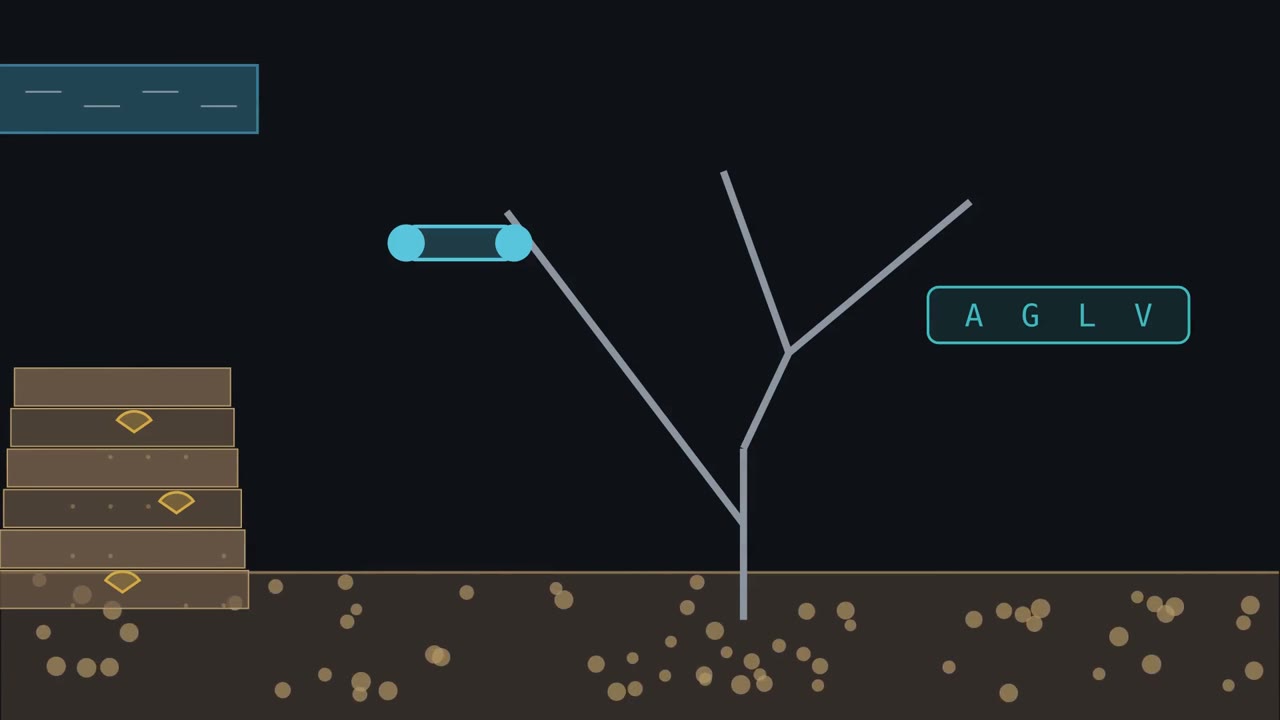
How can a record full of gaps still show that life changed? A fossil scallop rests inside a Virginia riverbank. Above it, a modern river crosses land that was once beneath a shallow sea. A fossil is the preserved remains or traces of past life. Shells, bones, teeth, and footprints can become fossils. Most remains rot or are eaten. Hard parts and quick burial improve the chance. The chance stays small. All fossils found so far make the fossil record. Because fossilization is rare, that record has gaps. A gap means some details are missing. It does not make the fossils beside it disappear. The pattern can survive. In undisturbed layers, read from older below to younger above.
Some kinds appear only in older rock. Some continue in changed forms. Sea shells inside inland rock also record an environment that is gone. Together, changes build history. Now remove one band of rock between two fossil layers. The lower layer holds one form. The upper layer holds a changed form. Does the missing band erase the pattern we can observe? Think before you decide.
No. We can still compare the fossils on both sides. The gap limits what we know between them, so keep it gray. Evidence stays honest when the picture shows both observations and uncertainty. Limits stay visible. Different groups also appear at different places on a time strip.
Fish, four-legged animals, mammal relatives, and bird-like dinosaurs have well-known early examples. They belong on separate branches, not one ladder. They are examples, not ancestors. Fossils record existence, extinction, change, and past environments. Each observation supports some claims and not others. A shell can place life in an old sea. It cannot name every branch by itself. Evidence needs clear scope. In science, a theory is a well-tested explanation backed by many lines of evidence.
Evolution explains why populations change and share ancestors. It also makes predictions that new evidence can test. That makes it testable. Return to the Virginia scallop. Its layer records a living thing and an ancient sea. Its resemblance to living scallops invites another question: which organisms share branches? Bones and sequences can test that next. The question continues. The record is incomplete, so every claim keeps its limits. Still, observed fossils remain evidence.
Across many layers, they show that life and environments changed through time.
How can a scallop shell millions of years old, a bat wing and a protein in your cells all tell the same story?
Continue in the lesson: Evidence for Change Over Time →
3:30 · Free, with captions and a transcript. The lesson has the full text, the questions and the sources.
More films from this lesson
How this film was made. Narration: written from this lesson's text and read by an AI narrator voice (Kokoro, af_heart). Animation: AI-generated in code (Manim) by Claude, a schematic with no drawn molecular structures. Captions come from the narration script. See something wrong? Report it.