Cell Signaling · Unit 6: Channels, the nucleus, and life or death
Signaling to the Nucleus: CREB, AP-1 and Immediate Early Genes
Rewritten on : new text and film. Your notes and highlights stay, but the text around them may have moved.
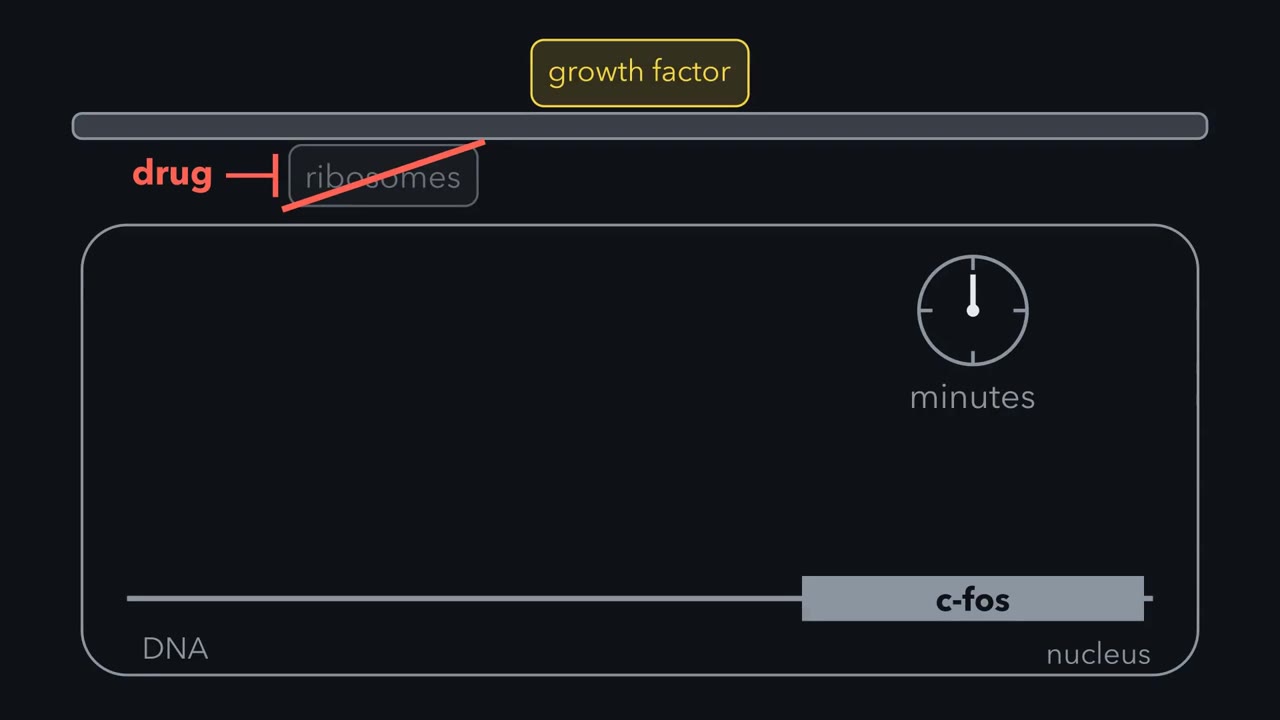
A resting cell starts transcribing c-fos within minutes of a signal, even with its ribosomes stopped. What was waiting in the nucleus?
The main idea, the figures and what the films show. Under each heading, "Read this part" opens it.
Both films in order, 7 minutes. Each one ends with what to take from it.
The whole lesson: about 17 minutes of reading and 7 of film.
Pause when the reading reaches a film, and offer to play it. Saved on this device.
Watch the film now, or keep listening
That is the end of the reading
This idea at other levels
This lesson teaches immediate early genes in Cell Signaling, a graduate course. Simpler: read a short college version here.
The college version · about 1 minute to read
Pathways that change gene expression quickly usually modify a transcription factor that is already made. CREB sits as a bZIP pair on the cAMP response element. PKA, after cAMP, or CaMKIV, after calcium and calmodulin, phosphorylates serine 133, and the phosphoserine lets CREB bind the KIX domain of the co-activator CBP, which acetylates histones and contacts the transcription machinery. NFAT uses the opposite chemistry: the calcium-activated phosphatase calcineurin removes phosphates that hide its nuclear import signal, and cyclosporin A and FK506, each bound to a helper protein, block calcineurin. bZIP factors bind DNA only as pairs joined by a leucine zipper, so members of the Fos and Jun families combine into many AP-1 pairs with different preferences. Immediate early genes such as c-fos are transcribed within minutes without new protein synthesis, and their products drive a second wave of genes.
See nearby ideasHide nearby ideas
This lesson also teaches one more idea; its ladder is below.
Immediate early genes
Some genes switch on within minutes of a signal, without the cell making any new protein first.
Taught at one level so far: graduate level.
Graduate · the level you chose
Signaling to the Nucleus: CREB, AP-1 and Immediate Early Genes · this lesson
c-fos switches on with ribosomes stopped; its products start a second wave.
Cell Signaling · about 17 min · film 3:22 · 3 practice questions
Next door to immediate early genes
- Transcription factorsSeveral of these genes, such as c-fos, make proteins that switch on a second wave of genes.
- Long-term potentiation and depressionNeurons that were active light up these genes, and lasting changes in a synapse need new gene activity.Nearest lesson: Synaptic Plasticity (upper-level college)
Transcription factors
Proteins that bind a short stretch of DNA near a gene and change how often it is copied.
Taught at one level so far: graduate level.
Graduate · the level you chose
Signaling to the Nucleus: CREB, AP-1 and Immediate Early Genes · this lesson
Four ways to switch on a ready-made factor: CREB, AP-1, NFAT.
Cell Signaling · about 17 min · film 3:22 · 3 practice questions
Next door to transcription factors
- Switching genes on and off (gene regulation)Each cell type uses its own set of these proteins, so cells with the same DNA make different products.Nearest lesson: The lac Operon: How Bacteria Regulate Genes (college core)
- Transcription factor codesA cell's type is set by which combination of these proteins it carries, not by one alone.Nearest lesson: Transcription Factor Codes: Building a Motor Neuron (graduate level)
Short versions inside this lesson
The plainest version · about 1 minute to read
A cell keeps some helpers sitting ready beside its instruction book. When a message arrives at the outside of the cell, the helpers do not have to be built. The message flips a little switch on a helper, and the helper opens the book to the right page. The first pages it opens tell the cell to build more helpers, and those open more pages.
Find an idea: every idea, searchable
Which lessons teach an idea, and the notes on each level, were written by AI models from the lessons and checked by a second model. A person has not yet read every one. How we use AI
About this lesson goals, parts
What you'll learn
- Sort the ways a signal switches on a transcription factor that is already made: add a phosphate (CREB), remove phosphates (NFAT), destroy an inhibitor (NF-κB), or make the messenger the factor (STATs, Smads, and the cut piece of Notch with its DNA-bound partner).
- Explain how PKA after cAMP and a calmodulin-dependent kinase after calcium put a phosphate on the same serine of CREB, and how that phosphate lets CREB hold the co-activator CBP.
- Explain how bZIP factors pair through a leucine zipper, and why pairing in different combinations gives many DNA preferences from few proteins.
- Define an immediate early gene, explain why c-fos marks recently active cells, and describe the second wave of genes that the first products switch on.
Builds on:cAMP and Protein Kinase A (read)Calcium: The Messenger Kept at Arm's Length (read)Phosphorylation: Kinases and Phosphatases (read)Why these?
Rewritten on : new text and film. Notes and highlights stay, but the text around them may have moved.
The main idea. Fast signals flip pre-made factors to switch on first-wave genes; paired factors widen gene choices and drive a slower second wave.
The films
 ▶ Watch Two Phosphate Switches That Flip Waiting Factors · 3:22
Read the transcript of “Two Phosphate Switches That Flip Waiting Factors”
Film transcript: Two Phosphate Switches That Flip Waiting Factors
How can a resting cell switch on a gene in minutes, even with every ribosome stopped? Add a growth factor, and c-fos transcripts still surge. Whatever switched the gene on was already built and waiting. The signal only had to flip it. A transcription factor binds a short DNA site near a gene. Making a new factor is slow, since it must be transcribed and translated. Fast pathways modify a factor already made. One waiting factor is CREB. It sits on DNA as a pair before any signal arrives, yet stays quiet. A transcription factor is slow, since it must be transcribed and translated. When cyclic AMP rises, it frees the active subunits of PKA. Some enter the nucleus and attach one phosphate onto CREB at serine 133.
That phosphate is a docking handle. CBP, a co-activator that cannot bind DNA itself, grips it through its KIX pocket. CBP then adds acetyl groups that loosen packaged DNA and calls in RNA polymerase. Next, a different messenger: calcium. Calcium binds calmodulin, and the pair switches on a nuclear kinase, CaMKIV. It puts a phosphate onto the exact same serine of CREB. Growth factors reach that serine too, through kinases that ERK switches on. So separate signals flip one switch. Adding a phosphate is one switch. Meet a second pre-made factor, NFAT, resting in the cytoplasm. It carries about a dozen phosphates that cover its nuclear entry tag.
Here, removing phosphates activates the factor, because those phosphates were locking it outside. When the T cell receptor fires, sustained calcium turns on calcineurin, a phosphatase that removes phosphates. Pause and predict: once those phosphates come off, where does this factor go?
The factor moves into the nucleus, because calcineurin strips the phosphates that covered its entry tag. With the tag exposed, it glides through a pore and switches on target genes. When calcium drops, kinases restore those phosphates and send it back out. Two transplant drugs, cyclosporin A and FK506, quiet T cells by jamming this switch. Neither drug blocks calcineurin on its own. Each binds a small helper protein. That pair sits beside calcineurin's active site and keeps protein substrates from reaching it. Back to the opening puzzle. Whether a signal adds one phosphate or removes many, the protein was built in advance. Fast signals flip pre-made factors to switch on first-wave genes like c-fos within minutes. Stopped ribosomes cannot stop a waiting switch.
From the film: four take-homes
- Fast signals flip pre-made factors to switch on first-wave genes.
- PKA after cAMP and CaMKIV after calcium phosphorylate CREB on serine 133, creating a binding handle for the co-activator CBP.
- Calcineurin activates NFAT by removing phosphates that hide its nuclear import signal, letting it enter the nucleus.
- Transplant drugs such as FK506 and cyclosporin A join helper proteins to block calcineurin, trapping NFAT in the cytoplasm.
Add a growth factor to a resting cell and, within minutes, it transcribes c-fos—even with every ribosome stopped. The first film showed two phosphate switches flipping waiting factors; below is the four-way map of fast nuclear switches, followed by their chemistry, drug proofs, pairing math, and two-wave timing.
Four ways a signal flips a waiting factor
A transcription factor is a protein that binds a short, specific DNA sequence near a gene and changes how often that gene is copied into RNA. Making more factor from scratch works, but transcription plus translation is slow. Fast pathways modify a pre-made factor in one of four ways:
| What the signal does | Example | Where you met it |
|---|---|---|
| Adds a phosphate that lets the factor hold a co-activator | CREB | This lesson |
| Removes phosphates so the factor can enter the nucleus | NFAT | This lesson |
| Destroys the factor’s inhibitor | NF-κB, freed when IκB is destroyed | The Toll-like receptor and NF-κB lesson |
| Makes the messenger itself the factor | STATs, Smads; the cut piece of Notch joins a DNA-bound partner, CSL | The JAK-STAT, TGF-β and Notch lessons |
Row one has other members—such as Elk-1, which extracellular signal-regulated kinase (ERK) phosphorylates in the Ras-to-MAPK lesson. In all four, synthesis is done in advance, so the signal only flips the switch.
CREB: one serine, two messengers
The first film traced cAMP and calcium to one serine on cAMP response element-binding protein (CREB); here are the DNA site, the co-activator chemistry, and the neuronal channel route.
CREB (cAMP response element-binding protein) binds the eight-letter cAMP response element (CRE), TGACGTCA, as a pair and sits largely on DNA before any signal arrives. Occupancy alone leaves the gene off.
Picking up from the cAMP and protein kinase A (PKA) lesson, cAMP frees PKA catalytic subunits, and some enter the nucleus to phosphorylate serine 133. A co-activator does not bind DNA itself but is brought to a gene by a factor that does. The KIX domain of CBP (CREB-binding protein) grips CREB far more tightly once serine 133 is phosphorylated, then acetylates nearby histones (loosening packaged DNA) and contacts the RNA polymerase machinery.
From the calcium lesson, calcium–calmodulin activates nuclear CaMKIV, which hits the exact same serine 133; growth factors also reach it via ERK-activated kinases (not extracellular signal-regulated kinase (ERK) directly).
Predict. A neuron receives glutamate and fires strongly. Trace depolarization at the membrane to phosphorylated CREB on DNA—and predict what happens to CBP if a nuclear phosphatase immediately strips serine 133.
Check your prediction
Depolarization opens L-type voltage-gated calcium channels and clears the magnesium ion blocking glutamate-bound NMDA receptors. Calcium enters, binds calmodulin, and activates CaMKIV with help from an upstream kinase, CaMKK, that phosphorylates CaMKIV. CaMKIV phosphorylates serine 133 within minutes; after strong or prolonged activity, a slower Ras–ERK kinase route keeps it phosphorylated so CBP stays bound. If a phosphatase strips serine 133 immediately, KIX loses its tight grip, CBP detaches, and transcription stops.
Many neuronal CRE genes also require a second co-activator, a CRTC, sent into the nucleus by calcium (Going deeper).
Calcineurin and NFAT: removing phosphates opens the door
The first film showed NFAT (nuclear factor of activated T cells) flipping in reverse—entering the nucleus when calcineurin strips about a dozen phosphates that hide its nuclear import signal. Here are the T-cell circuit and the living-cell drug proof.
When the T-cell receptor fires, store-operated entry (from the calcium lesson) sustains high calcium, activating calcium–calmodulin and the phosphatase calcineurin. Once inside the nucleus, NFAT binds DNA beside a Fos–Jun pair (met right after the second film) on genes such as interleukin-2, which tells the T cell to divide. When calcium drops, kinases restore the phosphates and NFAT exits.
Two chemically unalike transplant drugs mapped this pathway before anyone knew their target. In 1989 a Merck group and Stuart Schreiber’s group each identified FKBP12 as the small protein binding FK506; cyclosporin A binds cyclophilin. In 1991 Schreiber’s group and collaborators showed where they converge: each drug–helper complex binds and inhibits calcineurin. Neither drug nor helper blocks calcineurin alone—the pair sits beside the catalytic site and blocks bulky substrates such as NFAT. Jam calcineurin and NFAT keeps its phosphates and stays in the cytoplasm, so the interleukin-2 gene stays quiet.
Predict. FKBP12 and cyclophilin are enzymes themselves, so test-tube inhibition does not prove calcineurin is the drug target in living T cells. If calcineurin is the real target, how should overproducing calcineurin change T-cell sensitivity to FK506 and cyclosporin A?
Check your prediction
The cells should become more resistant to both drugs, needing higher doses to silence NFAT, because extra calcineurin leaves more enzyme unbound. In 1992 Neil Clipstone and Gerald Crabtree tested this in T cells: extra calcineurin raised resistance to both drugs and boosted NFAT-driven transcription. If more enzyme means more drug is needed, the enzyme is probably the target.
Design problem
Design a transcription factor activated by cAMP or calcium, drawing each pathway from surface to gene. Then modify it to require both messengers at once.
Saved in this browser only.
One way to do it
For OR, copy CREB: a DNA-bound factor with one serine hit by two kinases. Pathway 1: hormone → GPCR → Gs → adenylyl cyclase → cAMP → nuclear PKA → phosphoserine → co-activator → gene on. Pathway 2: depolarization → calcium channel → calmodulin → CaMKK → CaMKIV → same phosphoserine. Either suffices.
For AND, split location and activity. Let calcium/calcineurin unmask a nuclear import signal (as in NFAT), and let cAMP/PKA phosphorylate the co-activator handle. Calcium alone imports an inactive factor; cAMP alone phosphorylates a trapped cytoplasmic factor. Only both switch the gene on. (Composite sites like interleukin-2—NFAT beside Fos–Jun—also compute AND.)
At interleukin-2, NFAT needs a paired Fos–Jun partner—so how do two factors pair on DNA, and where does Fos come from?
Read the transcript of “Pairing Up to Launch the Second Wave”
Film transcript: Pairing Up to Launch the Second Wave
In the first film, signals flipped pre-made factors to launch genes in minutes. How does a cell build many distinct DNA switches from few genes, and stretch a brief signal into hours? Many nuclear factors belong to the basic leucine zipper, or bZIP, family, including CREB. A bZIP protein cannot grip DNA well alone; it works as a pair. Two helices zip along a stripe of leucines. Below that zipper, positively charged tips, drawn to negatively charged DNA, part like chopsticks to grip two half-sites. Pairing multiplies choices, because swapping one partner changes which DNA site the pair prefers. With n proteins that all pair freely, the count is n × (n + 1) / 2.
That counts same-partner pairs plus mixed pairs. Take 3 proteins: 3 × 4 = 12; 12 / 2 = 6 distinct pairs. In real cells, not every pair is stable. Two bZIP families, Jun and Fos, build the factor AP-1. Jun pairs with Jun or with Fos. Fos cannot pair stably with itself, because negatively charged residues beside its zipper repel each other. Try the partner rule yourself.
Suppose a cell makes 2 Jun proteins and 2 Fos proteins. Pause and predict: with no Fos–Fos pairs allowed, how many distinct pairs can form? Seven pairs, because the rule removes only the Fos–Fos pairs. 2 Jun proteins make 3 Jun–Jun pairs: 2 × 3 / 2 = 3. 2 Fos × 2 Jun add 4 mixed pairs. 3 + 4 = 7. Four free proteins would make 4 × 5 / 2 = 10. Swapping partners also tunes DNA grip. A Fos–Jun pair holds DNA more tightly than Jun–Jun. It also prefers a 7-letter DNA site, one letter shorter than CREB's 8-letter site. Back to the first film's gene, c-fos. Pre-made factors switch on c-fos transcripts within minutes.
When ribosomes are running, those transcripts build new Fos protein. Fos enters the nucleus and zips with Jun to form AP-1. On immune genes like interleukin-2, AP-1 sits beside NFAT from the first film. Two pathways then meet at one DNA site. Paired factors widen gene choices and drive a slower second wave.
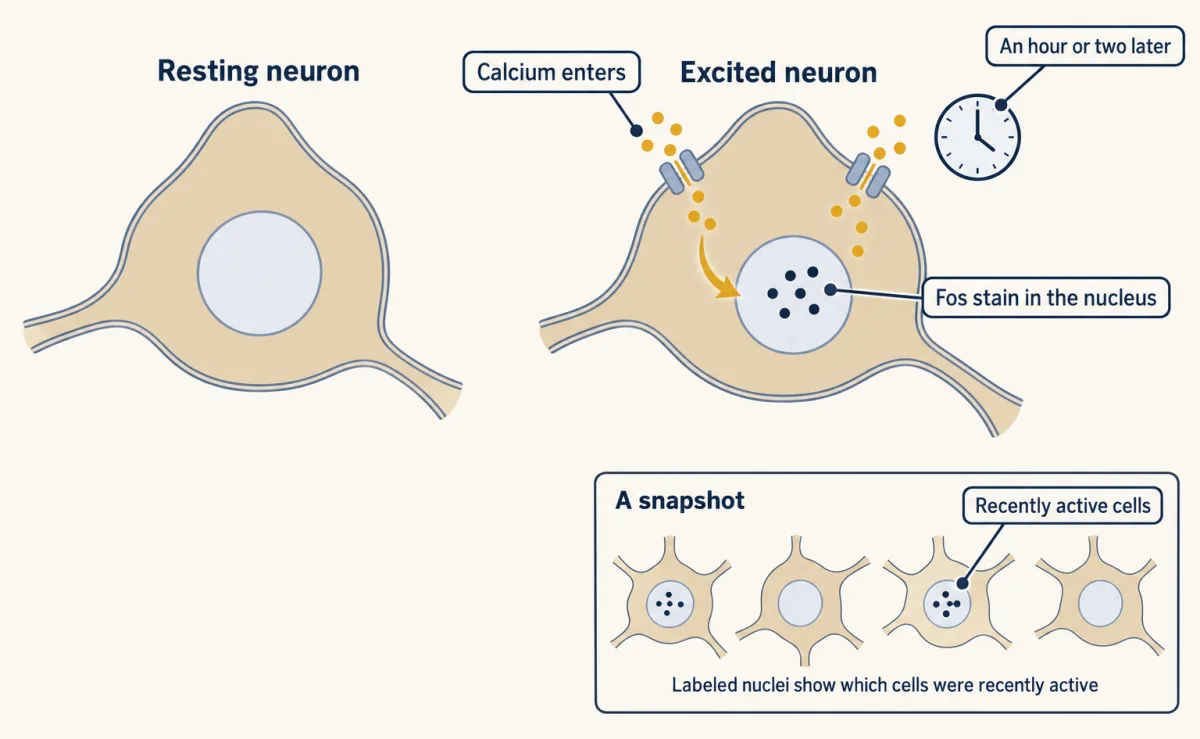
Newly assembled AP-1 switches on later genes over hours. Because that wave waits for newly made Fos and other first-wave proteins, a brief signal becomes a lasting program. Staining Fos hours later marks neurons that were strongly excited.
From the film
- Paired factors widen gene choices and drive a slower second wave.
- A bZIP factor joins two helices along a leucine zipper and grips two DNA half-sites with positively charged tips.
- If n proteins pair freely they make n(n + 1) / 2 pairs, while flanking charges rule out unstable pairs such as Fos–Fos.
- First-wave c-fos mRNA makes Fos protein, which pairs with Jun to form AP-1 and switch on slower second-wave genes.
Basic leucine zippers: pairing multiplies DNA choices
The second film built the chopstick model of pairing and the two-wave cascade; here are the helix geometry, DNA-site lengths, and pairing ceiling behind that rule—that paired factors widen gene choices and drive a slower second wave.
cAMP response element-binding protein (CREB), Fos, and Jun are bZIP (basic leucine zipper) proteins, built from two stretches of one long α-helix:
- Leucine zipper: a leucine sits at nearly every seventh position. Because an α-helix turns once every ~3.6 residues, seven residues span
7 / 3.6 ≈ 1.94turns—just shy of two full turns—so every seventh residue lands on nearly the same side, and the leucines form a gently twisting stripe down the helix. Two helices wind their stripes together to hide the leucines from water. - Basic stretch: rich in positively charged lysine and arginine; beyond the zipper, the helices part like chopsticks so each basic stretch enters the DNA major groove and reads one half-site.
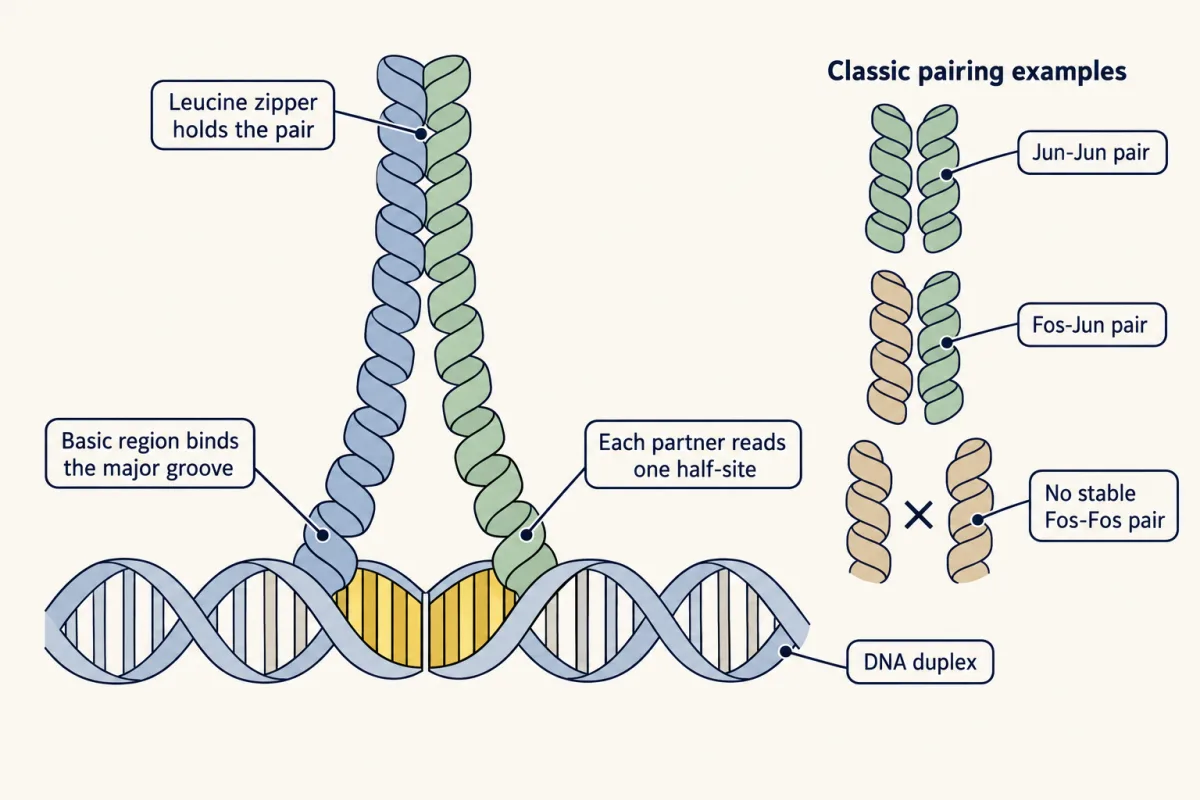
Swapping a partner changes DNA preference and output. AP-1 (activator protein 1) is classically a Fos–Jun or Jun–Jun pair (though both can pair with other bZIPs). Jun pairs with Jun; Fos cannot pair stably with Fos because negatively charged residues flanking its zipper repel each other, so Fos needs a partner (classically Jun), and Fos–Jun grips DNA more tightly than Jun–Jun. AP-1 prefers the seven-letter site TGACTCA, one letter shorter than the eight-letter cAMP response element (CRE) (TGACGTCA). Four Fos and three Jun genes yield well over a dozen AP-1 pairs.
Adding n same-partner pairs to n(n − 1) / 2 mixed pairs gives the unrestricted ceiling:
n proteins that can all pair with one another make n(n + 1) / 2 different pairs
Roughly fifty human bZIPs would make 50 × 51 / 2 = 1,275 pairs if all paired freely, but residues beside each leucine stripe restrict partner choice (Going deeper).
Predict. A cell expresses 3 Fos-family and 2 Jun-family proteins (Jun pairs with any Jun or Fos; Fos never pairs with Fos). How many distinct pairs can form, versus 5 freely pairing proteins?
Check your prediction
Five freely pairing proteins form 5 × 6 / 2 = 15 pairs. Under the Fos rule: 2 Jun make 2 × 3 / 2 = 3 Jun–Jun pairs, 3 Fos × 2 Jun make 6 Fos–Jun pairs, and Fos–Fos makes 0, yielding 9 pairs—still nearly double the gene count.
Immediate early genes: from minutes to hours
An immediate early gene (IEG) is transcribed within minutes of a signal without new protein synthesis, defined by the cycloheximide test: block ribosomes with cycloheximide, add the signal, and measure mRNA.
For c-fos, mRNA still rises because its promoter carries both a cAMP response element (CRE) (for cAMP response element-binding protein (CREB)) and a serum response element (SRE)—named because growth factors in blood serum trigger it in culture—bound by serum response factor (SRF) and partners such as Elk-1 (phosphorylated by extracellular signal-regulated kinase (ERK)). Thus cAMP, calcium, and growth factors all reach c-fos via pre-made factors.
In 1984 Michael Greenberg and Edward Ziff showed that c-fos transcription surges within minutes of adding growth factors to resting fibroblasts and soon shuts off again. Without cycloheximide, newly translated Fos pairs with Jun to form AP-1, switching on a slower second wave of genes that turns a minutes-long signal into an hours-long program.
Predict. Resting fibroblasts receive cycloheximide before growth factor. At 30 minutes you measure c-fos mRNA and Fos protein; at 2 hours you measure mRNA of an AP-1–driven second-wave gene. What happens to each?
Check your prediction
At 30 minutes, c-fos mRNA rises (pre-made factors need no ribosomes), but Fos protein does not rise (stopped ribosomes cannot translate it). At 2 hours, the second-wave mRNA stays off because it requires newly made Fos and other first-wave products.
Mapping active neurons with Fos
Resting neurons make very little Fos. Strong excitation brings calcium in, activating CREB and c-fos, so antibody staining a few hours later maps recently active nuclei across a whole brain without electrodes. Two cautions apply: a neuron can fire without making Fos, and the stain is a snapshot with timing no finer than hours.
From ion channels to CREB and long-term memory
A brief synaptic change modifies existing proteins; a long-lasting change requires new transcription, involving CREB where tested.
Predict. Injecting excess short CRE DNA (“decoy CRE DNA”) into a sensory neuron’s nucleus soaks up CREB away from real genes. After training, what should happen to short-lasting versus long-lasting synaptic strengthening?
Check your prediction
Short-lasting strengthening survives (it modifies proteins already at the synapse), whereas long-lasting strengthening fails because decoy DNA sequesters CREB. Eric Kandel’s laboratory reported this result in Aplysia in 1990.
In 1994, fruit flies expressing a blocking form of CREB failed to form long-term odor memory, and mice lacking two CREB forms showed a similar loss, with short-term memory intact in both. In Aplysia the messenger is cAMP; in mammalian neurons, calcium through N-methyl-D-aspartate (NMDA) receptors and L-type channels hits the same serine 133. Later mouse results varied with isoforms, gene dosage, training spacing, and compensation by CREM (Going deeper). None of this shows that CREB is where a memory is stored.
Going deeper
CRTC co-activators and coupled folding on CREB
CREB’s kinase-inducible domain is largely disordered alone and folds into two helices upon binding CBP’s KIX domain when serine 133 is phosphorylated. Many cAMP response element (CRE) targets also require CRTC co-activators, which enter the nucleus when calcineurin dephosphorylates them and cAMP silences the kinases holding them out—making those genes coincidence detectors for calcium and cAMP.
bZIP partner specificity across species
Charged residues flanking the hydrophobic leucine stripe set which helices pair stably (as in acidic-residue repulsion blocking Fos–Fos while permitting Fos–Jun). Deppmann, Alvania and Taparowsky (Molecular Biology and Evolution, 2006) compile bZIP pairing networks across humans, fruit flies, a plant, and yeast.
Why later mouse CREB memory studies varied
Later mouse studies proved less uniform than the 1994 knockout: the original mutants still made a third cAMP response element-binding protein (CREB) isoform, outcomes depended on gene dosage and training spacing, and CREB-deficient mice upregulated the related factor CREM, which may partly stand in for CREB.
Your notes
Select any text in the lesson to highlight it or add a note to it. Your highlights and notes are saved in this browser and collected in your notebook.
This browser is not letting the site save anything (a private window or strict privacy settings), so highlights and notes will be lost when you leave the page.
Try the Predict questions again
Five Predict questions from this lesson, on their own. Answer each one first, then open its check.
A neuron receives glutamate and fires strongly. Trace depolarization at the membrane to phosphorylated CREB on DNA—and predict what happens to CBP if a nuclear phosphatase immediately strips serine 133.
From: CREB: one serine, two messengers
Check your prediction
Depolarization opens L-type voltage-gated calcium channels and clears the magnesium ion blocking glutamate-bound NMDA receptors. Calcium enters, binds calmodulin, and activates CaMKIV with help from an upstream kinase, CaMKK, that phosphorylates CaMKIV. CaMKIV phosphorylates serine 133 within minutes; after strong or prolonged activity, a slower Ras–ERK kinase route keeps it phosphorylated so CBP stays bound. If a phosphatase strips serine 133 immediately, KIX loses its tight grip, CBP detaches, and transcription stops.
FKBP12 and cyclophilin are enzymes themselves, so test-tube inhibition does not prove calcineurin is the drug target in living T cells. If calcineurin is the real target, how should overproducing calcineurin change T-cell sensitivity to FK506 and cyclosporin A?
From: Calcineurin and NFAT: removing phosphates opens the door
Check your prediction
The cells should become more resistant to both drugs, needing higher doses to silence NFAT, because extra calcineurin leaves more enzyme unbound. In 1992 Neil Clipstone and Gerald Crabtree tested this in T cells: extra calcineurin raised resistance to both drugs and boosted NFAT-driven transcription. If more enzyme means more drug is needed, the enzyme is probably the target.
A cell expresses 3 Fos-family and 2 Jun-family proteins (Jun pairs with any Jun or Fos; Fos never pairs with Fos). How many distinct pairs can form, versus 5 freely pairing proteins?
From: Basic leucine zippers: pairing multiplies DNA choices
Check your prediction
Five freely pairing proteins form
5 × 6 / 2 = 15pairs. Under the Fos rule: 2 Jun make2 × 3 / 2 = 3Jun–Jun pairs, 3 Fos × 2 Jun make6Fos–Jun pairs, and Fos–Fos makes0, yielding 9 pairs—still nearly double the gene count.Resting fibroblasts receive cycloheximide before growth factor. At 30 minutes you measure
c-fosmRNA and Fos protein; at 2 hours you measure mRNA of an AP-1–driven second-wave gene. What happens to each?From: Immediate early genes: from minutes to hours
Check your prediction
At 30 minutes,
c-fosmRNA rises (pre-made factors need no ribosomes), but Fos protein does not rise (stopped ribosomes cannot translate it). At 2 hours, the second-wave mRNA stays off because it requires newly made Fos and other first-wave products.Injecting excess short CRE DNA (“decoy CRE DNA”) into a sensory neuron’s nucleus soaks up CREB away from real genes. After training, what should happen to short-lasting versus long-lasting synaptic strengthening?
From: Immediate early genes: from minutes to hours
Check your prediction
Short-lasting strengthening survives (it modifies proteins already at the synapse), whereas long-lasting strengthening fails because decoy DNA sequesters CREB. Eric Kandel’s laboratory reported this result in Aplysia in 1990.
How we measure it
Overexpressing a suspected drug target
Make cells produce far more of one protein than normal, then add the drug. If the cells with extra protein need more drug to be shut down, the drug is probably acting through that protein. Clipstone and Crabtree used this to tie cyclosporin A and FK506 to calcineurin inside T cells.
Reporter gene assay
Join the DNA site for one transcription factor to a gene whose product is easy to measure, and put the construct into cells. The amount of product reports how active that factor is. Mutating the factor or drugging the pathway then shows which step the response needs.
Blocking protein synthesis (the cycloheximide test)
Treat cells with a drug that stops ribosomes, give the signal, and measure mRNA. A gene that still switches on is an immediate early gene, because everything needed to transcribe it was already made. A gene that no longer switches on needs a product of the first wave.
Fos staining to map active cells
Fix tissue a few hours after a stimulus (Sagar and colleagues fixed at three hours) and stain it with an antibody against the Fos protein. Stained nuclei mark cells that were strongly activated shortly before. The result is a snapshot of a whole brain at single-cell detail, with no timing finer than hours.
Method films · the methods library
- Engineered mutants: site-directed, dominant-negative and constitutively active 4:25
- Gene targeting: knockout and knock-in mice 4:13
- Immunohistochemistry and immunofluorescence 4:06
- Misexpression, electroporation and gain-of-function tests 3:34
- Pharmacological blockade and inhibitors 4:10
- Reporter gene assays 2:42
- RNA-seq and transcript measurement 3:39
Practice questions on this lesson (3) → MCAT-style, original, each with an explanation
Where this lesson fits
Before thisReview first
- cAMP and Protein Kinase AThis course · Lesson 13
PKA freed by cAMP is the kinase that puts the phosphate on CREB serine 133 here.
- Calcium: The Messenger Kept at Arm's LengthThis course · Lesson 15
Calcium-calmodulin, calcineurin and CaMKIV from there are the links between calcium and CREB or NFAT.
- Phosphorylation: Kinases and PhosphatasesThis course · Lesson 6
The add-a-phosphate and remove-a-phosphate switches used on CREB and NFAT are taught there.
After thisStudy next
- The Shape of a Signal: Size, Duration, Frequency and PlaceThis course · Lesson 35
Signal duration decides which immediate early genes a cell switches on, the point this lesson's two gene waves set up.
- Long-Distance Signaling in NeuronsThis course · Lesson 37
It extends how a signal at the axon tip reaches nuclear CREB to turn on genes.
- Stress Signals: p38 and JNK, p53, Unfolded Proteins and OxidantsThis course · Lesson 33
It follows other kinase routes to transcription factors such as AP-1 that act on the nucleus.
Suggested by an AI model from the lessons themselves, then checked. How we use AI
That is the skim: you have the shape of it.
That is both films: the lesson in pictures.
The rest of the lesson is here when you want it.
Finish line
Test yourself
8 questions
Practice and MCAT-style, with explained answers.
Next · Lesson 33
Stress Signals: p38 and JNK, p53, Unfolded Proteins and Oxidants
Your cells build p53 all day and destroy it almost as fast. Why make a guardian only to shred it?
Continue →← Lesson 31 · Nuclear Receptors: Receptors That Are Transcription Factors
Rewritten on : new text and film. Notes and highlights stay, but the text around them may have moved.