Cell Signaling · Skim version
Signaling to the Nucleus: CREB, AP-1 and Immediate Early Genes
Read the full lesson → Skim the whole course →
The guiding idea
A resting cell starts transcribing c-fos within minutes of a signal, even with its ribosomes stopped. What was waiting in the nucleus?
Many signaling pathways end at a transcription factor that the cell has already made.
-
Other activation besides expression? The factor is already made
-
CREB: one serine, two messengers
-
Basic Leucine Zipper Factors: a zipper that makes pairs
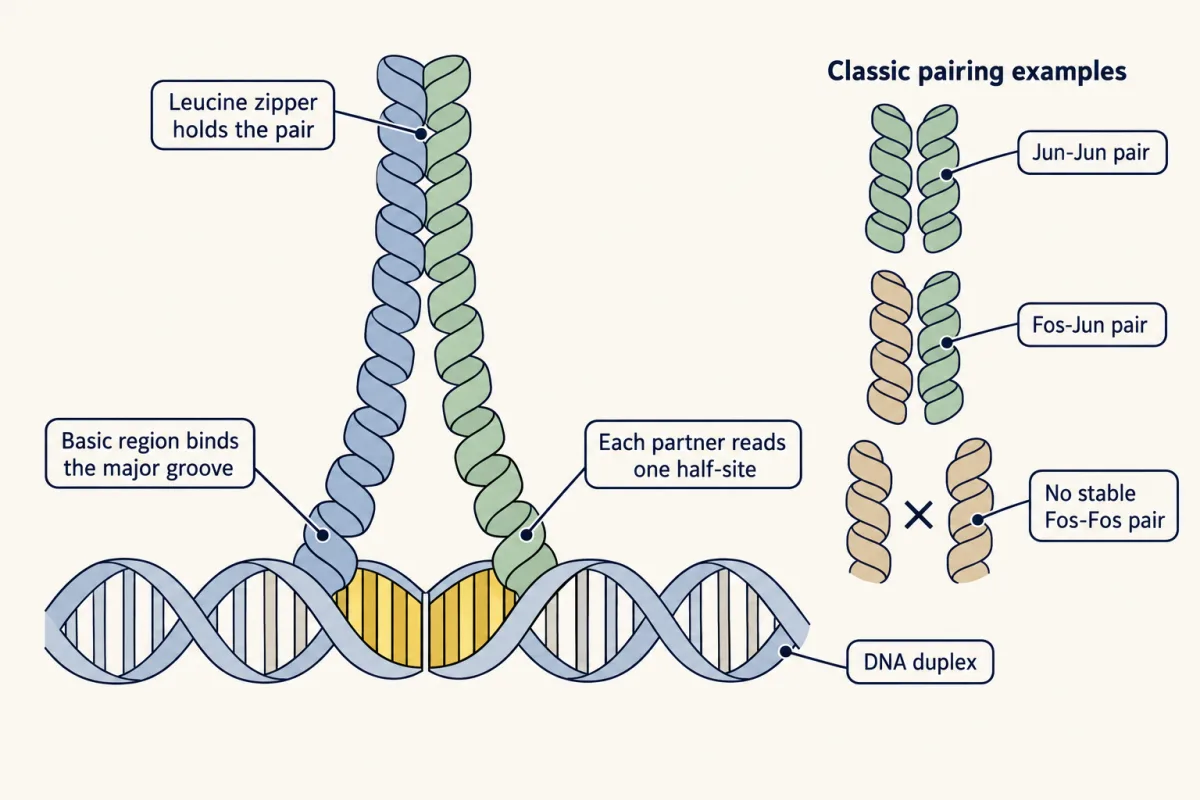
A bZIP factor works as a pair. The leucine zipper holds two proteins together at the top, and their basic stretches part like chopsticks to read half of a DNA site each. Fos needs a partner, classically a Jun, and a Fos-Jun pair holds DNA more tightly than a Jun-Jun pair. AI-generated illustration -
Calcineurin and NFAT: a phosphatase opens the door
-
The first genes to answer
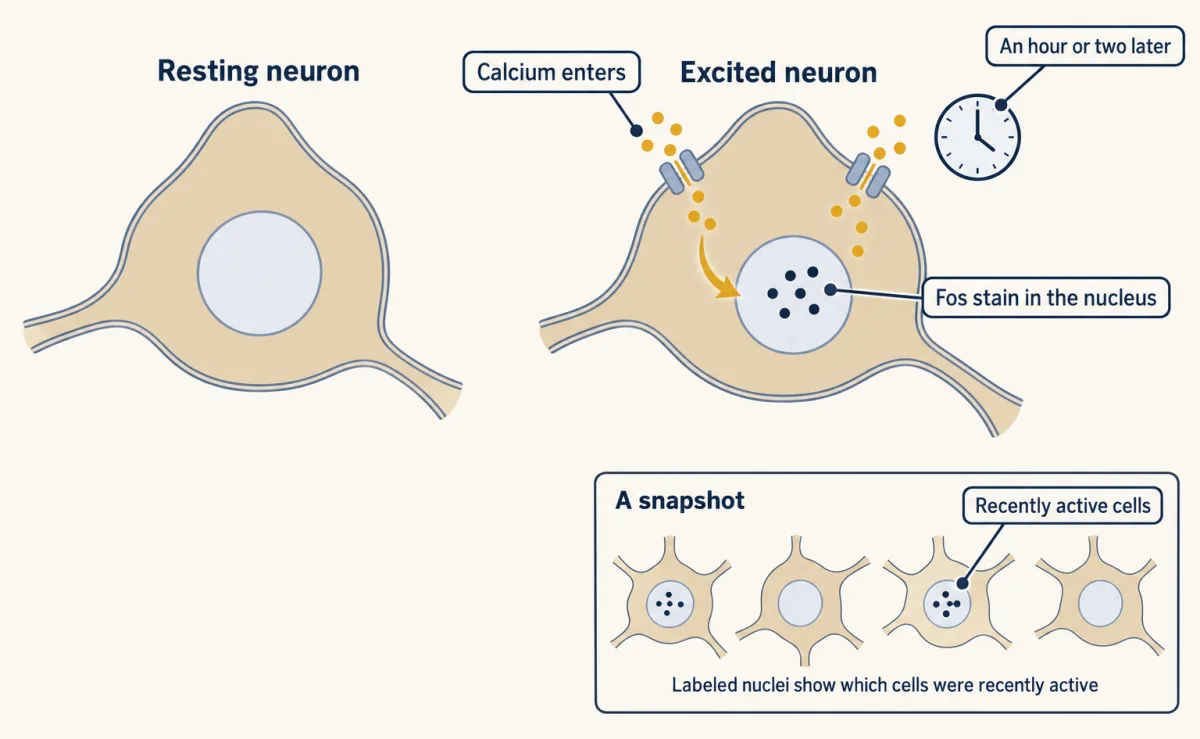
A resting neuron makes very little Fos. In a strongly excited neuron, calcium enters and the route to CREB switches on c-fos, and the Fos protein can be stained a few hours later. The stain is a snapshot, and a neuron can fire without making Fos. AI-generated illustration
Where this lesson fits
Before thisReview first
- cAMP and Protein Kinase AThis course · Lesson 13
PKA freed by cAMP is the kinase that puts the phosphate on CREB serine 133 here.
- Calcium: The Messenger Kept at Arm's LengthThis course · Lesson 15
Calcium-calmodulin, calcineurin and CaMKIV from there are the links between calcium and CREB or NFAT.
- Phosphorylation: Kinases and PhosphatasesThis course · Lesson 6
The add-a-phosphate and remove-a-phosphate switches used on CREB and NFAT are taught there.
After thisStudy next
- The Shape of a Signal: Size, Duration, Frequency and PlaceThis course · Lesson 35
Signal duration decides which immediate early genes a cell switches on, the point this lesson's two gene waves set up.
- Long-Distance Signaling in NeuronsThis course · Lesson 37
It extends how a signal at the axon tip reaches nuclear CREB to turn on genes.
- Stress Signals: p38 and JNK, p53, Unfolded Proteins and OxidantsThis course · Lesson 33
It follows other kinase routes to transcription factors such as AP-1 that act on the nucleus.
Suggested by an AI model from the lessons themselves, then checked. How we use AI