Cell Signaling · Skim version
Reverse Signaling: When the Ligand Is Also a Receptor
Read the full lesson → Skim the whole course →
The guiding idea
When a receptor grips a ligand that is stuck to another cell, which cell gets the message? Often both.
A ligand held in a cell's membrane can receive a signal as well as give one.
-
A curiosity: the ligand starts out as a large membrane protein
-
What is Reverse Signaling? Both cells get a message
-
Ephrins: a tail that borrows a kinase
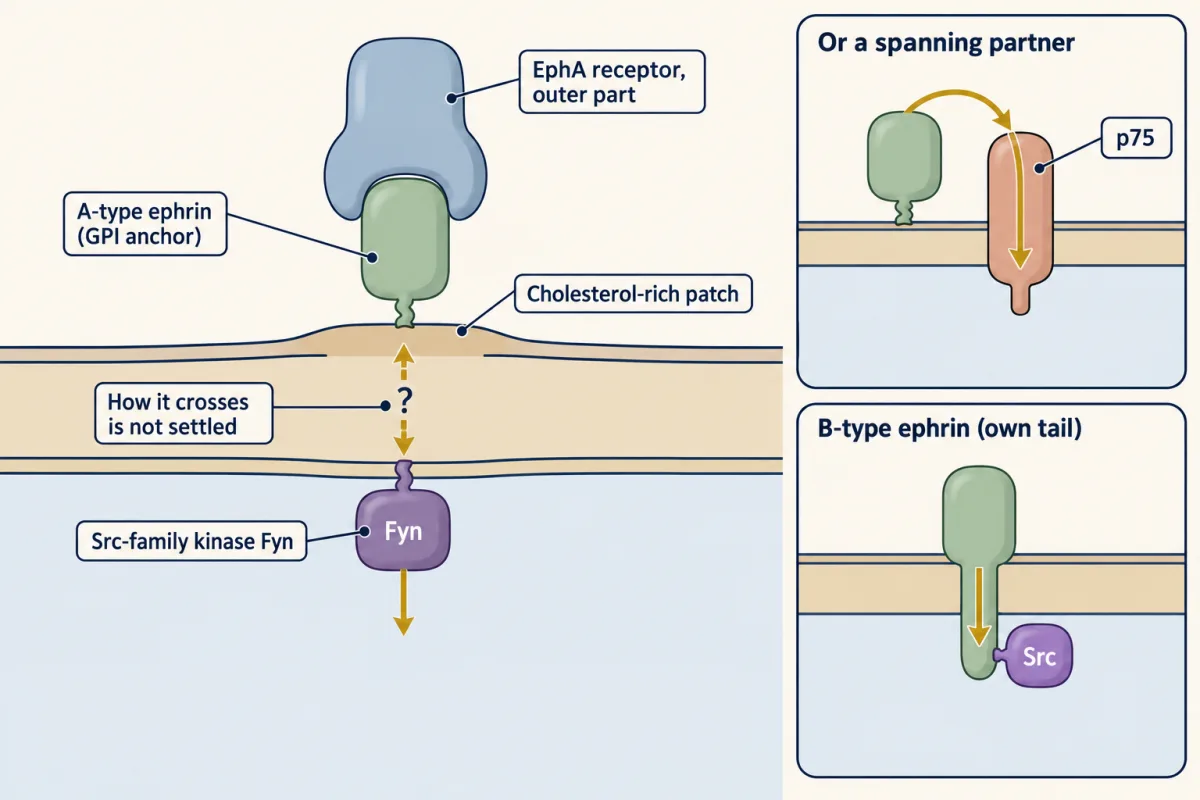
A-type ephrins have no cytosolic tail. Clustering ephrin-A can recruit Fyn, a Src-family kinase anchored to the inner membrane face, but how the signal crosses the bilayer is not settled. In retinal axons, the membrane-spanning partner p75 is required for ephrin-A reverse signaling and Fyn phosphorylation; the partners used depend on the cell. AI-generated illustration -
TNF and semaphorins: other ligands that listen
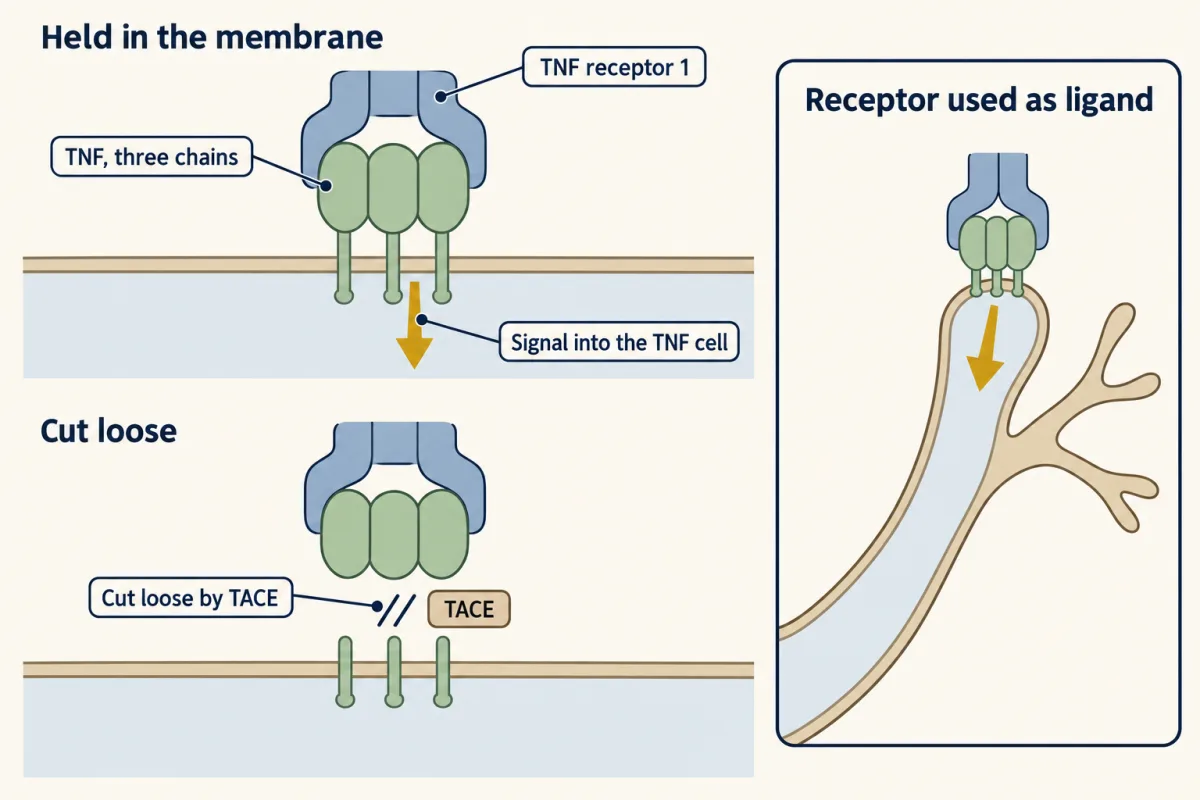
Uncut membrane TNF consists of three chains, each with a short cytosolic tail. Binding by a TNF receptor on another cell can send a reverse signal into the TNF-bearing cell. TACE cleavage releases the extracellular TNF trimer, breaking that connection to the producing cell; the membrane stubs are not intact TNF receptors. Released TNF can still act as a ligand for TNF receptors. AI-generated illustration -
Reading a knockout: which direction did you remove?
-
Going deeper
Where this lesson fits
Before thisReview first
- Protein Modules: SH2, SH3, PTB, PDZ and PHThis course · Lesson 9
The ephrin tail signals through PDZ and SH2 readers, which that lesson explains in detail.
- Lipids as Anchors and AddressesThis course · Lesson 11
You need to know how GPI anchors and lipid patches hold proteins in the outer leaflet to follow ephrin-A.
- Phosphorylation: Kinases and PhosphatasesThis course · Lesson 6
Reverse signaling through ephrin tails rests on Src-family kinases and phosphatases adding and removing phosphates.
After thisStudy next
- How Signaling EvolvedThis course · Lesson 40
It takes up how receptor and ligand families like Eph and ephrin arose and were reused.
Elsewhere on the siteFilms, simulations and method films in other courses
- A Rank Against a SlopeFilm · Developmental Neuroscience
Eph receptors and ephrin gradients are shown steering axons, the forward half of the signal studied here.
- The Cue Marks the PlaceFilm · Developmental Neuroscience
Semaphorins and their repulsive cues are introduced there, including the family whose transmembrane member signals back into its own cell.
- There, but Not WorkingFilm · Developmental Neuroscience
Contact-dependent adhesion molecules on opposing cells can signal into both cells, as in this lesson's two-way grip.
Suggested by an AI model from the lessons themselves, then checked. How we use AI