Neuroscience · Skim version
The Resting Membrane and Passive Signals
Read the full lesson → Skim the whole course →
The guiding idea
In a resting neuron potassium leaks out and sodium leaks in all the time. Why does the voltage hold still?
A neuron rests where its leaks balance, the conductance-weighted average of the ions' equilibrium potentials, and the leak also sets how big, how fast and how far a small nudge goes.
From the film: The Standoff
- In the lesson's made-up neuron at rest, potassium and sodium currents are each about 200 pA but equal and opposite, so rest means zero net current, not zero current for each ion.
- An ion's current is its conductance times its driving force, the gap between the membrane voltage and that ion's equilibrium potential.
- Each ion's open channels pull the voltage toward that ion's equilibrium potential, and rest is where those pulls cancel.
From the film: Where the Leaks Balance
- Rest is the average of the ions' equilibrium potentials weighted by their conductances, so opening more of one ion's channels slides it toward that ion's equilibrium potential.
- The Goldman-Hodgkin-Katz equation writes the same zero-net-current condition in permeabilities and concentrations, and gives the same rest for the lesson's cell.
- Rest is a steady state kept up by the sodium-potassium pump, not an equilibrium, and with the pump's own current set aside it is where the leaks balance.
From the film: A Nudge Takes Time
- Because the membrane stores charge like a capacitor, a step of current moves the voltage smoothly toward a plateau instead of making it jump.
- Input resistance is one over the total leak, and the time constant is capacitance divided by total leak, reaching about 63 percent of the change in one time constant.
- More leak means a smaller change reached sooner, and a longer time constant widens the window for temporal summation.
From the film: A Nudge Fades with Distance
- A steady input to a long, uniform passive cable falls off exponentially with distance, and about 37 percent remains one length constant away, so the length constant is a scale, not a cutoff.
- A leakier membrane or a narrower core shortens the length constant.
- More leak makes a cell faster, but its responses are smaller and reach less far.
From the film: Reading a Trace, Predicting a Drug
- For a compact passive cell, one current step gives input resistance (plateau divided by current), the time constant (time to 63 percent of the plateau) and capacitance (time constant divided by input resistance).
- An overshoot and sag, or a bent plot of plateau against current, means a conductance is changing with voltage, so a single resistor and capacitor fit will mislead.
- To predict a drug, ask which ion's conductance changed, which moves rest, and whether total conductance rose or fell, which moves input resistance and the time constant.
-
The standoff
-
Where the leaks balance
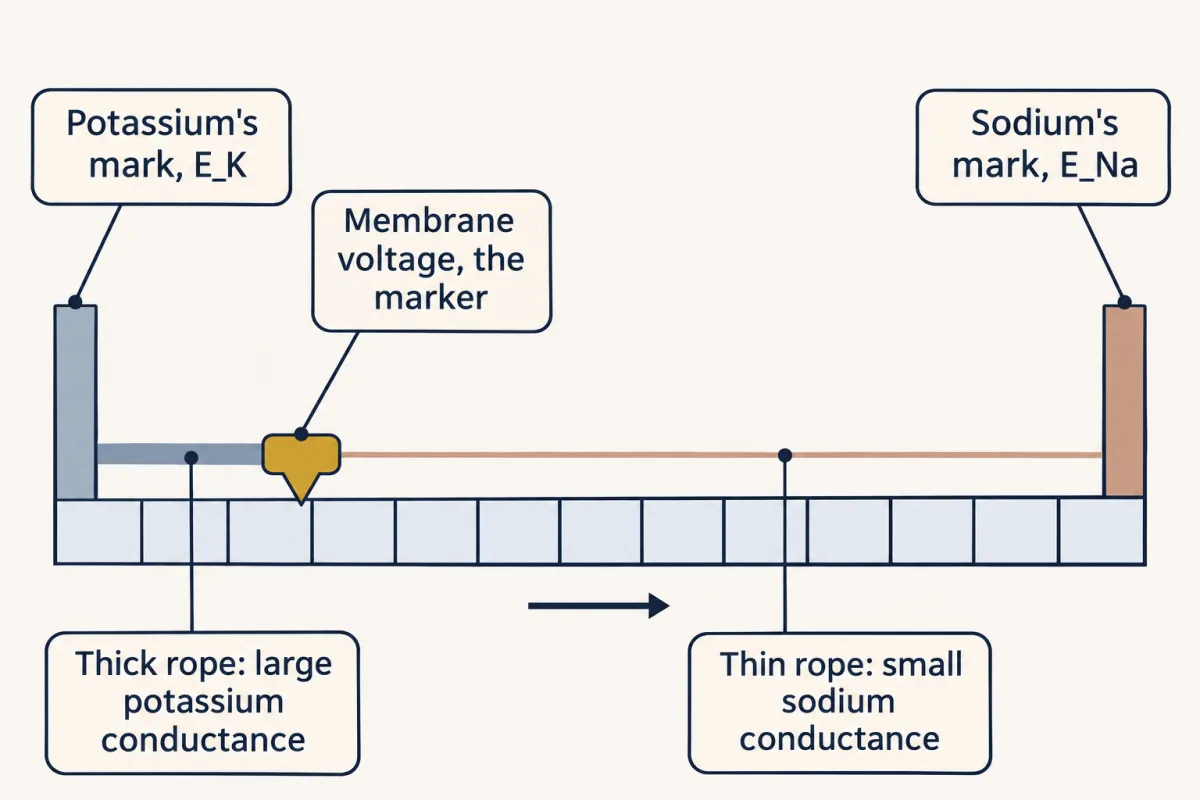
At rest the thick potassium rope outpulls the thin sodium rope, so the voltage settles near E_K, where the two pulls balance. AI-generated illustration -
A nudge takes time: the RC membrane
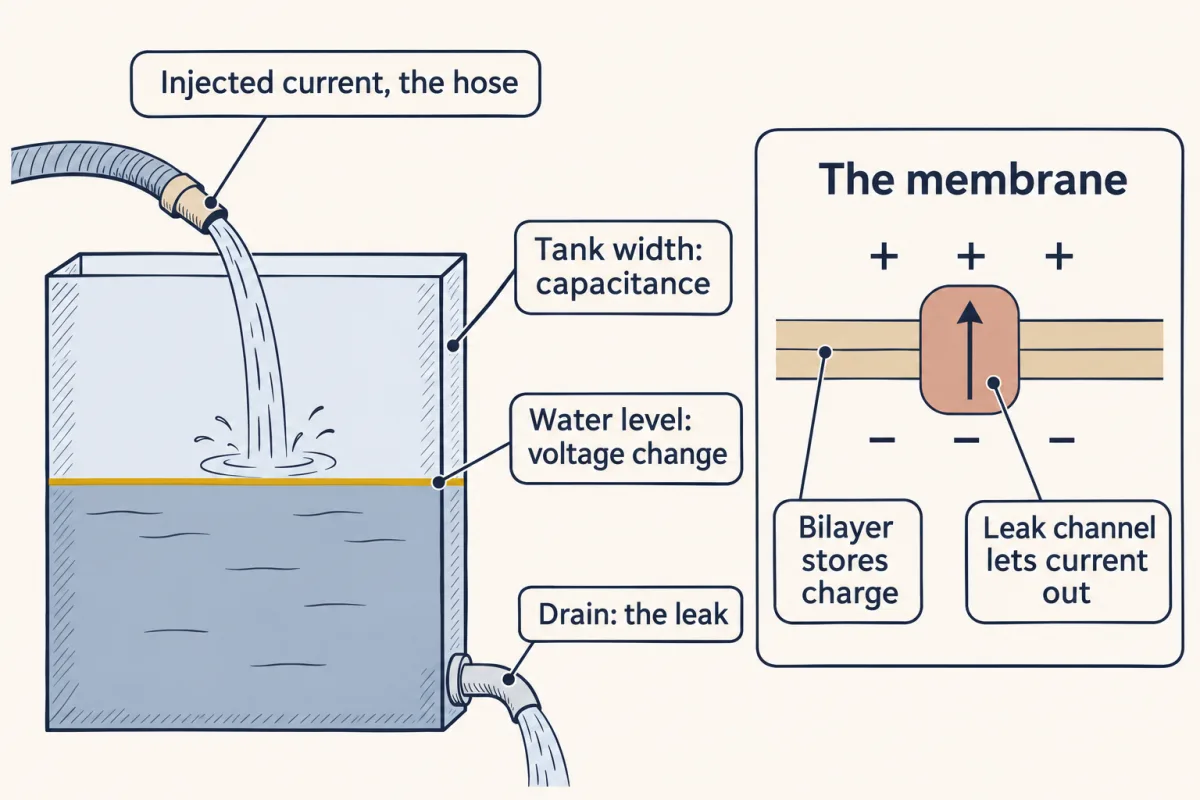
The membrane behaves like a tank with a drain: capacitance sets the tank's width, the leak sets the drain, and together they set how fast and how far the voltage moves when current is injected. AI-generated illustration -
A nudge fades with distance: the cable
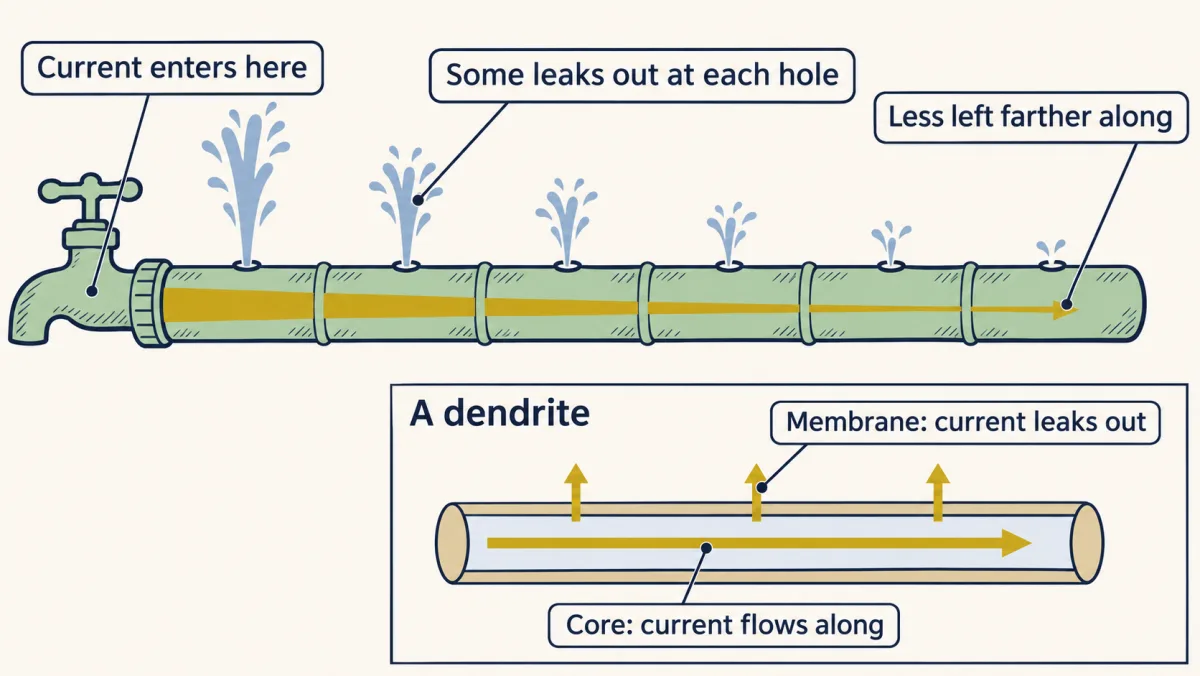
Like water in a leaky hose, current injected into a dendrite flows along the core and leaks out through the membrane, so less is left, and the steady voltage change is smaller, the farther along you go. AI-generated illustration -
Reading a trace and predicting a drug
-
Going deeper
Where this lesson fits
Before thisReview first
- Neurons and Glia at WorkThis course · Lesson 2
It introduces equilibrium potentials and how ion gradients shift E_K, which this lesson uses to compute driving forces.
- The Map: How the Nervous System Is OrganizedThis course · Lesson 1
It places the neuron in the nervous system, but it teaches no idea this lesson builds on.
After thisStudy next
- The Action Potential and ConductionThis course · Lesson 4
The action potential starts from the resting balance of leaks and adds voltage-gated conductances that change it.
- Integration, Inhibition and NeuromodulationThis course · Lesson 7
Summation and shunting inhibition rest on input resistance, time constant and length constant worked out here.
- Synaptic Transmission and Quantal ReleaseThis course · Lesson 5
Synaptic potentials are read as small passive voltage changes, whose size and decay follow from Rin and τ.
Elsewhere on the siteFilms, simulations and method films in other courses
- One channel, two numbersSimulation · Cell Biology
Its simulation shows how concentration difference and voltage together set an ion's net flow, the driving-force idea used here.
- Two Pushes, One HillFilm · Cell Biology
It shows that an ion feels both a concentration push and a voltage push, which is the driving force used here.
- Downhill for FreeFilm · Biology
It shows random molecular movement continuing at balance with no net flow, like the zero-net-current steady state of rest.
- Nernst calculatorSimulation · Cell Signaling
Its Nernst calculator lets you compute the equilibrium potentials used to find driving forces and rest.
Suggested by an AI model from the lessons themselves, then checked. How we use AI