Two Pushes, One Hill
Read the transcript of “Two Pushes, One Hill”
Film transcript: Two Pushes, One Hill
Why would potassium flow into a cell, against a 28-fold concentration difference? Take a cell with 140 mM K+ inside and 5 mM outside. Hold it at minus −70 mV and open potassium channels. Potassium leaves. Hold it at minus −100 and potassium comes in.
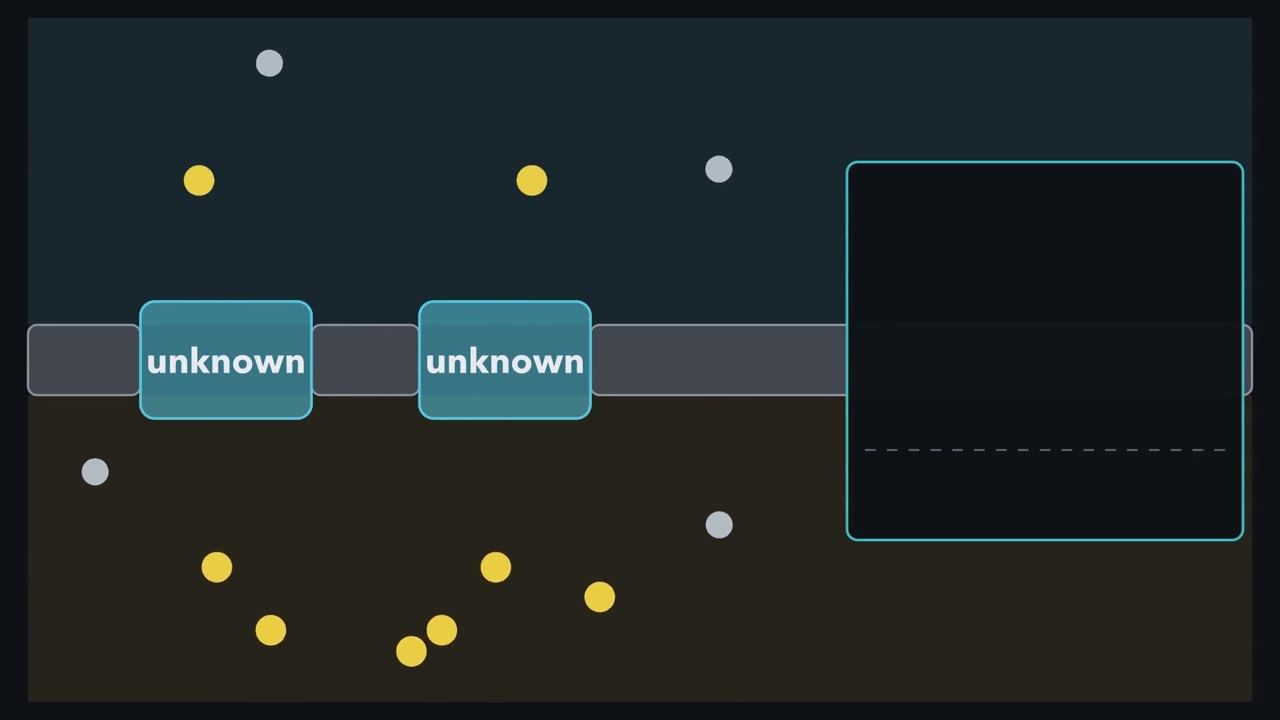
An ion feels two pushes. The first is concentration: potassium drifts from where it is crowded to where it is scarce. The second is voltage. The membrane potential, is the inside minus the outside, and a negative inside pulls positive ions in. Add the two pushes into one number. Picture the trip into the cell as a hill with two slopes. The concentration slope makes entering uphill. The voltage slope makes it downhill. Net flow always goes the way the total runs downhill. For each ion, one voltage makes the two slopes cancel. That is its equilibrium potential. For potassium, with these teaching values at 37 °C, the Nernst equation puts E_K at −89.1 mV. There, ions still cross, but equal numbers go each way.
So compare the voltage with that green mark. At minus −70 mV, which way does potassium go? And at minus −100 Decide before the picture moves. Minus −70 sits above the green mark. The voltage slope is shallower than the concentration slope, so entering is uphill, and potassium leaves. Minus −100 sits below it. Entering is downhill, so potassium comes in. That is the rule for passive flow. Find the equilibrium potential, then compare Vm with it. For a positive ion, Vm above the mark sends net flow out. Below the mark, net flow goes in. For a negative ion, the rule flips. The channel did the same thing in both cases. It opened a path, and it chose which ion could use it, and how fast.
The slopes chose the direction. Channels and passive carriers never decide which way. How does a cell move anything uphill? It couples that trip to one running further downhill. The sodium pump splits ATP to push 3 Na+ out and bring 2 K+ in. Then SGLT1 lets 2 Na+ run downhill into the cell, and that run pays for glucose to climb. Every crossing follows the same hill. A channel or passive carrier only opens the way. Add up the slopes of everything that moves together, and the total must run downhill.
Which way will potassium flow if you hold a cell at −70 millivolts? Its concentrations alone will not tell you.
Continue in the lesson: Transport Across Membranes →
3:18 · Free, with captions and a transcript. The lesson has the full text, the questions and the sources.
More films from this lesson
How this film was made. Narration: written from this lesson's text and read by an AI narrator voice (Kokoro, af_heart). Animation: AI-generated in code (Manim) by Claude, a schematic with no drawn molecular structures. Captions come from the narration script. See something wrong? Report it.