Physiology · Skim version
Resistance, Compliance and Local Blood Flow
Read the full lesson → Skim the whole course →
The guiding idea
In the muscle of an anesthetized cat, only about 15 percent of arterial pressure is spent crossing the capillary bed. So where does the rest go?
The heart and the reflexes hold arterial pressure nearly steady, and each tissue claims its share of cardiac output by setting the resistance of its own arterioles.
-
Where the pressure goes
-
Beds in parallel share one pressure
-
Tissues set their own flow
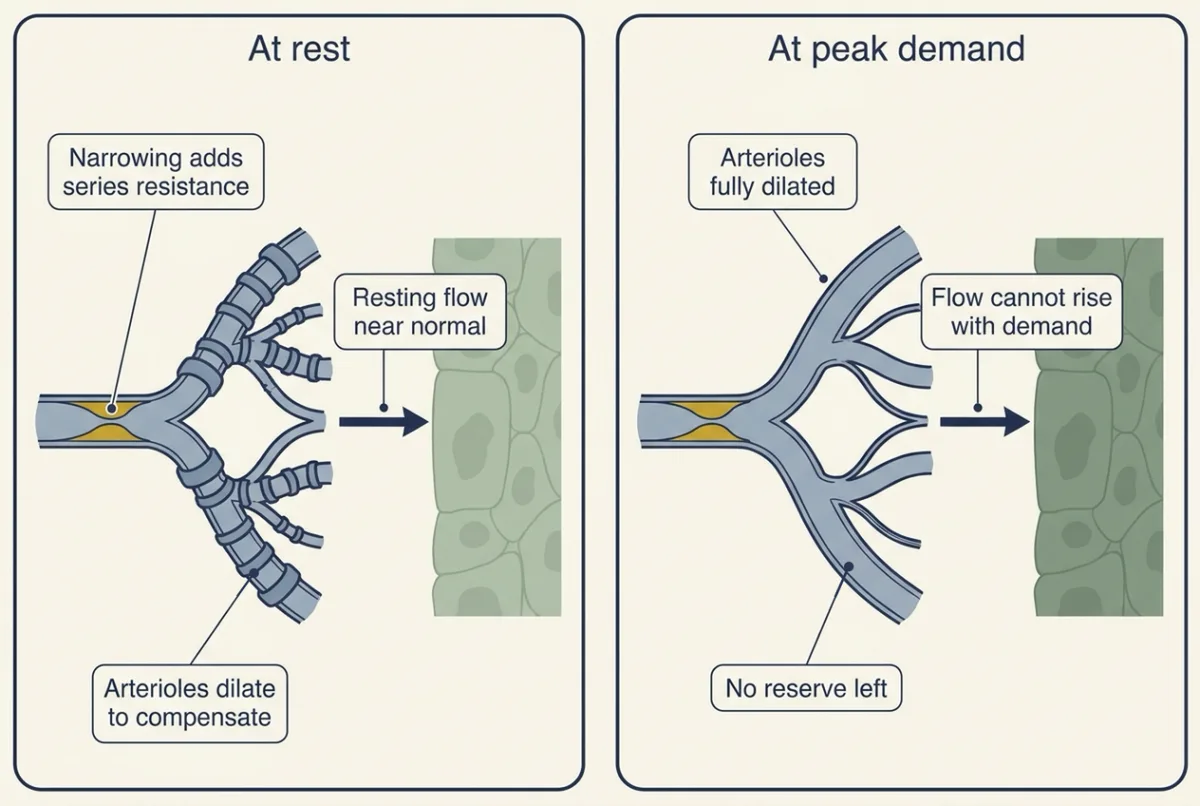
Past a narrowing, the arterioles dilate to hold resting flow near normal, but they have spent part of their reserve: at peak demand they reach full dilation sooner, and from then on flow follows pressure instead of demand. AI-generated illustration -
Who turns the tap: four circulations
-
Compliance: the pulse the rule leaves out
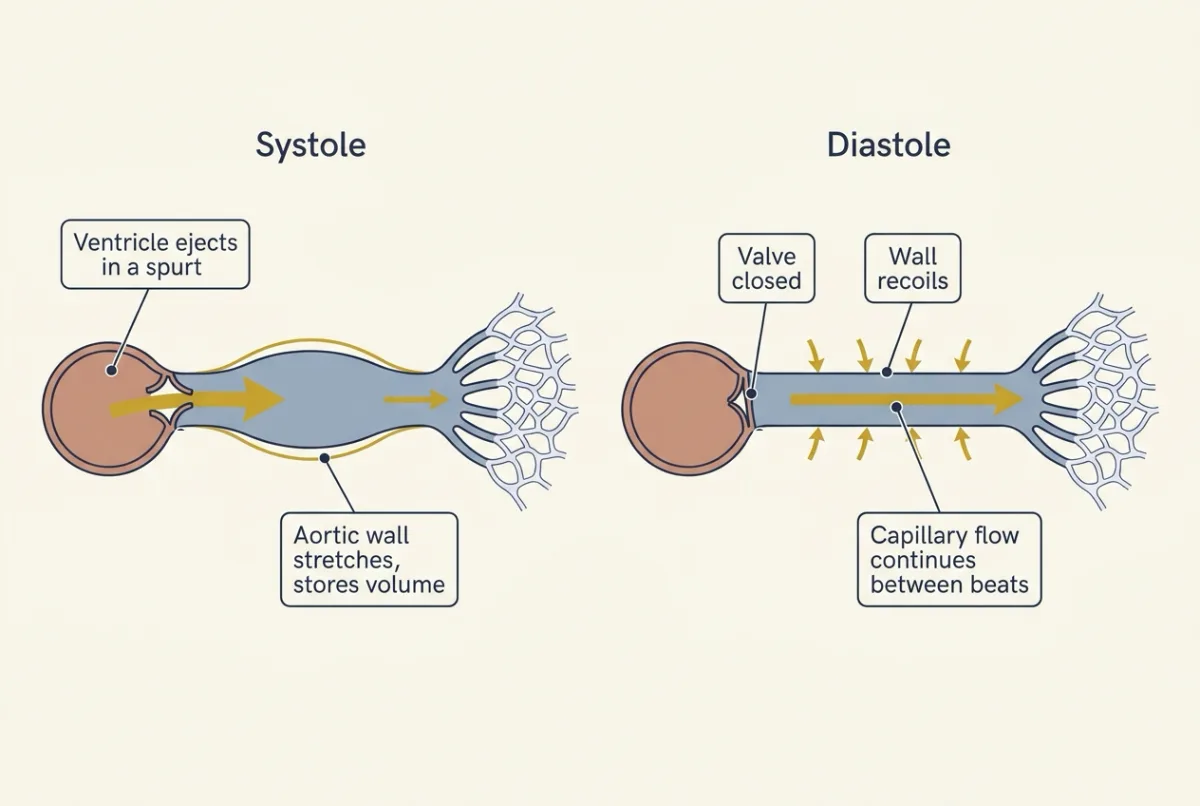
The arteries are stretchy: in systole they take up part of each stroke volume by stretching, and in diastole they recoil and keep blood flowing through the capillaries between beats, Frank's Windkessel. AI-generated illustration -
Going deeper
Where this lesson fits
Before thisReview first
- Cardiac Output and Venous ReturnThis course · Lesson 7
You need cardiac output and the pressure it works against to calculate total peripheral resistance here.
- The Cardiac Cycle and Pressure-Volume LoopsThis course · Lesson 6
Stroke volume and the pressure it produces during each beat are used here to estimate arterial compliance.
- Smooth Muscle and the Myogenic ResponseThis course · Lesson 4
The myogenic response of small arteries to stretch is used here to explain autoregulation.
After thisStudy next
- Capillary Exchange, Lymph and EdemaThis course · Lesson 9
It takes up the capillary bed, where arteriolar resistance sets the pressure that drives filtration.
- Regulating Arterial PressureThis course · Lesson 10
It shows how reflexes and kidneys defend the mean arterial pressure this lesson assumes is held steady.
- Exercise: The Whole Body at WorkThis course · Lesson 30
It applies muscle arteriolar dilation and redistribution of output to the whole body at work.
Elsewhere on the siteFilms, simulations and method films in other courses
- Starling forces along a capillarySimulation · Organismal Biology
Flow equals pressure difference over resistance there, the same relation used here to find where pressure falls.
- Downhill in PressureFilm · Organismal Biology
It shows flow as pressure difference divided by resistance, the relation used here to locate resistance.
- One Flow, Two PressuresFilm · Organismal Biology
It shows both sides of the heart pumping the same flow around two circuits in turn.
Suggested by an AI model from the lessons themselves, then checked. How we use AI