One Flow, Two Pressures
Read the transcript of “One Flow, Two Pressures”
Film transcript: One Flow, Two Pressures
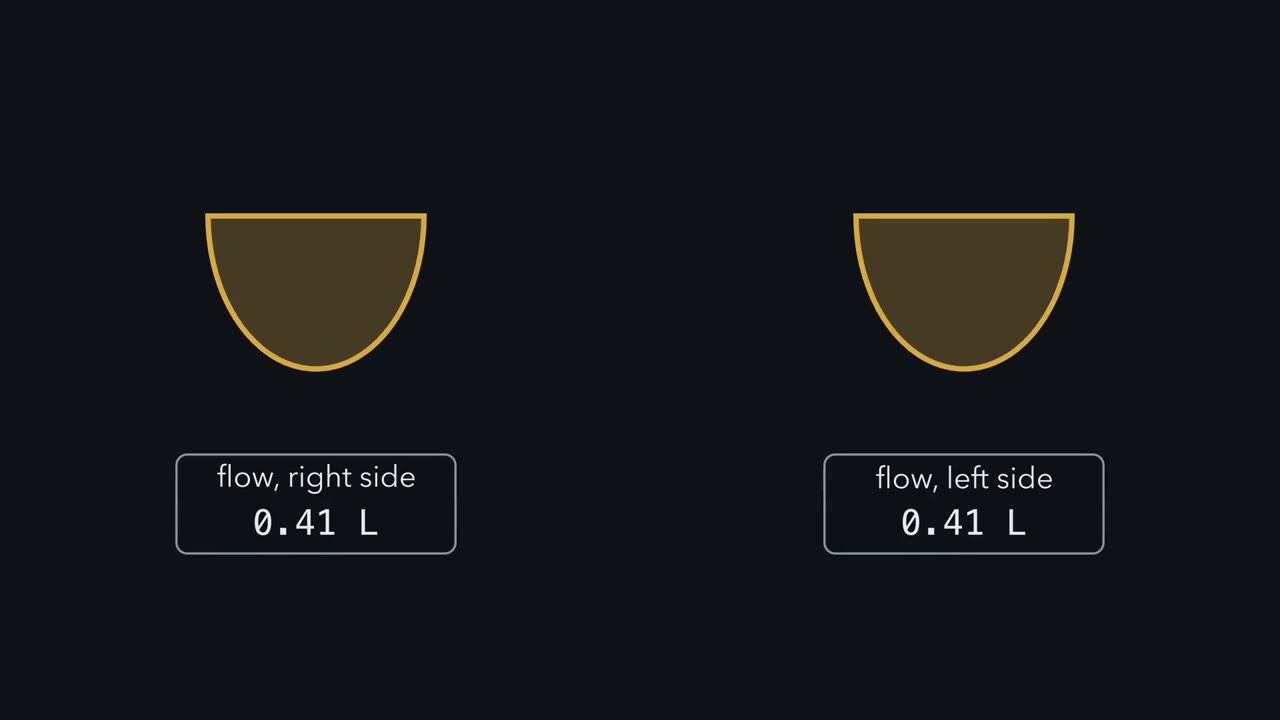
Both sides of your heart pump the same flow of blood every minute. So why does the left side push so much harder than the right? Start with flow. Flow is the volume of blood moved each minute. One ventricle's flow is its heart rate times its stroke volume, the blood it ejects with each beat. Now follow the loop. The right ventricle sends oxygen-poor blood through the lungs. It comes back oxygen-rich to the left side, which sends it through the body. The two sides pump one after the other, in series.
Blood leaving one side must pass through the other before it comes back. So over time, their average flows must be equal. Now draw pressure as height. Each ventricle is a lift that raises blood up. Then blood rolls downhill through its circuit, from high pressure to low. Some circuits are harder to push through. Narrow vessels resist the flow, like a narrow pipe. Call that resistance. The pressure drop across a circuit equals the flow times its resistance. The lungs resist the flow only a little. So the right ventricle needs only a small lift to drive the whole flow through them. The body's circuit resists far more. So the left ventricle must lift the same flow much higher, to drive it down that long, narrow slope.
Same flow, different costs. At the same flow, the circuit with more resistance needs the bigger pressure drop. Two separate pumps let each circuit get its own pressure. One caution. This rule is bookkeeping on averages over many beats. In a living body, the heart and the vessels set the flow together. Now a heart with one pump. A teleost fish, such as a trout, has one ventricle. It drives blood through its narrow gill capillaries first, then on to the body. Here is the question. Blood leaves the gills and reaches the body. Is its pressure the same as the ventricle made, higher, or lower?
Lower. The gill capillaries resist the flow, so part of the pressure is spent there. The body is supplied with only what is left. Birds and mammals avoid that trade. They have two pumps. The lungs run at low pressure and the body at high pressure. Both carry the full flow. One flow, two costs. Both sides move the same blood. The harder circuit, the body's, takes the bigger pressure drop.
An adult human holds about 5 litres of blood, yet at rest each side of the heart pumps about that much every minute. Where does it all go?
Continue in the lesson: Circulation and the Heart →
3:07 · Free, with captions and a transcript. The lesson has the full text, the questions and the sources.
More films from this lesson
How this film was made. Narration: written from this lesson's text and read by an AI narrator voice (Kokoro, af_heart). Animation: AI-generated in code (Manim) by Claude, a schematic with no drawn molecular structures. Captions come from the narration script. See something wrong? Report it.