Downhill in Pressure
Read the transcript of “Downhill in Pressure”
Film transcript: Downhill in Pressure
Blood moves fastest in your widest artery and slowest in your narrowest vessels. How can narrower mean slower? A single river channel does the opposite. Where its cross-section shrinks, the same water has to speed up. Start with what makes blood flow along a vessel. In a level tube, fluid flows only from higher pressure to lower pressure. Equal pressure at both ends drives no flow, however high that pressure is. How much flows depends on two things. One is the pressure difference between the ends. The other is the resistance in the way. Flow equals the pressure difference divided by the resistance. Now lay out the whole circulation as one branching tree.
The aorta splits into arteries, then arterioles, then capillaries. The capillaries gather again into veins that return to the heart. Above the tree, follow the pressure. It falls all the way from the aorta to the heart's right atrium. It falls most steeply across the arterioles. Arterioles have walls of smooth muscle. When the muscle tightens, the arteriole narrows. In an ideal tube, resistance rises with the fourth power of a falling radius. A small squeeze makes a large change. So arterioles act like taps.
Nerves, hormones and local signals set their tone. Tightening one organ's arterioles cuts that organ's share of the blood. But a capillary is narrower than a typical arteriole. On its own, it can resist more. So which level sets most of the resistance?
The arterioles. Most capillaries are not lined up in a chain. They lie side by side, in huge numbers. Side by side, paths share the flow, so together they resist less. Now return to speed. In this simplified tree at steady state, no blood bypasses the capillaries. So the same flow crosses every level.
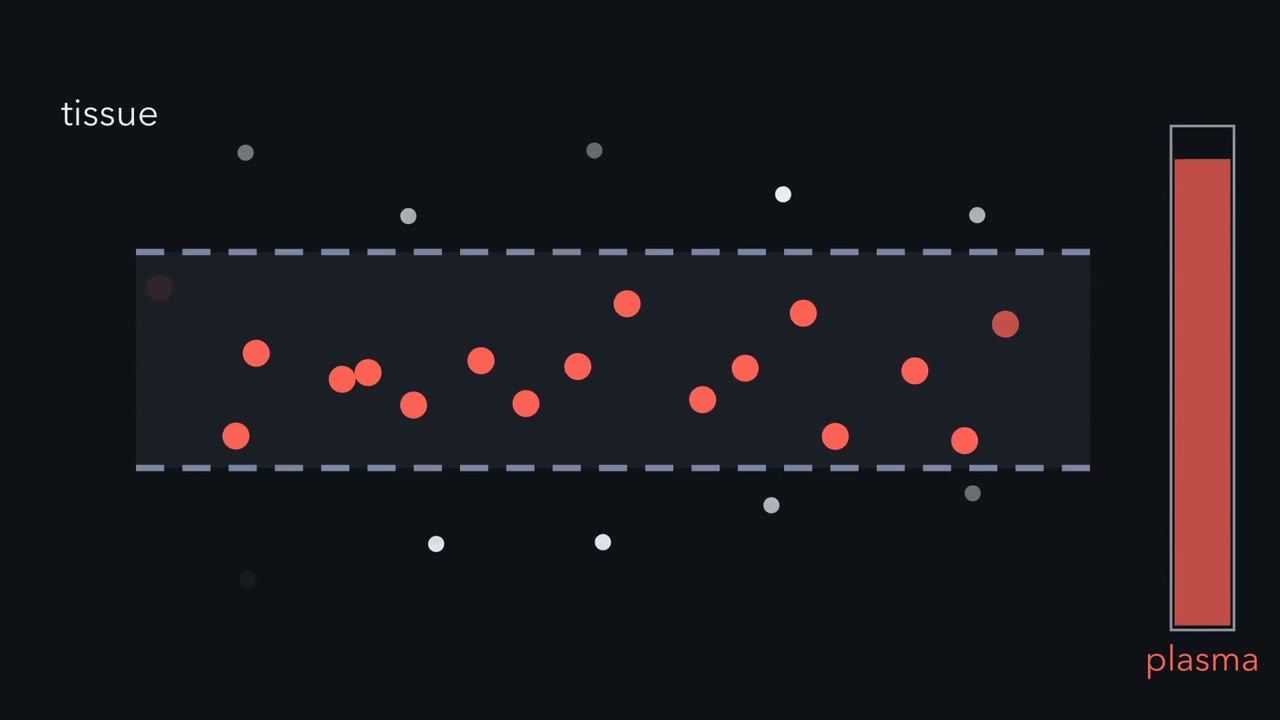
Speed is that flow divided by the total cross-section at each level. Each capillary is tiny. But together their cross-section far exceeds the aorta's. Spread the same flow over that huge area, and it has to move slowly. That is why blood creeps through the capillaries, the narrowest vessels of all. So narrow does not, by itself, mean slow. A single narrow tube carrying the whole flow would speed blood up. What matters is the total area at each level. That slow passage gives blood time to trade with the tissues. And fluid crossing the capillary wall obeys the same rule: a pressure difference over a resistance.
Blood moves slowest in the narrowest vessels in your body. How can narrower mean slower?
Continue in the lesson: Blood Vessels, Blood and Lymph →
3:21 · Free, with captions and a transcript. The lesson has the full text, the questions and the sources.
More films from this lesson
How this film was made. Narration: written from this lesson's text and read by an AI narrator voice (Kokoro, af_heart). Animation: AI-generated in code (Manim) by Claude, a schematic with no drawn molecular structures. Captions come from the narration script. See something wrong? Report it.