Ecology and Evolution · Skim version
Reading Phylogenetic Trees
Read the full lesson → Skim the whole course →
The guiding idea
Is a trout more closely related to a shark, or to you?
On a phylogenetic tree, relatedness lives at the nodes and change lives on the branches: a trout is closer kin to you than to a shark because the ancestor it shares with you descends from, and so is more recent than, the one it shares with a shark.
From the film: Relatedness Lives at the Nodes
- Each internal node on a tree is an inferred common ancestor of every lineage descending from it.
- Two tips are more closely related the more recent the common ancestor they share.
- A trout shares a more recent ancestor with you than with a shark, so it is closer kin to you.
- Spinning the branches at a node changes the drawing, not the relationships.
- No living tip is more evolved than another: every lineage has had the same time since the root.
From the film: Change Lives on the Branches
- Characters change state along branches, and the outgroup's state is taken as the starting point.
- Jaws need only one gain, on the branch from the root to node J, so on this mapping jaws in sharks and humans are homologous.
- Two taxa share a state by homology when both inherit it from one gain on a shared branch; other lineages may later lose it. Separate gains are convergence.
- Parsimony prefers the mapping with the fewest changes, and two mappings can tie.
- A tie means parsimony alone cannot tell homology from convergence, so more evidence is needed.
-
The parts of a tree
-
Reading relatedness from the MRCA
-
Characters on branches: shared derived and shared ancestral
-
How trees are built and how confident to be
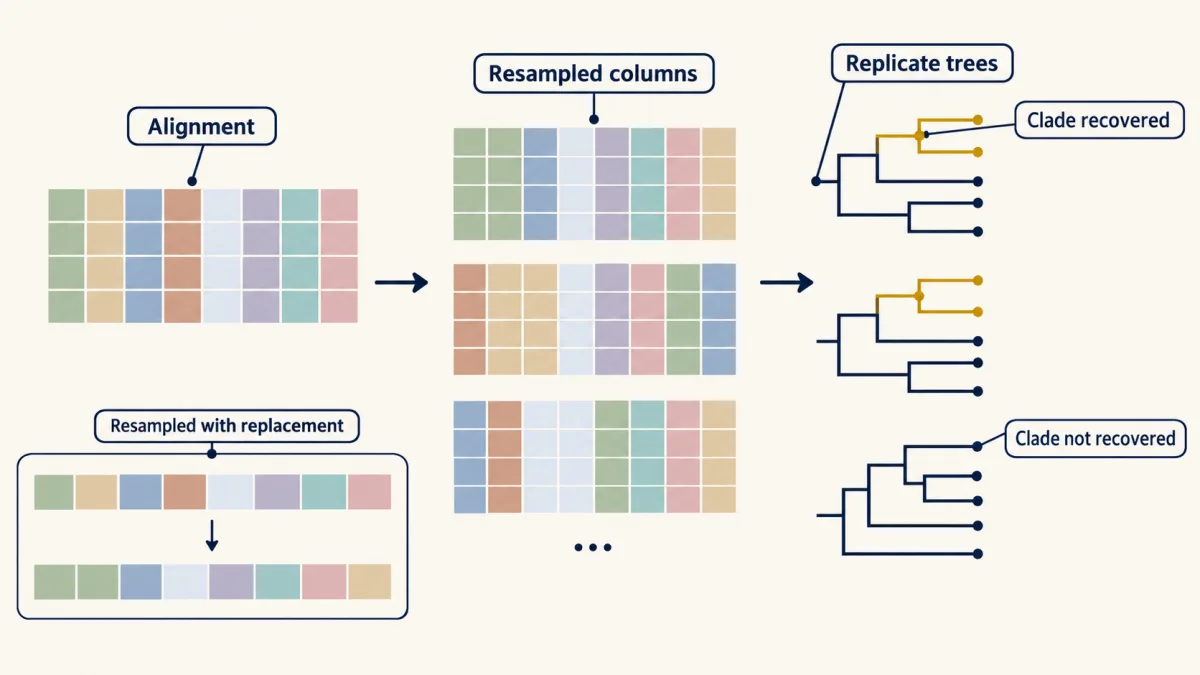
In a bootstrap, the alignment's columns are resampled with replacement to make many replicate data sets of the same size, and a tree is inferred from each. A clade's support is the percentage of replicate trees that contain it, which is not the probability that the clade is true. AI-generated illustration -
Going deeper
Where this lesson fits
Before thisReview first
- How to Test an Evolutionary ExplanationThis course · Lesson 1
A tree is a hypothesis that can be tested and overturned, which is how this lesson treats it.
After thisStudy next
- Molecular EvolutionThis course · Lesson 5
It turns branch lengths into dates with a molecular clock, which this lesson only mentions.
- Speciation: How Barriers to Gene Flow EvolveThis course · Lesson 7
It explains how lineages split, producing the nodes and sister groups you learned to read here.
- History of Life: Transitions, Extinctions and RadiationsThis course · Lesson 8
It uses trees to place radiations and extinctions in time across the history of life.
Elsewhere on the siteFilms, simulations and method films in other courses
- Build a cladogramSimulation · Biology
You can build a cladogram yourself from shared derived traits and see how branch points are chosen.
- Which Similarities Reveal Relatives?Film · Biology
It shows how shared derived traits locate closest relatives, as a whale's kinship to land mammals does.
Suggested by an AI model from the lessons themselves, then checked. How we use AI