Biochemistry · Cellular Respiration
The Proton-Motive Force and ATP Synthase
Rewritten on : new film. Your notes and highlights stay, but the text around them may have moved.
Electron transport and ATP synthesis are one coupled machine: the chain pumps protons into a gradient, and protons falling back through ATP synthase turn a rotary motor that makes ATP.
The main idea, the figures and what the films show. Under each heading, "Read this part" opens it.
Both films in order, 6 minutes.
The whole lesson: about 27 minutes of reading and 6 of film.
Pause when the reading reaches a film, and offer to play it. Saved on this device.
Watch the film now, or keep listening
That is the end of the reading
This idea at other levels
This lesson teaches chemiosmosis in Biochemistry, an upper-level college course. Simpler: read a short high school version here.
The high school version · about 1 minute to read
The electron transport chain uses the energy from food to pump protons (H⁺) across the inner mitochondrial membrane, building a gradient like water behind a dam. ATP synthase is a real spinning motor: protons flow back through it, turning a shaft that forces ADP and phosphate together into ATP. Block the proton flow and ATP stops; poke a leak (an uncoupler) and the energy comes out as heat. This whole setup, chemiosmosis, makes most of the ~30 ATP you get from one glucose.
See nearby ideasHide nearby ideas
Chemiosmosis (the proton gradient that makes ATP)
Electron flow pumps protons across a membrane, and protons flowing back through ATP synthase make ATP.
Taught at one level so far: upper-level college.
College, upper level · the level you chose
Oxidative Phosphorylation: The Electron-Transport Chain
Block ATP synthase and oxygen use stops; add an uncoupler and it speeds up.
Biochemistry · about 24 min · film 3:54 · 5 practice questions
The Proton-Motive Force and ATP Synthase · this lesson
ATP synthase is a rotary motor: 8 protons and three ATP per turn.
Biochemistry · about 27 min · film 2:53 · 7 practice questions
Next door to chemiosmosis
- Electrochemical gradient (Nernst potential)The proton gradient is a concentration difference plus a voltage, pushing protons through ATP synthase.Nearest lesson: Transport Across Membranes (college core)
- Endosymbiosis: where mitochondria and chloroplasts came fromMitochondria make ATP this way because they began as bacteria that did it first.Nearest lesson: Organelles as Distinct Environments (college core)
Short versions inside this lesson
The graduate version · about 1 minute to read
Mitchell's chemiosmotic coupling reframed oxidative phosphorylation as a transmembrane electrochemical proton potential doing work, with ΔΨ typically dominating Δp in actively respiring mitochondria. F1Fo is a two-stroke rotary engine. Proton transfer through the staggered a-subunit half-channels onto the c-ring carboxylate ratchets the rotor, driving γ against the α3β3 stator; the bent γ's asymmetry then enforces sequential O→L→T occupancy. The major energy-requiring step is release of tightly bound ATP, not bond formation. The asymmetric 1BMF crystal (Walker) supports the three-state cycle, single-molecule assays show rotation directly (Noji/Yoshida), and forcing γ to turn mechanically makes ATP (Itoh 2004). Stoichiometry is set by c-ring number (species-variable 8–17), the electrogenic ANT exchange, and the symporting Pi carrier; integrated flux is governed by Δp-dependent respiratory control, IF1 gating, and regulated uncoupling (UCP1). Pathology tracks heteroplasmic mtDNA load with tissue thresholds (LHON ND4, usually homoplasmic, is an exception).
The plainest version · about 1 minute to read
Your cells build a wall of water and then let it pour over a tiny waterwheel. The waterwheel spins and makes little energy batteries called ATP. The 'water' is really crowded bits called protons. Push them to one side, let them rush back, and the spinning wheel packs your energy. If you poke a hole in the wall so the water just leaks out, the wheel stops making batteries and your body uses the leak to stay warm instead.
Find an idea: every idea, searchable
Which lessons teach an idea, and the notes on each level, were written by AI models from the lessons and checked by a second model. A person has not yet read every one. How we use AI
About this lesson goals, parts
What you'll learn
- Write the proton-motive force Δp as the sum of an electrical term (ΔΨ) and a chemical term (ΔpH), and explain why both the electrical (ΔΨ, ~0.15 V, matrix negative) and chemical (~0.5–1 pH unit) components matter — students who drop ΔΨ lose the larger part of the energy.
- Explain chemiosmotic coupling: how the proton gradient links electron flow to ATP synthesis so that blocking one (cyanide or oligomycin) stops or sharply slows the other, and cite the Racker-Stoeckenius reconstitution and Jagendorf acid-bath experiments as the proof (Mitchell's 1961 proposal is context).
- Describe ATP synthase as a real rotary motor — Fo c-ring rotor + a-subunit half-channels, F1 α3β3γ head — and walk Boyer's binding-change mechanism (O→L→T), explaining that energy is spent releasing tightly bound ATP, not forming it.
- Predict the effect of any ETC inhibitor, the ATP-synthase inhibitor oligomycin, or an uncoupler on three readouts (O2 consumption, ATP output, gradient size), and explain why oligomycin raises the gradient while uncouplers raise O2 consumption.
- Account for the ~30–32 ATP per glucose, justify why the number is approximate (shuttle choice and the proton tax on ATP export), and connect respiratory/acceptor control (ADP acting on the chain through the synthase and Δp) and energy charge (tuning fuel supply upstream) to the cell's real-time regulation of the rate.
Builds on:Oxidative Phosphorylation: The Electron-Transport Chain (read)Membranes: The Impermeable Sheet That Builds Itself (read)Metabolism: Basic Concepts and Design (read)Why these?
Rewritten on : new film. Notes and highlights stay, but the text around them may have moved.
The main idea. Electron transport and ATP synthesis are one coupled machine, joined by a proton gradient across the inner mitochondrial membrane.
The films
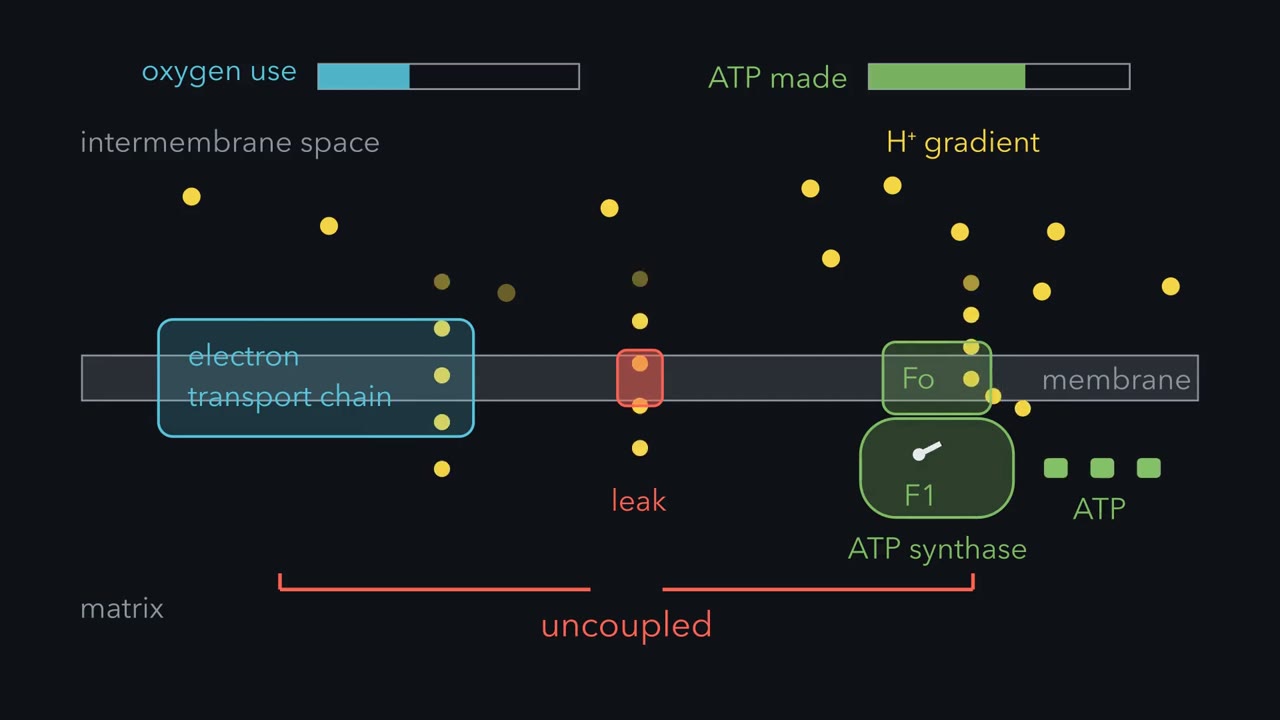 ▶ Watch Breaking the proton gradient · 2:53
Read the transcript of “Breaking the proton gradient”
Film transcript: Breaking the proton gradient
Picture the electron transport chain and ATP synthase as a couple in a committed relationship. Normally they are tightly coupled. The chain builds the proton gradient, and ATP synthase spends it to make ATP. Uncoupling is the breakup. Protons find another way back across the membrane instead of going through ATP synthase, so the energy of the gradient is released as heat rather than captured as ATP. The chain keeps pumping furiously, oxygen consumption climbs, but the partnership no longer produces anything useful. This table forces you to reason like the chain itself. An ETC inhibitor, such as rotenone or cyanide, shuts everything down. Oxygen consumption, ATP synthesis and the proton gradient all fall.
An ATP synthase inhibitor, oligomycin, blocks the exit for protons, so synthesis falls and consumption falls, but the gradient backs up and rises. The uncoupler is the counterintuitive case. ATP synthesis falls and the gradient collapses, yet oxygen consumption increases. Why? Because with the gradient leaking away, the chain races to rebuild it, pumping faster and burning more oxygen. If you can predict each row, you understand how coupling actually works. Electrons flow only slowly through the transport chain unless ADP is available to be turned into ATP. Watch the oxygen consumption trace, respiration idles until ADP is added, then the rate jumps, and it falls again once the supply of ADP is nearly exhausted. This is acceptor control, also called respiratory control, and it is the cell's way of matching fuel burning to demand.
ADP is the signal for need. When the cell has spent its ATP, the ADP it generates lifts the brake on the chain. This is a clean example of metabolism being governed by energy charge rather than by substrate alone. ATP synthase is reversible. During normal respiration, the proton gradient drives it forward to make ATP. But in ischemia or severe hypoxia, oxygen runs low, the chain stalls, and the gradient collapses. Now the enzyme can spin backward, hydrolyzing the cell's remaining ATP to hold up the gradient, spending precious energy exactly when it is scarcest. The inhibitory factor IF1 is the emergency brake. It binds at low pH, which marks oxygen deprivation, and blocks the reverse rotation, protecting cellular ATP.
Give isolated mitochondria ADP and they start using oxygen faster, though no part of the respiratory chain ever touches ADP.
The record comes from an oxygen electrode, a probe that tracks the oxygen left in a chamber of mitochondria. With fuel but no ADP, the oxygen line slopes down slowly. Add a little ADP and the slope steepens at once: State 3, respiration with ADP. When the ADP has all become ATP, the slope flattens again: State 4, respiration with the ADP used up. The chain burns oxygen; ATP synthase, a separate protein, uses ADP. How does the chain know there is ADP?
In the last chapter Complexes I, III and IV pumped protons out of the matrix, like water raised behind a dam. The water is the protons, its height is the proton-motive force, Δp, and the turbine is ATP synthase, a real rotary motor a few nanometers wide.
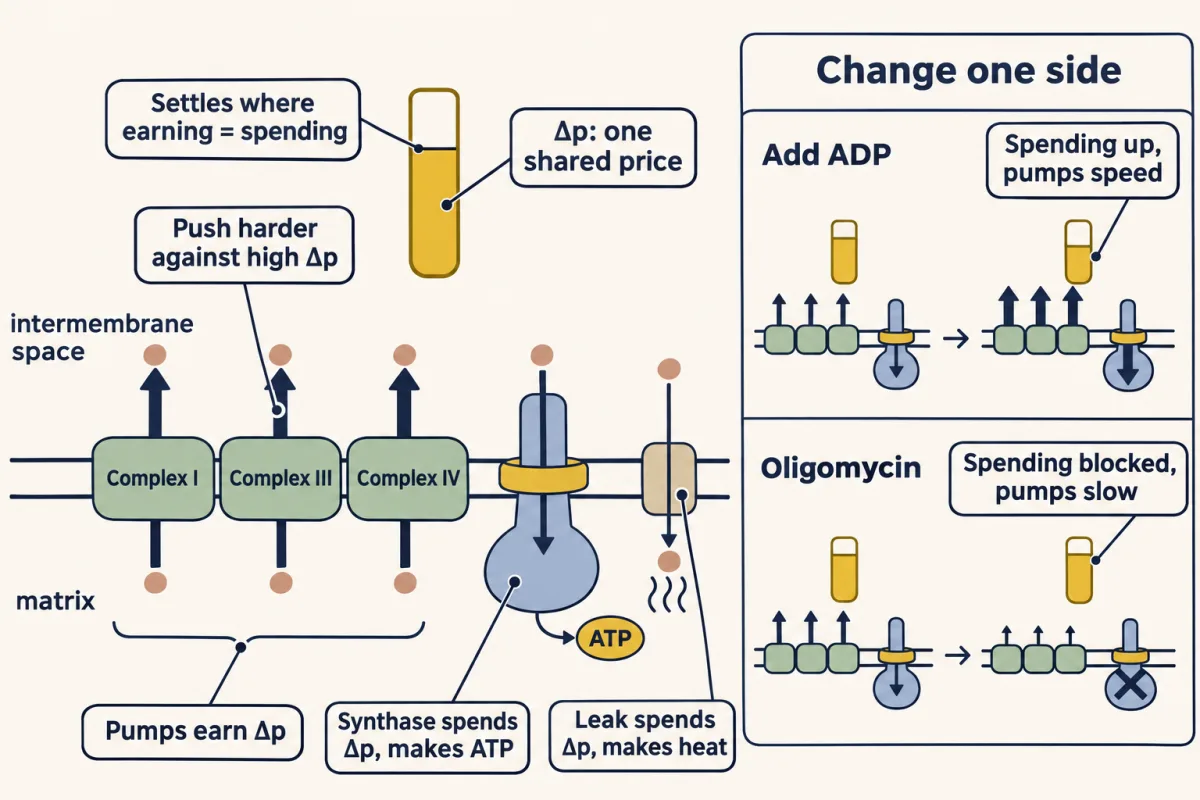
The one idea to carry through this lesson. Every proton that crosses the inner membrane is priced by one shared number, the proton-motive force Δp, worth about 19 kJ per mole of protons. The pumps earn Δp and must push against it, so they slow as it rises. ATP synthase and any leak spend it, and they speed up as it rises. Δp settles where earning equals spending. To predict any drug, disease or change in demand, ask which side it changed (earning, spending through the synthase, or spending through a leak), then follow Δp to the other side.
This holds for an intact, sealed inner membrane near steady state, where Δp is the only link between the chain and the synthase. It tells you which way each rate moves, not by how much. One exception: if the chain stops completely, the synthase can run backward (IF1, near the end).
The film above previews this lesson’s last section: coupling, the poisons, the oxygen trace and IF1.
How we know: a gradient alone makes ATP
In 1961 Peter Mitchell proposed that the energy linking electron flow to ATP synthesis is stored not in a high-energy chemical intermediate but in a proton gradient across a sealed membrane: the chemiosmotic hypothesis. Two kinds of experiment settled it.
Jagendorf and Uribe soaked chloroplast membranes in acid, then jumped them into base: a hand-built proton gradient, with no light and no electron transport. They made ATP in the dark. Racker and Stoeckenius rebuilt vesicles from only purified lipids, bacteriorhodopsin (a light-driven proton pump borrowed from a salt-loving microbe) and ATP synthase. Shine light, and the pump builds a gradient, the gradient drives the synthase, and ATP appears, with no respiratory chain anywhere. With many other results, these experiments won the argument, and in 1978 Mitchell the Nobel Prize.
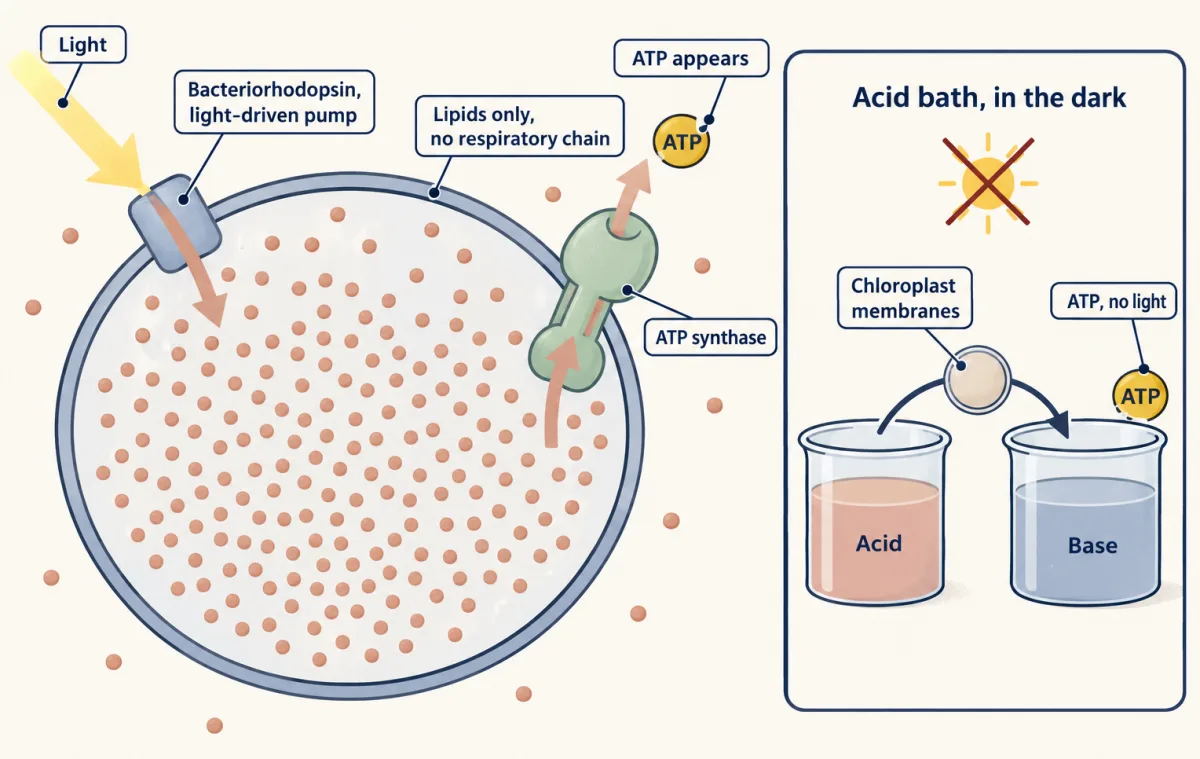
Predict. The lit vesicles are making ATP. Now add an uncoupler, a compound that carries protons straight back across the membrane. The light stays on. What happens to ATP synthesis?
Check your prediction
It stops, or nearly. The pump still earns, but the leak spends faster than the pump can rebuild, so the gradient collapses and the synthase has nothing to spend. Pump and synthase share nothing but the gradient.
What the dam stores: Δp, in one number
Two pulls draw a proton back into the matrix. The first is electrical: the pumps carry positive charge out, leaving the matrix about 150 mV negative, which attracts the positive protons back. This is the membrane potential, ΔΨ (“delta psi”). The second is chemical: the matrix is about 0.5 to 1 pH unit more alkaline, so protons are scarcer inside and drift in. The matrix is both negative and alkaline, so both pulls point inward.
But one is in millivolts and the other in pH units, and you cannot add 150 to 0.75. The bridge: at body temperature, a tenfold concentration difference, exactly one pH unit, pushes as hard as 61.5 mV (log scales).
In words The proton-motive force equals the size of the membrane potential, plus 61.5 millivolts for every pH unit of difference across the membrane.
- Δp“delta p”
- the proton-motive force: the total pull on a proton, in one unitmV
- ΔΨ“delta psi”
- the membrane potential; the bars mean we use its sizemV
- ΔpH“delta p H”
- matrix pH minus intermembrane-space pH; about 0.5 to 1pH units
- 61.5 mV“sixty-one point five millivolts”
- the voltage worth one pH unit at 37 °C (2.303RT/F)mV per pH unit
Sanity check Both terms add. If the pH were equal on both sides, Δp would be ΔΨ alone. Textbooks that write a minus sign use a different sign convention, not different physics.
Try one number
Take ΔΨ = 150 mV and ΔpH = 0.75. Chemical part: 61.5 × 0.75 = 46 mV.
Δp = 150 + 46 = 196 mV, about 0.2 V. The electrical part is 150 / 196, about three-quarters.
Energy per mole of protons: F × Δp = 96.5 kJ per mole per volt × 0.196 V = 18.9 kJ/mol. Across ΔpH 0.5 to 1, this is about 17 to 20 kJ/mol.
Where it comes from optional
The electrical work to move a mole of protons through ΔΨ is F × ΔΨ; the chemical work across a ΔpH is 2.303 × R × T × ΔpH. Add them and divide by F: Δp = ΔΨ + (2.303RT/F) × ΔpH. At 310 K, 2.303 × 8.314 × 310 / 96,485 = 0.0615 V.
Need a refresher? units and prefixes · log scales
The electrical term is the larger, so forgetting it is the most common mistake here.
Predict. A mitochondrion is treated so that the pH is equal on both sides of its inner membrane, but its membrane potential rises to 180 mV. Can it still make ATP?
Check your prediction
Yes. Δp = 180 + 61.5 × 0 = 180 mV, about 17 kJ per mole of protons, at the low end of the usual range. The synthase responds to the total pull. A student who tracks only the pH would predict no ATP, throwing away all of the energy.
One price for every proton
That 19 kJ per mole is a price both machines face at once.
For the synthase it is income. Making ATP and delivering it to the cytosol costs about 50 to 60 kJ/mol in a working cell, far more than the 30.5 kJ/mol standard value, because the cell keeps ATP high and ADP low. 55 / 19 is about 3, so at least about three protons must fall per ATP delivered. The machine actually spends about 3.7 (counted below). That margin keeps it running forward; a machine spending exactly the minimum would sit at equilibrium and make nothing.
For the pumps it is a cost. Electrons passing from one NADH to oxygen release about 220 kJ per mole at standard potentials (about 210 in the cell), and the chain pumps about ten protons per NADH. At Δp = 200 mV those ten protons cost 10 × 19.3 = 193 kJ, about 88% of the standard total. What is left over, only a few tens of kJ (about 27 at standard potentials, about 17 in the cell), is the pumps’ margin. The chain runs close to its limit: if Δp climbs to about 220 mV, the margin is gone and electron flow slows to a trickle. That is back-pressure.
A motor, not a metaphor
ATP synthase has two parts named, unhelpfully, Fo and F1.
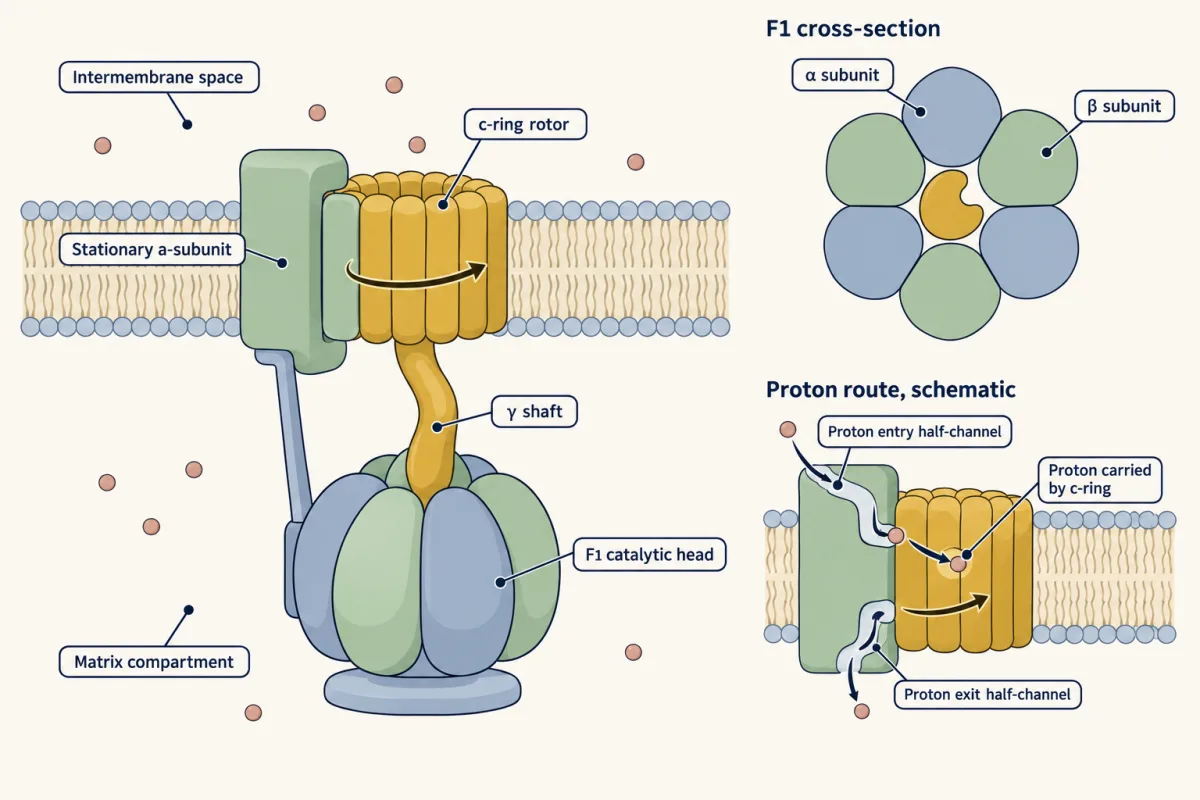
Fo sits in the membrane: a ring of c-subunits (the rotor) pressed against a stationary a-subunit that holds two offset half-channels. A proton enters one half-channel from the intermembrane space and lands on a conserved acidic residue on the c-ring. A charged group cannot sit in the oily core of the membrane; only a c-subunit whose acid carries a proton can turn away from the a-subunit into the lipid. The proton-motive force biases the ring’s random jostling. Protons board easily from the acidic, positive side and leave easily into the alkaline, negative matrix, so the ring steps mostly one way. The voltage and the pH difference both supply that bias, which is why the acid-bath chloroplasts could turn theirs with a pH jump alone. Nearly a full turn later, that c-subunit returns to the a-subunit and releases its proton into the matrix through the second half-channel.
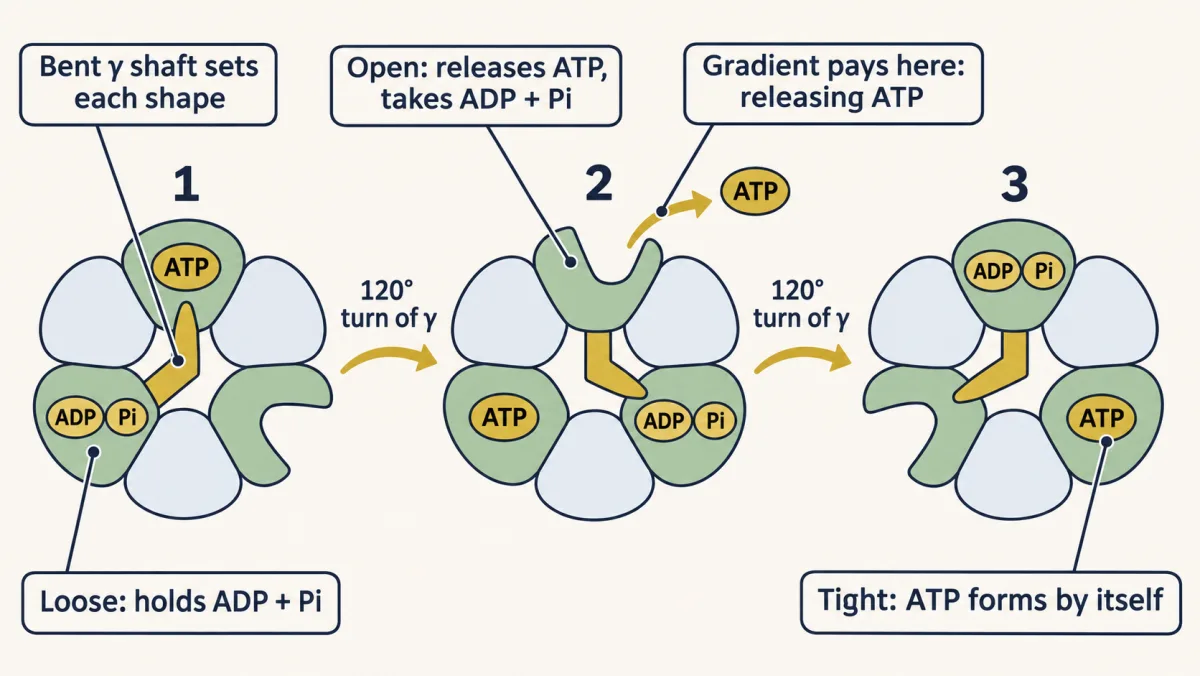
F1 is the catalytic head in the matrix: three α and three β subunits arranged like orange segments around a bent, asymmetric γ shaft. The c-ring and γ are bolted together, so the proton flow that spins the rotor spins the shaft. γ’s off-center bend presses differently on each β subunit at any instant, holding each in a different shape.
Read the transcript of “Paid to Let Go”
Film transcript: Paid to Let Go
We have watched poisons block the proton flow, or let it leak around ATP synthase. Now look inside. Protons fall through, and ATP comes out. How does a falling proton pay for a chemical bond? In the membrane, a ring of c subunits, the rotor, presses against a fixed subunit. A proton enters a half channel and lands on an acid on the ring. Only a loaded subunit can turn into the oily membrane. The gradient biases the ring's random jostling, so it steps mostly one way. Nearly a full turn later, the proton leaves into the matrix. The ring is bolted to a bent shaft, gamma. The shaft reaches into the head, in the matrix. Three alpha and three beta subunits sit around it like orange segments.
The bent shaft presses differently on each beta, holding each in its own shape. Each beta subunit is where ATP is made, from ADP and phosphate. So what does the proton's energy buy? Making the bond, or something else? Paul Boyer turned the question inside out. As the shaft turns, each beta site cycles through three shapes. Open takes in ADP and phosphate.
Loose holds them. In Tight, ATP forms on its own, held too firmly to leave. On the enzyme, making the bond costs almost nothing. Here is the idea. Protons turn the shaft, and the turning pays above all to pry finished ATP loose. It also drives the binding of ADP and phosphate. Each one hundred twenty degree turn moves every site one step and releases one ATP.
John Walker later caught all three in one crystal. One site held an ATP look-alike, one ADP, and one was empty. Now count the price. The vertebrate ring has eight c subunits, the smallest known. Eight protons make one full turn, which releases three ATP. That is about two point seven protons per ATP. A translocase then swaps each ATP out of the matrix for ADP. That swap moves charge, so the voltage takes a toll. Phosphate comes in with a proton too.
Together, about three point seven protons per exported ATP. Follow one proton. It rides the ring nearly once around, and pays for an eighth of a turn. The bond costs almost nothing. What the proton buys, above all, is the moment a finished ATP lets go.
From the film
- Protons ride a ring of c subunits through the membrane, and the gradient makes the ring step mostly one way.
- The ring turns a bent gamma shaft, which holds each beta subunit of the head in a different shape.
- In Boyer's cycle, ATP forms on the enzyme at almost no cost; the turning pays above all to release it, and also drives binding of ADP and phosphate.
- Each 120 degree turn releases one ATP, so the vertebrate ring of eight c subunits spends about 2.7 protons per ATP.
- Exporting ATP and importing phosphate add about one more proton, for about 3.7 protons per exported ATP.
Boyer’s inside-out insight: where the energy goes
Paul Boyer asked: what if it takes no energy to make ATP at the catalytic site, but it takes energy to get the ATP off?
That is the binding-change mechanism. Each β subunit cycles through three states as γ turns: Open (releases finished ATP, takes in ADP and Pi), Loose (ADP and Pi held loosely) and Tight (ATP forms spontaneously and is held so firmly it won’t leave). Each 120° turn of γ moves all three forward one state and releases one ATP, so a full turn releases three. John Walker later caught the three β subunits in a single crystal, one holding an ATP analogue, one ADP, one empty: a frozen snapshot of Boyer’s cycle.
So where does Δp’s energy go? On the enzyme, making the bond costs almost nothing either way. The gradient pays for the rest: above all, prying the finished ATP loose, and, as later work showed, driving the binding of ADP and Pi.
Predict. Detach F1 from the membrane, so there is no Fo and no gradient, and give it ATP. What does it do?
Check your prediction
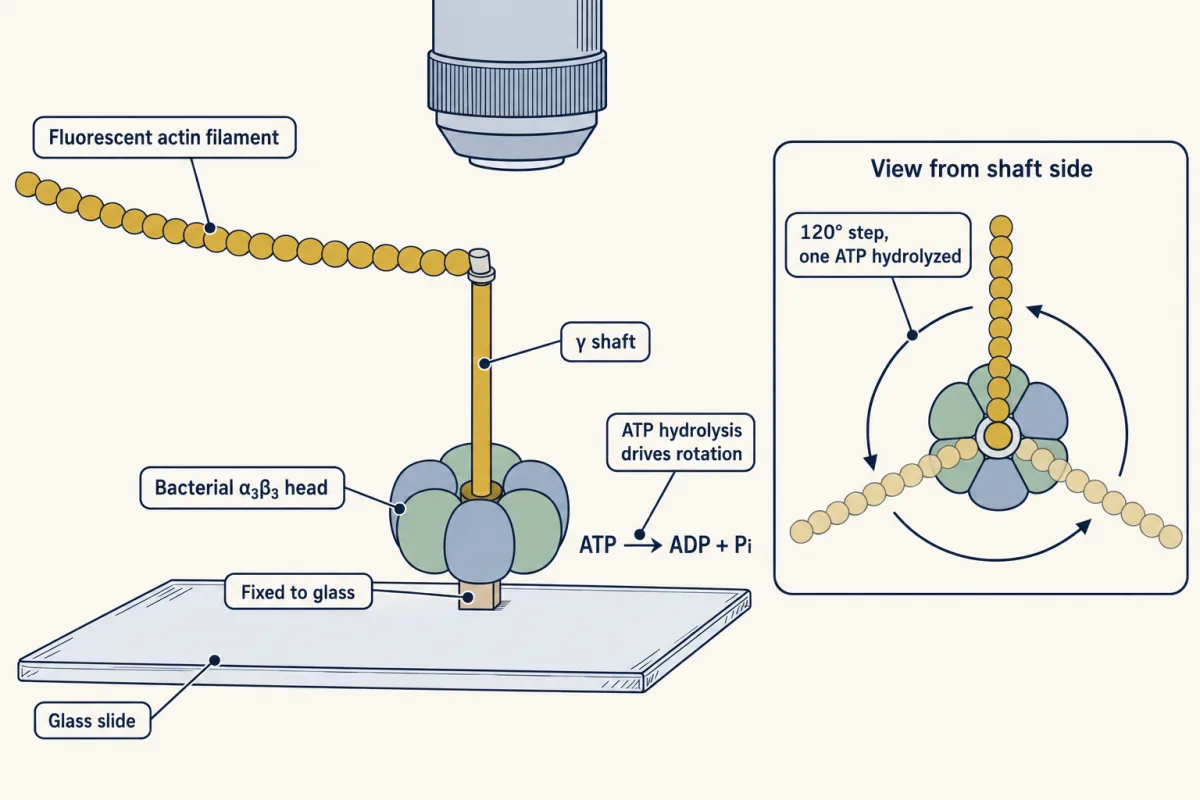
It splits ATP, and γ spins the opposite way from synthesis: without the gradient, the machine runs the easy way, downhill. The gradient does not make the chemistry possible; it sets the direction. Noji and Yoshida used exactly this: ATP-fed α3β3γ heads fixed to glass spun an attached fluorescent actin filament in discrete 120° steps, one per ATP (figure below). Later, Itoh and colleagues turned γ with magnets in the synthesis direction, and ATP appeared.
Counting protons and ATP
The vertebrate c-ring has 8 subunits, the smallest ring and lowest proton cost per ATP known. Eight protons and three ATP per turn: 8 / 3 ≈ 2.7 H⁺ per ATP. But the ATP must leave the matrix. The ATP–ADP translocase, one of the inner membrane’s most abundant proteins, swaps ATP⁴⁻ out for ADP³⁻ in, an electrogenic 1:1 exchange in which ΔΨ pulls one net negative charge outward: a proton tax on every ATP shipped. The phosphate carrier imports Pi with a proton. Together, the two carriers cost about one more proton-equivalent, for about 3.7 H⁺ per exported ATP, just above the floor of about three.
Cytoplasmic NADH can’t cross the inner membrane, so a shuttle hands its electrons in. The glycerol-3-phosphate shuttle delivers them to FAD and CoQ, bypassing Complex I, so that NADH is worth only about 1.5 ATP. The malate-aspartate shuttle regenerates matrix NADH, worth about 2.5 ATP. Many tissues run both, and the mix depends on enzyme levels and metabolic state.
On exams, use NADH ≈ 2.5 and FADH₂ ≈ 1.5, which gives about 30–32 ATP per glucose. Those rounded values assume about 4 H⁺ per ATP. The c8 machine’s 3.7 would allow about 2.7 and 1.6, or about 32–34 per glucose (depending on the shuttle) before any leak, but measured P/O ratios in isolated mitochondria come out near the exam values (Going deeper, “Shuttles and measured yields”). The word “approximately” is doing real work.
The "P/O ratio" you memorized as a constant is really a gear ratio you can read off the hardware, plus a one-proton tax for shipping each ATP out of the matrix. A smaller c-ring (mammal c8 ≈ 2.7 H⁺/ATP) is a high-yield gearbox — fewer protons per ATP — but it needs a steeper proton-motive force to crank, like a low gear on a hill. A bigger ring (spinach c14 ≈ 4.7) spends more protons per ATP yet can turn at a lower Δp. Same machine, different transmission — and evolution tuned each one to the membrane it lives in.
Setting the rate, and breaking it on purpose
Where the film calls coupling a relationship, read two machines sharing one Δp. Where it says energy charge governs the rate, read: ADP reaches the chain through the synthase and Δp, and energy charge is read by enzymes upstream.
Back to the opening trace.
Predict. Resting mitochondria have fuel but almost no ADP. You add ADP. What happens first to Δp, then to the pumps, then to oxygen use?
Check your prediction
ADP lets the synthase spend, so Δp dips. A lower Δp lowers the price of each proton the pumps push out, their margin grows, electrons flow faster, and oxygen use rises: State 3. When the ADP is used up, spending drops, Δp climbs back toward the pumps’ ceiling, and the chain idles: State 4. The chain feels ADP only through Δp.
Δp itself moves only a little. A 10 mV dip in Δp saves about 10 kJ on the pumps’ ten protons, widening their few-tens-of-kJ margin by a third or more. So Δp barely rises when ADP runs out; small changes in Δp drive large changes in flow.
This is acceptor (respiratory) control: ADP availability is a main control on the pace, alongside substrate supply and other signals. Energy charge, a gauge of the cell’s balance of ATP, ADP and AMP, works upstream instead, telling enzymes such as phosphofructokinase-1 (PFK-1) how much fuel to send.
Poisons dissect the coupling, and the table they make is heavily tested. Read each on three gauges, O₂ consumption, ATP output and gradient size, and ask which side it changed.
Predict. Respiring mitochondria get oligomycin, which plugs Fo. Minutes later they also get an uncoupler (DNP or FCCP). Predict all three gauges after each.
Check your prediction
Oligomycin removes spending through the synthase. Δp rises as back-pressure, and the pumps slow until earning matches the small remaining leak. O₂ down to the leak rate, ATP down, gradient up.
The uncoupler adds a large leak. Δp drains without making ATP, the pumps’ margin opens wide, and the chain races to refill the gradient. O₂ up, usually past the starting rate; gradient down; ATP still zero. Given alone, an uncoupler gives O₂ up, ATP down, gradient down.
ETC inhibitors change the earning side: rotenone at Complex I, antimycin A at Complex III, cyanide or CO at Complex IV. Pumping stops: O₂ down, ATP down, gradient down. (That holds in isolated mitochondria whose fuel enters the chain upstream of the block, such as pyruvate plus malate with rotenone, and with no ATP to run the synthase backward; see Going deeper, “When blocking the chain does not empty the gradient.”)
Run all three on the dam below and predict each gauge before you click.
- Δp formula
- Δp = |ΔΨ| + 61.5 mV × ΔpH (37 °C); ΔΨ ≈ 150 mV is the larger part, Δp ≈ 200 mV.
- Electron flow / O₂ use
- Gradient Δp
- ATP output
- Heat
The whole point of coupling is that you cannot move one of these dials alone. Block the chain and the dam runs dry; jam the turbine and the water backs up until the pumps can't push against it — that back-pressure is respiratory control, and it's why a poisoned turbine also quiets the chain. Punch a leak and the chain races flat-out to refill a dam that never fills, burning fuel straight to heat — that's how brown fat keeps a newborn warm, and how DNP diet pills cooked people from the inside in the 1930s. Same gradient, three very different fates. (Qualitative teaching model, not literal kinetics.)
Biology runs its own uncoupler. UCP1 (thermogenin) in brown fat deliberately leaks protons to make heat instead of ATP, the basis of nonshivering thermogenesis: O₂ rises while ATP output stays low.
The earning side can also stop. In ischemia, when oxygen runs short, the chain stalls and the gradient collapses, so the synthase can run backward, burning ATP to hold Δp up. The IF1 inhibitor protein locks the rotor at low pH, stopping that reverse spin and saving the cell’s ATP.
We have now followed one glucose from the gut to the last drop of ATP. Next we leave the mitochondrion for the chloroplast, where the same proton-gradient trick runs on sunlight instead of food.
Going deeper
Mitchell, Glynn House and the Nobel banquet
The high-energy intermediate was the molecule everyone was hunting and no one could find, and Mitchell’s alternative met years of resistance. Forced out of Edinburgh by illness, he restored a half-ruined Cornish mansion, founded a small private research institute there, and kept measuring protons with his collaborator Jennifer Moyle. At the 1978 Nobel banquet he said he was “not a little astonished.”
Signs in the Δp equation
The lesson’s equation uses sizes, so both terms come out positive. Measured as inside minus outside, ΔΨ ≈ −150 mV and the equation reads Δp = ΔΨ − 61.5 mV × ΔpH ≈ −196 mV. Same size; only the sign bookkeeping differs.
Where energy charge fits
Energy charge, ([ATP] + ½[ADP]) / ([ATP] + [ADP] + [AMP]), is held near 0.85–0.90. This fuel gauge tunes phosphofructokinase-1 (PFK-1), isocitrate dehydrogenase and pyruvate dehydrogenase, while the chain itself feels ADP only through the synthase and Δp.
Shuttles and measured yields
The glycerol-3-phosphate shuttle is prominent in brown fat and some skeletal muscle and brain cells; the malate-aspartate shuttle is major in heart and liver, and also active in muscle and brain. Measured P/O ratios fall below the c8 ceiling mainly because of proton leak and slip: some protons return without making ATP.
Rotor and speed details
The c-ring’s acidic residue is a glutamate in mitochondria and an aspartate in E. coli. Swap the long, draggy actin filament for a tiny bead and the motor spins roughly 130 revolutions per second, about 400 ATP per second.
When blocking the chain does not empty the gradient
Rotenone blocks Complex I, but electrons from succinate still enter at Complex II. And in intact cells making ATP by glycolysis, the reversed synthase can spend that ATP to keep ΔΨ partly up after the chain is blocked.
More on UCP1, IF1 and old gradients
Brown-fat thermogenesis can be lit up on a PET-CT in a cold adult. Pigs carry a broken UCP1 gene, which is why piglets rely on shivering. IF1 is overexpressed in some cancers, where its role is still debated. The proton gradient is older than mitochondria: chloroplasts and most bacterial flagella run on it too.
Leber hereditary optic neuropathy as a respiratory-chain disease
Mitochondrial DNA mutations show the same principle. mtDNA is maternally inherited and present in many copies, so disease often depends on heteroplasmy, the mix of mutant and normal genomes in a cell, and on the mutant fraction, and strikes high-demand tissues first. LHON, most often caused by the m.11778G>A mutation in ND4 (a Complex I subunit), can blind otherwise healthy young adults, mostly men, over weeks, though many carriers never lose vision.
Your notes
Select any text in the lesson to highlight it or add a note to it. Your highlights and notes are saved in this browser and collected in your notebook.
This browser is not letting the site save anything (a private window or strict privacy settings), so highlights and notes will be lost when you leave the page.
Try the Predict questions again
Five Predict questions from this lesson, on their own. Answer each one first, then open its check.
The lit vesicles are making ATP. Now add an uncoupler, a compound that carries protons straight back across the membrane. The light stays on. What happens to ATP synthesis?
From: How we know: a gradient alone makes ATP
Check your prediction
It stops, or nearly. The pump still earns, but the leak spends faster than the pump can rebuild, so the gradient collapses and the synthase has nothing to spend. Pump and synthase share nothing but the gradient.
A mitochondrion is treated so that the pH is equal on both sides of its inner membrane, but its membrane potential rises to 180 mV. Can it still make ATP?
From: What the dam stores: Δp, in one number
Check your prediction
Yes. Δp = 180 + 61.5 × 0 = 180 mV, about 17 kJ per mole of protons, at the low end of the usual range. The synthase responds to the total pull. A student who tracks only the pH would predict no ATP, throwing away all of the energy.
Detach F1 from the membrane, so there is no Fo and no gradient, and give it ATP. What does it do?
From: Boyer's inside-out insight: where the energy goes
Check your prediction
It splits ATP, and γ spins the opposite way from synthesis: without the gradient, the machine runs the easy way, downhill. The gradient does not make the chemistry possible; it sets the direction. Noji and Yoshida used exactly this: ATP-fed α3β3γ heads fixed to glass spun an attached fluorescent actin filament in discrete 120° steps, one per ATP (figure below). Later, Itoh and colleagues turned γ with magnets in the synthesis direction, and ATP appeared.
Resting mitochondria have fuel but almost no ADP. You add ADP. What happens first to Δp, then to the pumps, then to oxygen use?
From: Setting the rate, and breaking it on purpose
Check your prediction
ADP lets the synthase spend, so Δp dips. A lower Δp lowers the price of each proton the pumps push out, their margin grows, electrons flow faster, and oxygen use rises: State 3. When the ADP is used up, spending drops, Δp climbs back toward the pumps’ ceiling, and the chain idles: State 4. The chain feels ADP only through Δp.
Respiring mitochondria get oligomycin, which plugs Fo. Minutes later they also get an uncoupler (DNP or FCCP). Predict all three gauges after each.
From: Setting the rate, and breaking it on purpose
Check your prediction
Oligomycin removes spending through the synthase. Δp rises as back-pressure, and the pumps slow until earning matches the small remaining leak. O₂ down to the leak rate, ATP down, gradient up.
The uncoupler adds a large leak. Δp drains without making ATP, the pumps’ margin opens wide, and the chain races to refill the gradient. O₂ up, usually past the starting rate; gradient down; ATP still zero. Given alone, an uncoupler gives O₂ up, ATP down, gradient down.
How we measure it
Liposome reconstitution
Strip the question down to its minimum parts. Racker and Stoeckenius rebuilt artificial vesicles from purified lipids plus just two proteins — bacteriorhodopsin (a light-driven proton pump) and ATP synthase. Shine light, build a gradient with no electron transport chain anywhere, and ATP still appears. Putting a function back together from defined components is the strongest way to prove what is sufficient to cause it.
Single-molecule rotation assay
Noji, Yoshida and colleagues (1997, 1998) fixed isolated α3β3γ heads to a glass slide, glued a fluorescent actin filament to the γ shaft, added ATP, and watched the filament spin under a microscope — in discrete 120° steps, one per ATP hydrolyzed. Watching one molecule work, rather than averaging billions, turned 'rotary motor' from a model into a thing you can see turn.
Polarographic respirometry (the oxygen electrode)
A Clark-type oxygen electrode measures O2 consumption by isolated mitochondria in real time. Add ADP and respiration jumps (State 3); let ADP run out and it slows (State 4). This is how acceptor/respiratory control was discovered and how modern Seahorse assays still separate coupled respiration from proton leak using oligomycin and FCCP.
Practice questions on this lesson (7) → MCAT-style, original, each with an explanation
Where this lesson fits
Before thisReview first
- Oxidative Phosphorylation: The Electron-Transport ChainThis course · Lesson 20
You need the electron-transport chain and its proton pumping from there, since this lesson spends the gradient those pumps build.
- Membranes: The Impermeable Sheet That Builds ItselfThis course · Lesson 12
The gradient only exists because the inner membrane is a sealed, nearly impermeable sheet, as shown there.
- Metabolism: Basic Concepts and DesignThis course · Lesson 15
The ATP price of about 50 to 60 kJ per mole and coupling of uphill work come from there.
After thisStudy next
- Photosynthesis: The Light ReactionsThis course · Lesson 22
Chloroplasts build a proton gradient from light and use the same ATP synthase to make ATP.
- Integration of Metabolism: How the Body Switches FuelsThis course · Lesson 30
Acceptor control and energy charge from here help explain how the body switches fuels.
Elsewhere on the siteFilms, simulations and method films in other courses
- One channel, two numbersSimulation · Cell Biology
Its 'One channel, two numbers' simulation lets you combine concentration and voltage terms to find which way ions flow.
- Two Pushes, One HillFilm · Cell Biology
It shows an ion feeling both a concentration push and a voltage push, as protons do in Δp.
- A Tap, a Hole, a LevelFilm · Cell Biology
It shows how a pump must keep paying to hold a gradient that the membrane leaks away.
Suggested by an AI model from the lessons themselves, then checked. How we use AI
That is the skim: you have the shape of it.
That is both films: the lesson in pictures.
The rest of the lesson is here when you want it.
Finish line
Test yourself
9 questions
Practice and MCAT-style, with explained answers.
Play it · about 3 min
Ledger Rush: Electron transport
Track the protons: 10 per NADH, 6 per FADH₂, about 4 per ATP.
Play →Next · Lesson 22
Photosynthesis: The Light Reactions
Two photon-driven uphill boosts, wired so water splits, oxygen leaves, and NADPH and ATP get made.
Continue →Unit review · Central Metabolism
MCAT Gauntlet: Central Metabolism
15 timed questions across glycolysis, gluconeogenesis, pyruvate dehydrogenase, the citric acid cycle and oxidative phosphorylation. Three lives.
← Lesson 20 · Oxidative Phosphorylation: The Electron-Transport Chain
Rewritten on : new film. Notes and highlights stay, but the text around them may have moved.