Biochemistry · Skim version
The Proton-Motive Force and ATP Synthase
Read the full lesson → Skim the whole course →
The guiding idea
Electron transport and ATP synthesis are one coupled machine: the chain pumps protons into a gradient, and protons falling back through ATP synthase turn a rotary motor that makes ATP.
Electron transport and ATP synthesis are one coupled machine, joined by a proton gradient across the inner mitochondrial membrane.
-
How we know: a gradient alone makes ATP
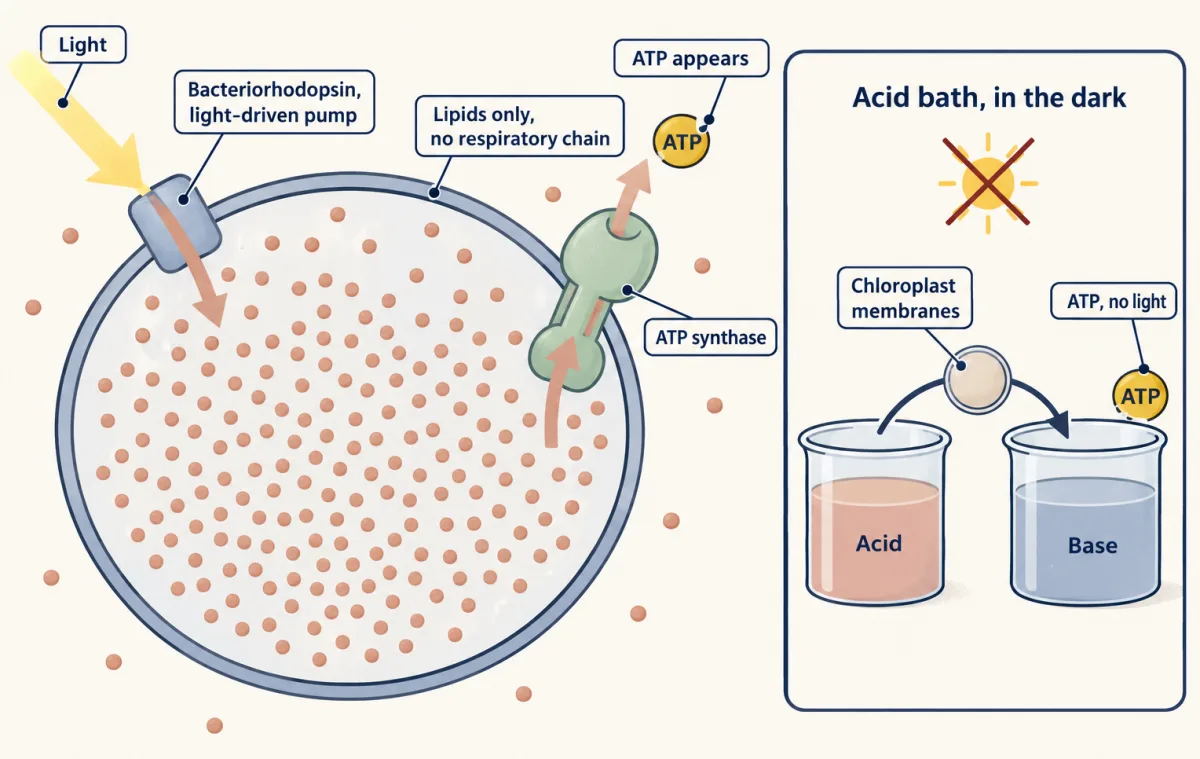
Two experiments supporting chemiosmosis: Racker and Stoeckenius’s light-driven vesicles (main) and Jagendorf and Uribe’s acid-bathed chloroplast membranes in the dark (inset), each making ATP from a gradient with no respiratory chain. AI-generated illustration -
What the dam stores: Δp, in one number
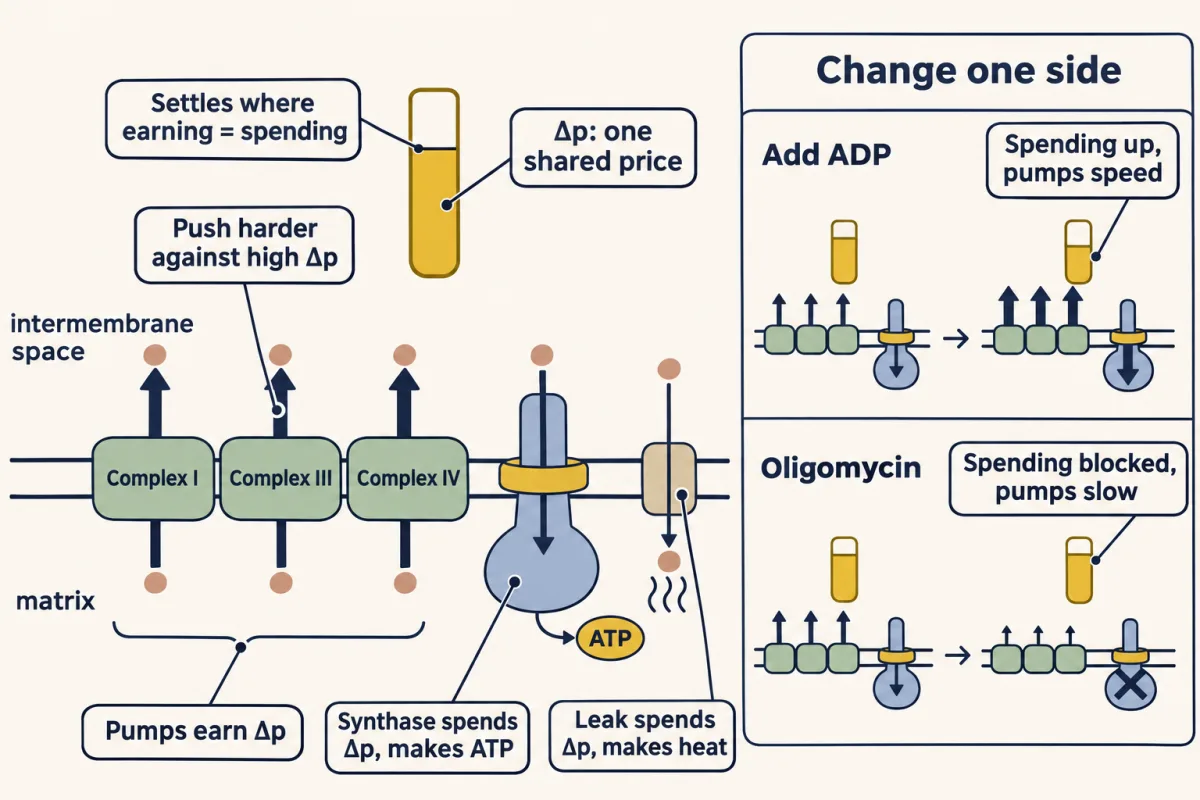
One price for every proton. The pumps earn the proton-motive force (Δp) and must push against it; ATP synthase and any leak spend it. Δp settles where earning equals spending, so a change on one side reaches the other only through Δp (inset: adding ADP versus oligomycin). AI-generated illustration -
A motor, not a metaphor
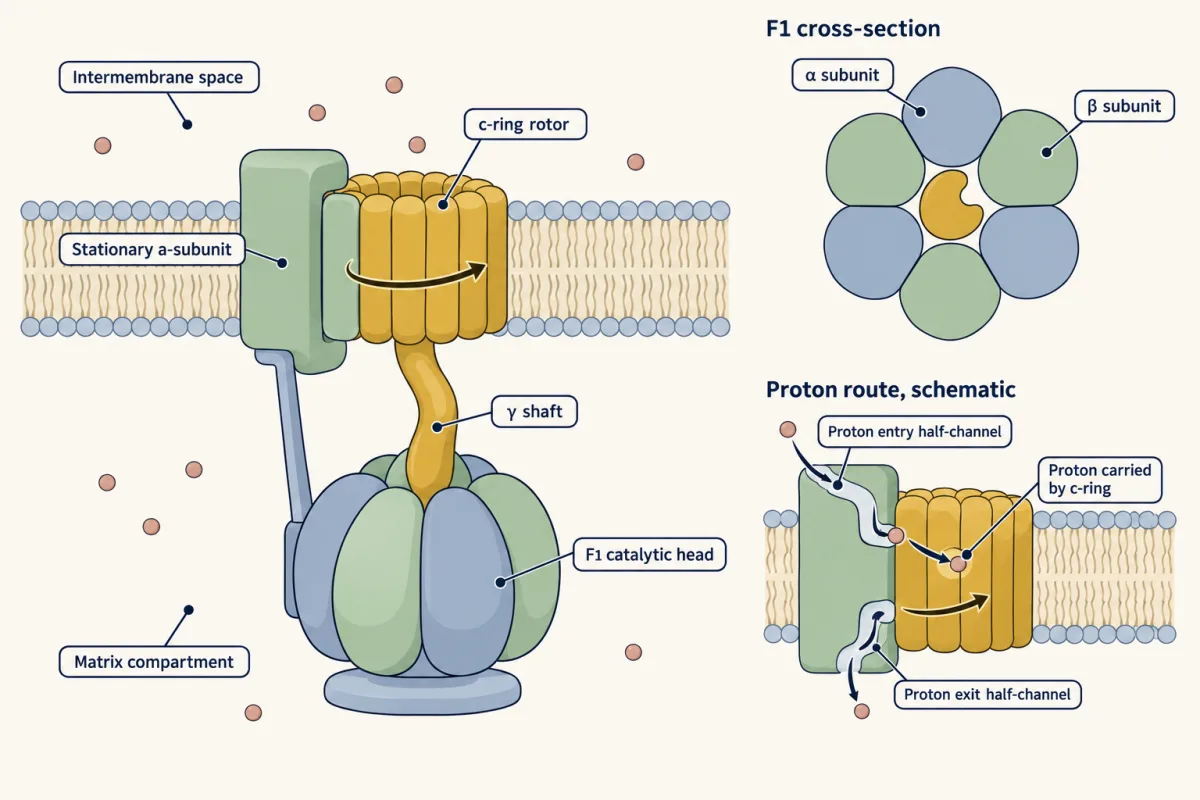
ATP synthase couples proton movement to rotation. Protons enter one a-subunit half-channel from the intermembrane space, bind to the c-ring, travel around with it and leave through the other half-channel into the matrix. The c-ring turns the gamma shaft within the matrix-facing F1 head, which contains three alpha and three beta subunits. AI-generated illustration -
Boyer’s inside-out insight: where the energy goes
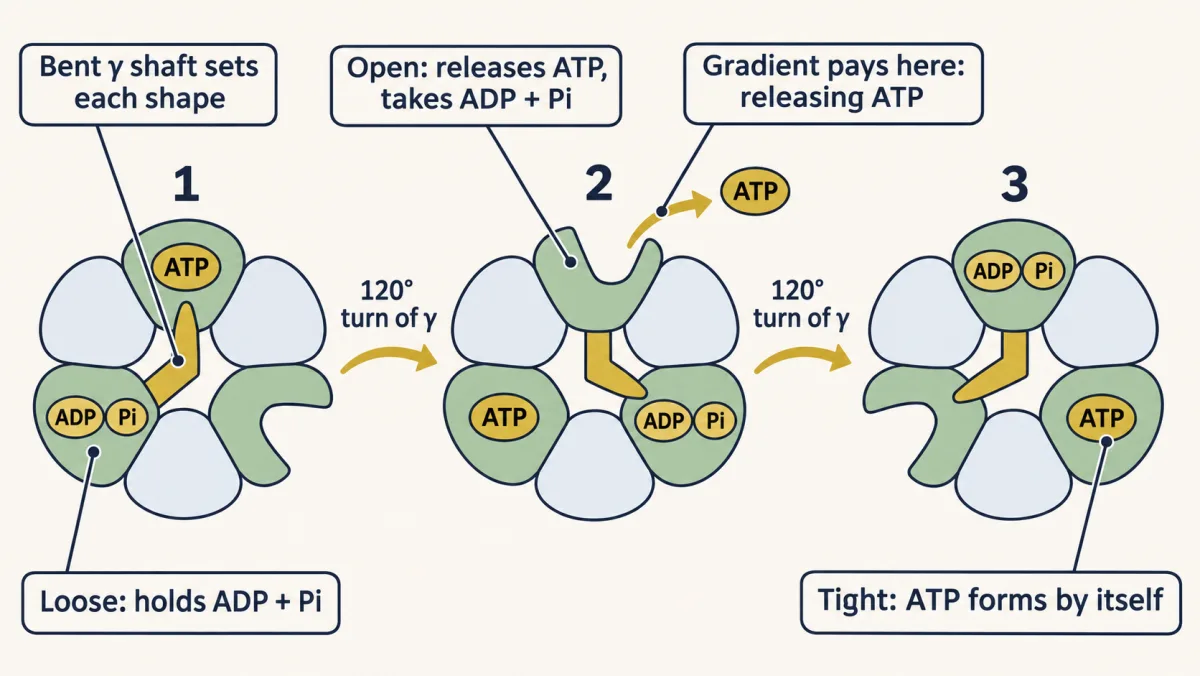
Boyer’s binding-change cycle. Each 120° turn of the bent γ shaft moves every β subunit one state forward: Loose to Tight (ATP forms with almost no energy cost), Tight to Open (the finished ATP is released), Open to Loose (new ADP and phosphate bind). The gradient pays mainly for the release and for binding, not for making the bond. AI-generated illustration 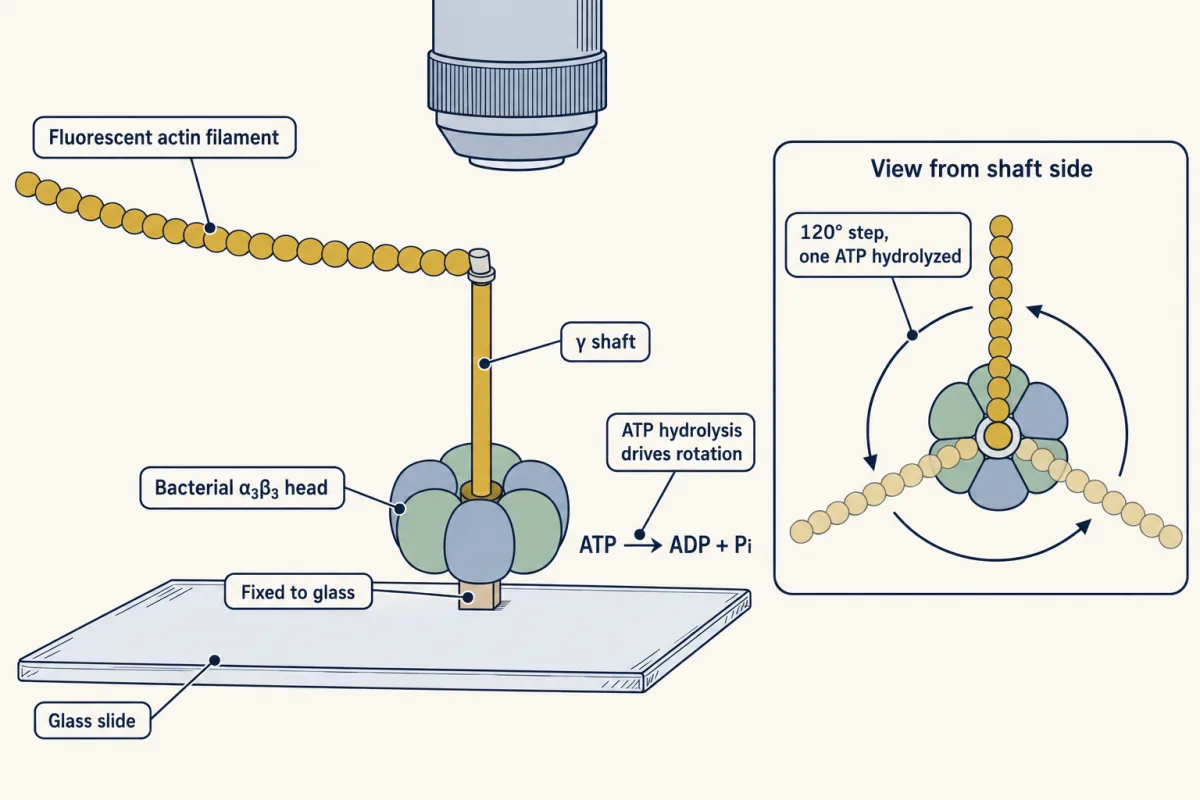
Watching ATP-driven rotation. An isolated F1 head from a thermophilic bacterium is fixed to glass, and a fluorescent actin filament is attached to its gamma shaft. ATP hydrolysis drives counterclockwise rotation when viewed from the shaft side, with one ATP consumed per 120° step under stepping-assay conditions. AI-generated illustration -
Counting protons and ATP
-
Setting the rate, and breaking it on purpose
-
Going deeper
Where this lesson fits
Before thisReview first
- Oxidative Phosphorylation: The Electron-Transport ChainThis course · Lesson 20
You need the electron-transport chain and its proton pumping from there, since this lesson spends the gradient those pumps build.
- Membranes: The Impermeable Sheet That Builds ItselfThis course · Lesson 12
The gradient only exists because the inner membrane is a sealed, nearly impermeable sheet, as shown there.
- Metabolism: Basic Concepts and DesignThis course · Lesson 15
The ATP price of about 50 to 60 kJ per mole and coupling of uphill work come from there.
After thisStudy next
- Photosynthesis: The Light ReactionsThis course · Lesson 22
Chloroplasts build a proton gradient from light and use the same ATP synthase to make ATP.
- Integration of Metabolism: How the Body Switches FuelsThis course · Lesson 30
Acceptor control and energy charge from here help explain how the body switches fuels.
Elsewhere on the siteFilms, simulations and method films in other courses
- One channel, two numbersSimulation · Cell Biology
Its 'One channel, two numbers' simulation lets you combine concentration and voltage terms to find which way ions flow.
- Two Pushes, One HillFilm · Cell Biology
It shows an ion feeling both a concentration push and a voltage push, as protons do in Δp.
- A Tap, a Hole, a LevelFilm · Cell Biology
It shows how a pump must keep paying to hold a gradient that the membrane leaks away.
Suggested by an AI model from the lessons themselves, then checked. How we use AI