A Tap, a Hole, a Level
Read the transcript of “A Tap, a Hole, a Level”
Film transcript: A Tap, a Hole, a Level
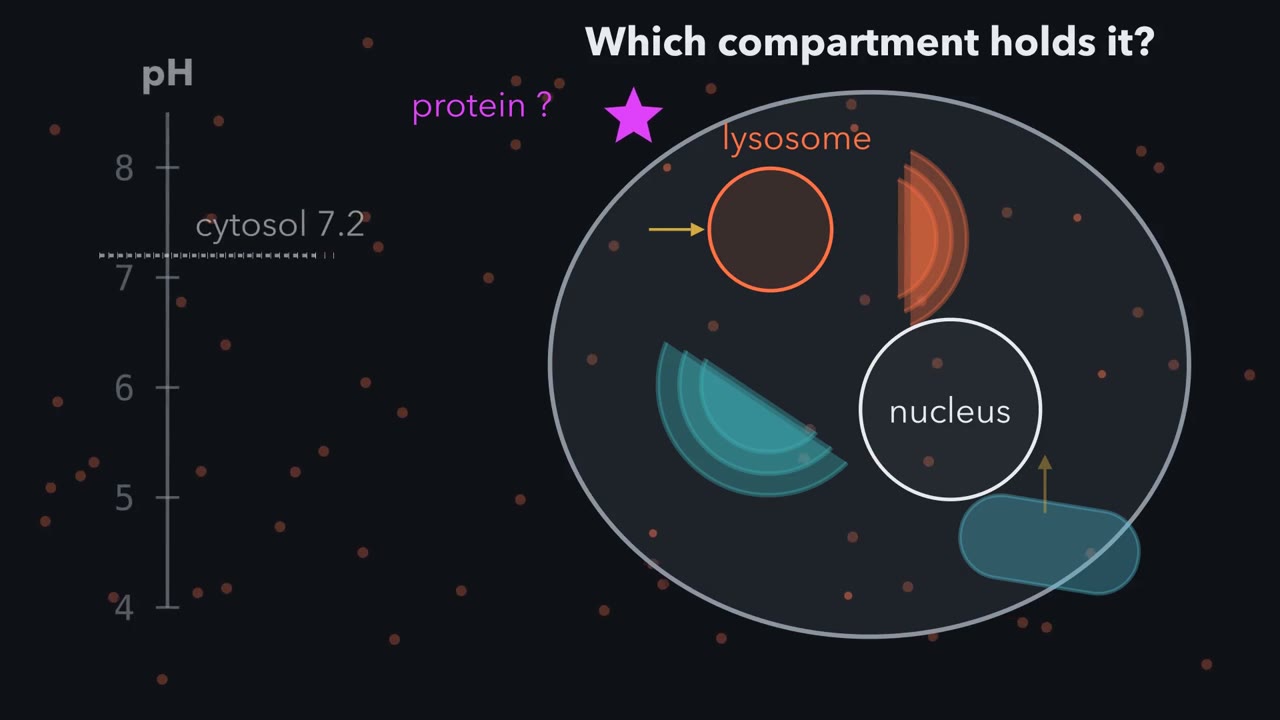
How can one cell hold a lysosome at pH 4.7 and a mitochondrion near 8, in one cytosol? Why does each settle at its own number? This is the cell's pH ladder, with typical values from different cells. Each marker is one compartment. The white line is the cytosol. Acid compartments sit below. The matrix, the mitochondrion's inside, sits above. Start with the wall. A membrane lets ions through slowly, but not never. Protons trickle back toward the cytosol. Picture the lysosome as a container with a tap and a hole. The tap is a proton pump, the V-ATPase, spending ATP to push protons in.
As protons pile up, more leak back out through the hole. At some level, out matches in, and the level stops rising. This picture needs no sensor to set that level. That is the idea, for this acid lumen. The level sits where pumping in meets leaking out. Other things equal, a stronger pump makes it more acid. A leakier wall makes it less acid. Now a drug, bafilomycin, clamps the V-ATPase tap shut. Watch the ladder. Which way will the lysosome's marker move, up or down?
Up, toward the line: less acid. With the tap off, the hole keeps draining. In HeLa cells, bafilomycin made the Golgi less acid. So that acid is actively kept. The Golgi uses the same pump family, yet it settles higher, near six point six. Does the lysosome have more pumps, a tighter wall, or something else? That is still being worked out. The nucleus is different. Its envelope is full of pores, and small ions, protons included, pass through them quickly. So its pH stays close to the cytosol's. The ER is also a nonequilibrium store. A calcium pump called SERCA fills it to thousands of times the cytosol's level, while leaks and release channels move calcium out.
Thapsigargin, a plant compound, blocks SERCA. Calcium keeps leaking out, and nothing pumps it back. The store runs down, and cytosol calcium rises for a while. The mitochondrion's pumps face the other way. They are the respiratory chain, driven by electron transport. While it runs, they push protons out of the matrix, so the matrix sits above the line. Why the other way? The matrix was once a bacterium's cytoplasm, and during respiration its electron-transport chain pumped protons outward. Chloroplasts did the same. Their stroma, the fluid inside, was once a cyanobacterium's cytoplasm, and in light it turns alkaline. Every proton pump here pushes out of a cytoplasm.
The acid lumens, the matrix and the stroma need ongoing energy-dependent transport. Acid lumens need their V-ATPase. The matrix and stroma need respiration or light. Stop that input, and those gradients run down.
A lysosome near pH 4.7 and a mitochondrial matrix near pH 8 share one cytosol near 7.2. What holds each at its own number?
Continue in the lesson: Organelles as Distinct Environments →
3:56 · Free, with captions and a transcript. The lesson has the full text, the questions and the sources.
More films from this lesson
How this film was made. Narration: written from this lesson's text and read by an AI narrator voice (Kokoro, af_heart). Animation: AI-generated in code (Manim) by Claude, a schematic with no drawn molecular structures. Captions come from the narration script. See something wrong? Report it.