Biochemistry · Skim version
Protein Turnover and Amino Acid Catabolism: Tag, Recognize, Destroy, Recycle
Read the full lesson → Skim the whole course →
The guiding idea
A protein's lifespan runs from minutes to a lifetime, set in large part by tags the cell reads and acts on.
A protein's lifespan ranges from minutes to a lifetime, set in large part by molecular tags the cell reads and acts on.
From the film
- In proteasomal degradation, ATP pays for tagging and handling, not peptide-bond cleavage.
- E3 ligases give ubiquitin tagging its target specificity.
- In an adult at nitrogen balance, most released amino acids return to protein.
- In adult humans, most waste nitrogen leaves as urea.
- Amino-acid carbon enters seven metabolic doors, but only five can yield net glucose.
-
Choosing: the ubiquitin tag
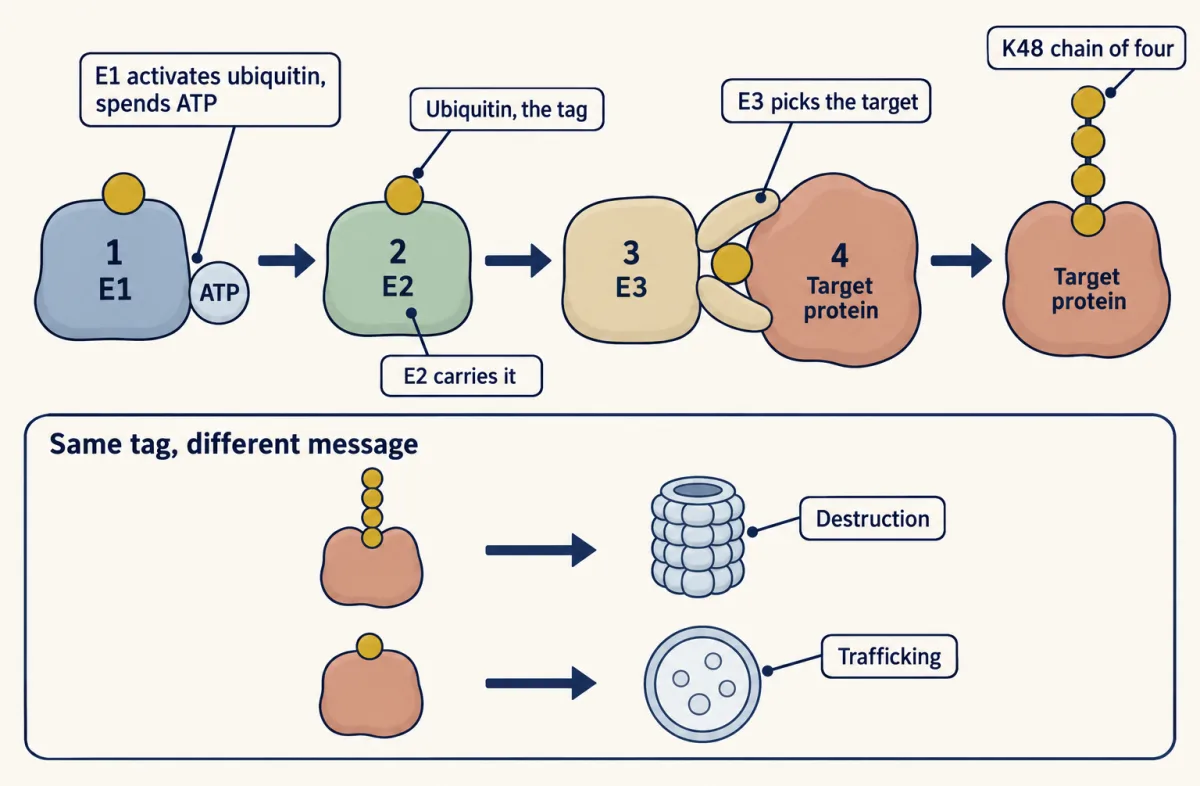
Writing the tag. E1 spends ATP to activate ubiquitin and E2 carries it; E3 picks the target. The drawing shows a HECT-type E3, which takes the ubiquitin onto its own cysteine first; RING E3s instead bring the ubiquitin-loaded E2 and target together for direct transfer. AI-generated illustration -
Destroying: the proteasome
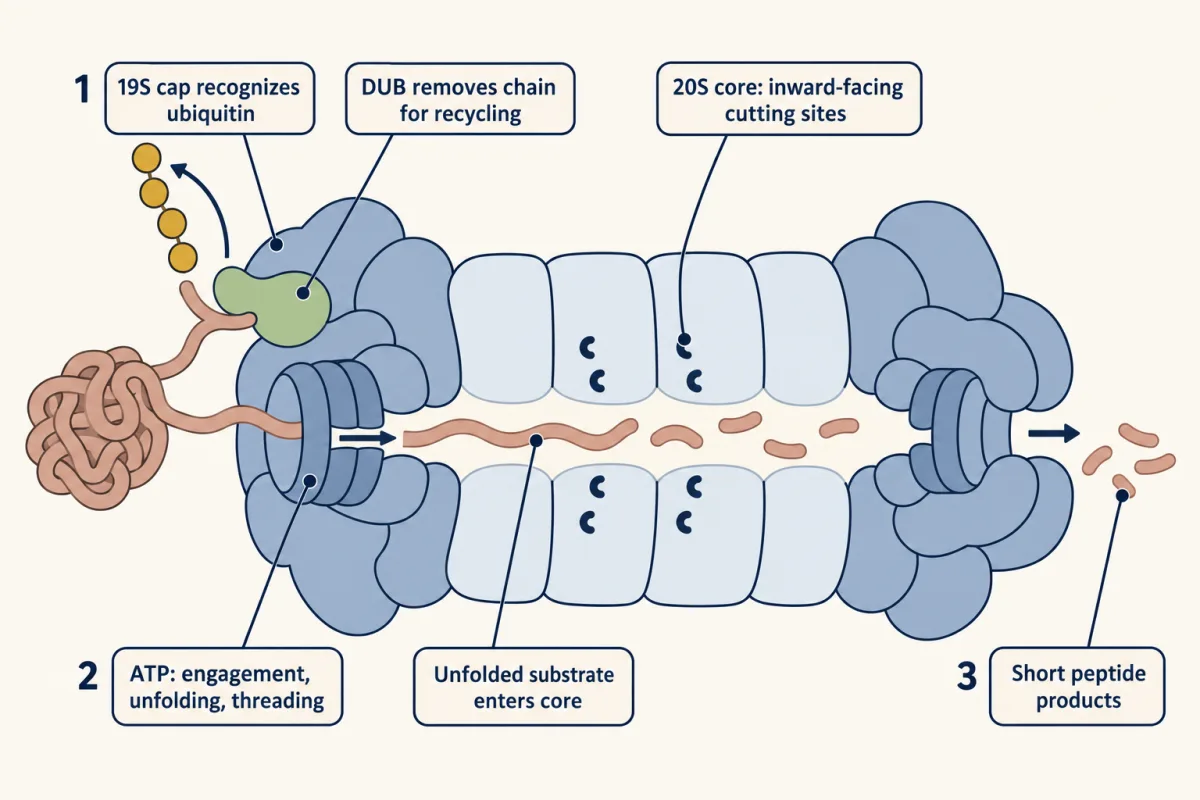
The 26S proteasome, here with two 19S caps on a 20S core. The ATP goes to binding, unfolding and threading, never to cutting. AI-generated illustration -
From destruction to fuel: most amino acids are reused
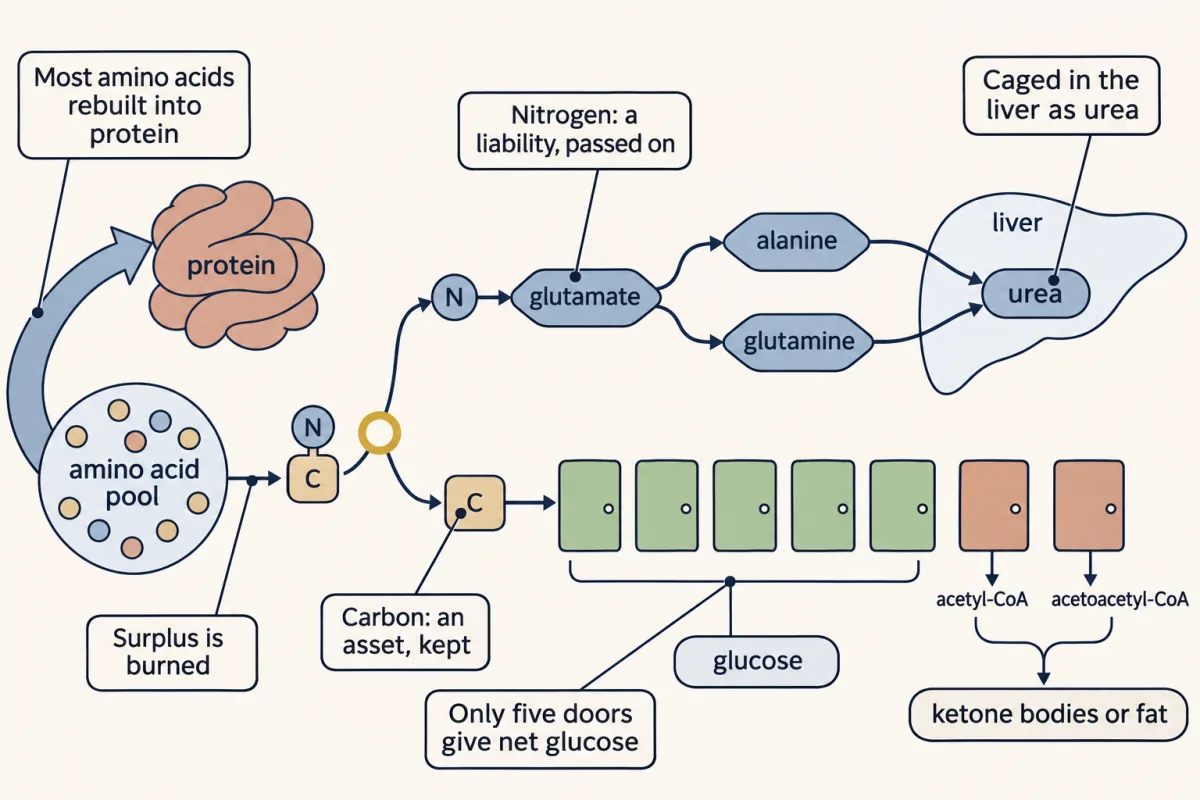
Choose, then split by atom. Most freed amino acids go back into protein. When the surplus is burned, nitrogen and carbon part ways: the nitrogen is handed from carrier to carrier and caged as urea, and the carbon enters at one of seven doors. Only the five doors that can become oxaloacetate give net glucose. AI-generated illustration -
The nitrogen road
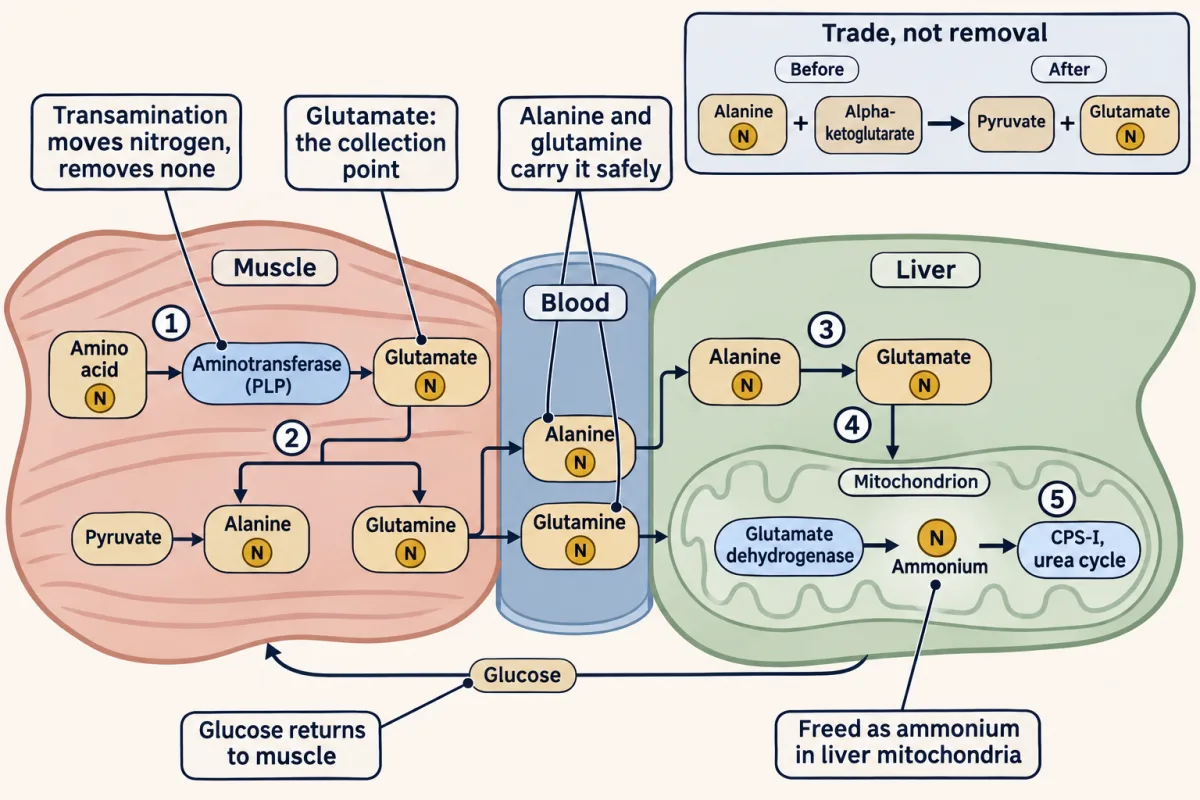
Nitrogen rides on carriers until the last moment. Aminotransferases trade the amino group onto alpha-ketoglutarate, making glutamate; muscle ships it as alanine or glutamine; and in liver mitochondria glutamate dehydrogenase frees most of it as ammonium, right beside the enzyme that cages it (glutaminase frees some directly). AI-generated illustration 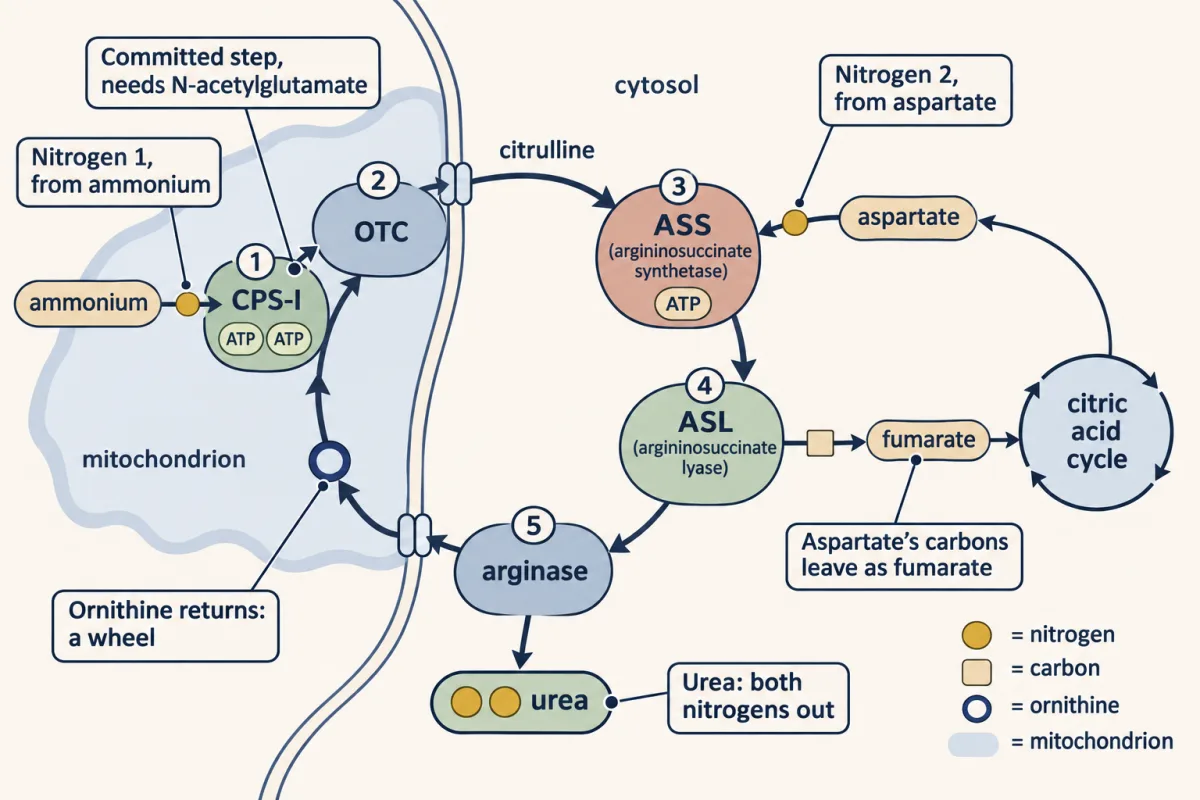
One nitrogen from each source. Ammonium enters in the mitochondrion at CPS-I; aspartate brings the second nitrogen in the cytosol. The nitrogen stays and leaves as urea; aspartate's carbon leaves as fumarate and returns as aspartate through the citric acid cycle (the Krebs bicycle), so the loop recycles carbon rather than adding glucose. Ornithine is used at step 2 and returned at step 5. AI-generated illustration -
The carbon road: seven doors
-
The whole lesson in one bird
-
Going deeper
Where this lesson fits
Before thisReview first
- The Citric Acid Cycle: Harvesting ElectronsThis course · Lesson 19
Fumarate, oxaloacetate, alpha-ketoglutarate and succinyl-CoA are the cycle intermediates where amino-acid carbon enters and the urea cycle meshes.
- Gluconeogenesis: Pushing Glucose Back UphillThis course · Lesson 17
You need to know how oxaloacetate becomes glucose to see which amino-acid doors give net glucose.
- The Pyruvate Dehydrogenase Complex: The One-Way Gate to the CycleThis course · Lesson 18
Its irreversibility is why acetyl-CoA cannot return to pyruvate, so ketogenic amino acids give no net glucose.
After thisStudy next
- Integration of Metabolism: How the Body Switches FuelsThis course · Lesson 30
It uses muscle protein breakdown, urea and amino-acid carbon for glucose to show how the body switches fuels between fed and fasting.
- Nucleotide Metabolism: Build It, Recycle It, or Pay in Uric AcidThis course · Lesson 29
It takes up aspartate, glutamine and carbamoyl phosphate, which also feed the pyrimidine pathway where orotic acid appears.
Elsewhere on the siteFilms, simulations and method films in other courses
- HIF and oxygenSimulation · Cell Signaling
It shows how oxygen-controlled ubiquitin tagging destroys HIF, the same PHD and VHL switch used here.
- Filter Far More, Take Most BackFilm · Organismal Biology
It follows the urea that the liver makes out of waste nitrogen into the kidney and urine.
- Take It Apart, Build It AgainFilm · Biology
It shows how proteins are broken into amino acids by adding water, the first step of the recycling here.
Suggested by an AI model from the lessons themselves, then checked. How we use AI