Biochemistry · The Citric Acid Cycle
New to this? Review it at high school level: Respiration and ATP
The Citric Acid Cycle: Harvesting Electrons
Rewritten on : new text, figures and flashcards. Your notes and highlights stay, but the text around them may have moved.
The citric acid cycle makes almost no ATP. Its real product is high-energy electrons.
Pause when the reading reaches a film, and offer to play it. Saved on this device.
Watch the film now, or keep listening
Builds on:The Pyruvate Dehydrogenase Complex: The One-Way Gate to the CycleGlycolysis: The Investment-and-Payoff PathwayMetabolism: Basic Concepts and DesignWhy these?
 ▶ Watch Follow the Electrons · 3:22
Read the transcript of “Follow the Electrons”
Film transcript: Follow the Electrons
If the citric acid cycle makes almost no ATP directly, what is it actually doing? Follow the electrons. A two-carbon acetyl group enters a schematic roundabout. Four-carbon oxaloacetate waits there as a reusable platform, ready to carry another load.
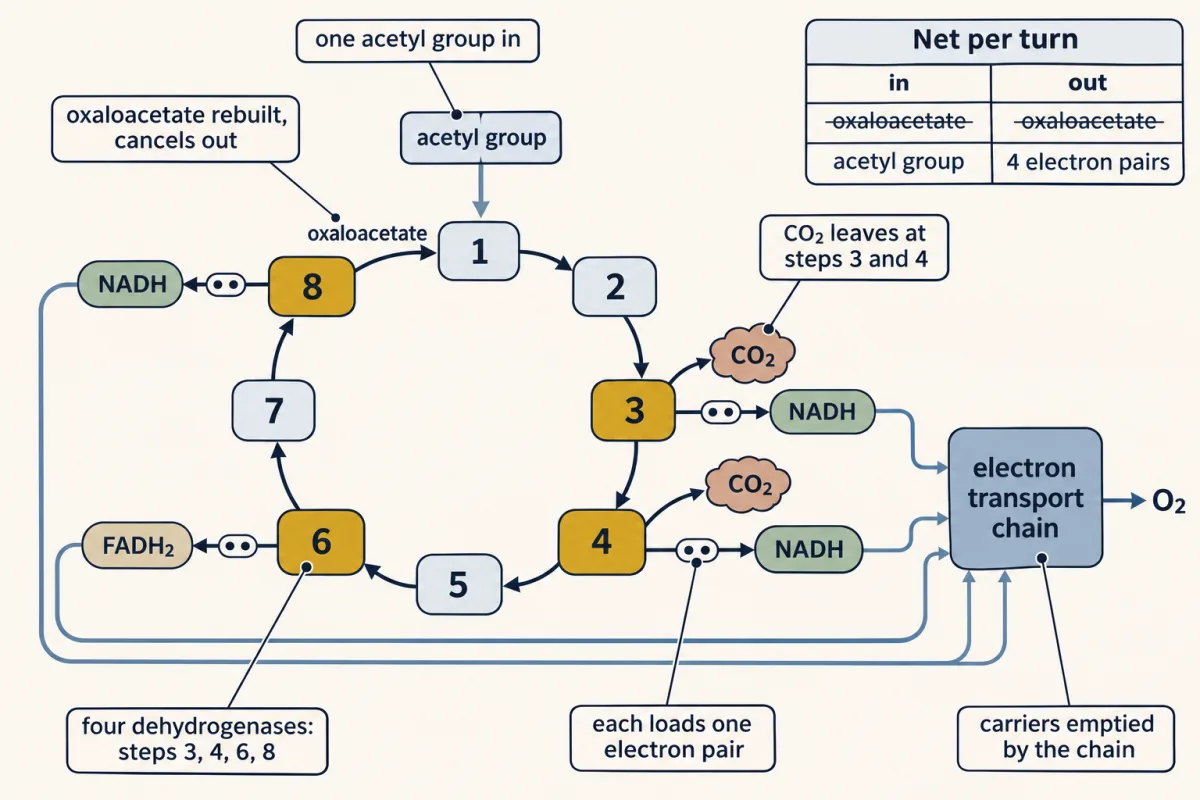
Start with the fuel's electron budget. For net bookkeeping, its two carbons eventually become CO₂, though not during that same turn. Reaching that fully oxidized state releases eight electrons. They leave as four pairs. Now predict the machinery. Eight electrons must leave the acetyl group. How many carrier-loading steps should the cycle need?
Four. The cycle has four dehydrogenase steps, each collecting one electron pair. Three pairs load NAD⁺ plus into NADH. One pair reduces FAD inside Complex II, the cycle enzyme built into the chain. Here is the guiding idea: the cycle loads electron carriers, and the electron transport chain empties them.
Empty NAD⁺ returns for another load. Enzyme-bound FAD also passes its electrons onward and becomes ready again. After one turn, the tally is 3 NADH and 1 FADH₂. The cycle also makes 1 GTP and releases 2 CO₂. The direct payout is tiny. The chain uses the carriers' energy to make most ATP. Meanwhile, the carbon path goes from six carbons, to five, to four. The roundabout finishes with four-carbon oxaloacetate again. In its simplest form, oxaloacetate is regenerated, so the cycle does not consume it in net terms. Oxygen appears in none of the cycle's eight reactions. So why does removing O₂ stop the cycle? The chain needs O₂ as its final electron acceptor.
Without O₂, electron traffic backs up and the carriers stay loaded. Loaded carriers cannot accept another pair. The four dehydrogenases stall, then the rest of the roundabout slows behind them. Oxygen is therefore required indirectly: it keeps the carrier-recycling route open. This handoff also links fuel use to demand. When the chain empties carriers faster, more NAD⁺ returns. When NADH accumulates, it helps slow the cycle. The detailed control points come next in the lesson. So the cycle is not mainly an ATP mint. It is an electron-loading roundabout with a reusable platform. Follow the electrons: the cycle fills the carriers, and the chain drains them for reuse.
From the film
- For net bookkeeping, one acetyl group supplies eight electrons in four pairs.
- Each turn loads three NADH and one FADH2 but makes only one GTP (or ATP) directly.
- Oxaloacetate is regenerated, so it is a reusable platform in the simplest cycle.
- The cycle loads carriers, and the electron transport chain empties them.
- Oxygen is required indirectly because it accepts electrons at the chain's end.
Add a pinch of a four-carbon acid to minced pigeon breast muscle, and the muscle burns far more oxygen than oxidizing that pinch could ever explain.
That is what Szent-Györgyi and then Krebs saw when they measured the muscle’s oxygen use. The acid was not being used up as fuel. It was being reused, over and over, to burn something else. That reuse is what makes the citric acid cycle a cycle.
The film above follows the electrons; the ledger below follows the chemistry step by step.
Where we are, and what the cycle is for
Glycolysis handed off two pyruvates and warned us the real bottleneck was NAD⁺. Here that warning comes due. In the mitochondrial matrix, pyruvate dehydrogenase turns each pyruvate into acetyl-CoA, releasing one CO₂ and one NADH. One glucose, two acetyl-CoA, two turns of the cycle. Everything below is per acetyl-CoA.
The film above follows the cycle’s real product into the electron transport chain. The scale of that handoff is stark: one NADH’s electron pair, handed to oxygen, releases about 220 kJ/mol; the cycle’s lone GTP is worth about 30.
Predict. An oxidation state counts the electrons a carbon has lost to its bonding partners (negative if it has gained them): each bond to O or S counts +1, each bond to H −1, a bond to C 0. Carbon in CO₂ is at +4. In the acetyl group, the methyl carbon (CH₃) is at −3 and the carbonyl carbon (bonded to CoA) at +3. How many electrons must come off to make both into CO₂? If each dehydrogenase removes one pair, how many dehydrogenases should the cycle have?
Check your prediction
Eight electrons: 7 from the methyl carbon (−3 to +4) and 1 from the carbonyl carbon (+3 to +4). Four pairs, so four dehydrogenases, and the cycle has exactly four.
The one idea to carry through this lesson: follow the electrons. The cycle loads carriers and the chain empties them; the four-pair count follows from oxidizing an acetyl group to carbon dioxide.
The count gives you the number of pairs, four, without memorizing. It does not say which carrier takes each pair (step 6’s chemistry does) or which atoms leave as CO₂ (the carbon section), and it holds only while nothing is drawn off (last section).
Burn the fuel, then rebuild the machine
Hold the eight enzymes as two stages, like a fireplace: Stage One burns the firewood down to CO₂, and Stage Two sweeps the ashes into a new fireplace, rebuilding oxaloacetate. Each stage loads two carriers. Two of the four oxidations actually come in Stage Two.
Stage One: the carbons leave (steps 1–4)
1 · Citrate synthase joins 4-carbon oxaloacetate (OAA) to 2-carbon acetyl-CoA, making 6-carbon citrate. A synthase uses no ATP; the energy comes from cleaving acetyl-CoA’s high-energy thioester.
2 · Aconitase turns citrate into isocitrate by moving its hydroxyl (–OH) to a neighboring carbon. No redox happens here.
Predict. Citrate already has an –OH. Why can’t the next enzyme just oxidize citrate?
Check your prediction
Citrate’s –OH sits on a carbon with no hydrogen (a tertiary alcohol). Making C–OH into C=O means removing that carbon’s hydrogen, and there is none to remove without breaking a carbon–carbon bond. Aconitase moves the –OH to a carbon that has one.
3 · Isocitrate dehydrogenase carries out the first oxidative decarboxylation: oxidize, then remove a carboxyl as CO₂. Out come CO₂ #1 and NADH #1. Textbooks often call it the cycle’s rate-limiting step, and that is the answer exams usually expect. In living tissue, control is shared with citrate synthase and α-ketoglutarate dehydrogenase.
4 · The α-ketoglutarate dehydrogenase complex carries out the second: CO₂ #2 and NADH #2. It is the twin of pyruvate dehydrogenase.
Which two carbons left is a puzzle for later.
Stage Two: oxaloacetate is rebuilt (steps 5–8)
5 · Succinyl-CoA synthetase is the cycle’s only substrate-level phosphorylation, a phosphate made directly by the reaction rather than by the chain. Cleaving succinyl-CoA’s thioester drives GDP to GTP (or ADP to ATP, depending on the enzyme isoform).
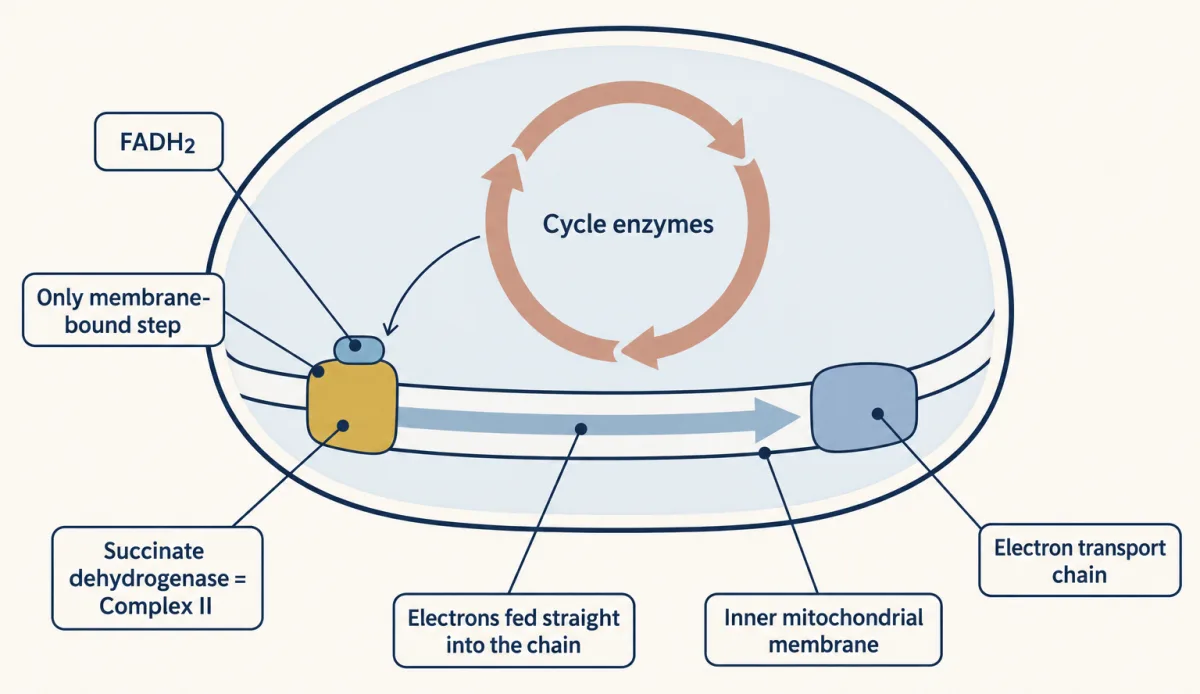
6 · Succinate dehydrogenase is the odd one out. It sits in the inner mitochondrial membrane and is Complex II of the ETC, feeding electrons straight into the chain.
Predict. Step 6 takes two hydrogens off succinate’s CH₂–CH₂ to make fumarate’s C=C. Which carrier gets the pair, and why not NAD⁺?
Check your prediction
FAD. Those electrons are too low in energy to reduce NAD⁺: handing them to NAD⁺ would cost about 68 kJ/mol under standard conditions. The FAD held inside the enzyme sits at a far more positive potential than NAD⁺, so accepting the pair costs little, roughly 6 to 20 kJ/mol depending on the value used, and ubiquinone, the chain’s next carrier, pulls them on.
7 · Fumarase adds water across fumarate’s double bond to make L-malate.
8 · Malate dehydrogenase regenerates OAA and loads NADH #3, closing the ring. This step is unfavorable on its own, but citrate synthase uses up OAA the instant it appears, pulling it forward. The steps are coupled, not independent.
| Step | Product | Carbons | Loaded or made |
|---|---|---|---|
| 1 | citrate | 6 | — |
| 2 | isocitrate | 6 | — |
| 3 | α-ketoglutarate | 5 | NADH, CO₂ |
| 4 | succinyl-CoA | 4 | NADH, CO₂ |
| 5 | succinate | 4 | GTP |
| 6 | fumarate | 4 | FADH₂ |
| 7 | malate | 4 | — |
| 8 | oxaloacetate | 4 | NADH |
Add it up: oxaloacetate cancels
The last column sums to 3 NADH, 1 FADH₂, 1 GTP, 2 CO₂. Write the turn as one reaction. One OAA goes in at step 1 and one comes out at step 8, so OAA appears on both sides and cancels:
acetyl-CoA + 3 NAD⁺ + FAD + GDP + Pᵢ + 2 H₂O → 2 CO₂ + 3 NADH + FADH₂ + GTP + CoA-SH + 2 H⁺
That answers the pigeon-muscle puzzle. The added acid joins the cycle’s pool of four-carbon intermediates, and every turn hands the acceptor back, so each added molecule carries many acetyl groups through, each sending its electrons to oxygen.
As the film’s roundabout shows, OAA is the reusable platform, not the fuel, so a small pool supports many turns. Its atoms are replaced over time, as the next section shows.
Check the tally against your own: tap through the eight steps, or press “Turn the whole cycle”.
regulated step
The condensation that starts the turn. 'Synthase' means no ATP is spent: the energy comes from cleaving acetyl-CoA's high-energy thioester. Ordered induced fit, with the citryl-CoA intermediate hydrolyzed while still bound so the thioester energy is not wasted. One of the most exergonic steps (ΔG°′ ≈ −31.4 kJ/mol, standard free energy), effectively irreversible — the committed step that pulls the whole cycle forward. Because it consumes oxaloacetate, this step drives the otherwise-unfavorable malate→oxaloacetate step (8) forward: the cycle's reactions are coupled, not independent.
Regulation. Limited by oxaloacetate supply; slowed by its products (citrate, and succinyl-CoA competing with acetyl-CoA).
An isomerization, not a redox step: a dehydration then a rehydration moves the hydroxyl from a tertiary, un-oxidizable carbon to a secondary one so step 3 can oxidize it. Uses a [4Fe-4S] iron–sulfur cluster to position the substrate.
Clinical. Fluoroacetate (a natural toxin of Australian Gastrolobium plants, also made synthetically as the pesticide sodium fluoroacetate) is converted in the cell to fluorocitrate, a suicide inhibitor that jams aconitase and backs up citrate — a diagnostic poison worked out by Rudolph Peters after the cycle was found.
First oxidative decarboxylation: oxidize, then lose CO₂ (via a bound oxalosuccinate intermediate), banking NADH #1. A principal flux-controlling step and a major throttle — distinct from the committed step (citrate synthase), which provides the thermodynamic pull.
Regulation. STOP: ATP and NADH. GO: ADP (directly activates it), NAD⁺ and Ca²⁺.
Clinical. Mutant IDH1 or IDH2 (the NADP⁺-dependent cousins of the cycle's IDH3; in gliomas and AML) gains a new activity, making the oncometabolite 2-hydroxyglutarate, which scrambles DNA and histone methylation. IDH inhibitors are now approved drugs.
Second oxidative decarboxylation, banking NADH #2 and the cycle's second CO₂. Mechanistically the twin of pyruvate dehydrogenase: E1/E2/E3 with five cofactors and substrate channeling. Two carbons have now left as CO₂, an acetyl group's worth, though not the acetyl atoms themselves (see the carbon section).
Regulation. STOP: NADH and succinyl-CoA (its products). GO: Ca²⁺ during muscle work.
The only substrate-level phosphorylation in the cycle. Cleaving succinyl-CoA's thioester drives GDP→GTP (ATP in some tissues) through a phosphohistidine enzyme intermediate. The cycle's lone direct high-energy phosphate. 'Synthetase' (uses/forms a nucleotide triphosphate) versus 'synthase' (step 1, none): the naming tells you whether nucleotide energy is involved.
The only membrane-bound step — it IS Complex II of the electron-transport chain, embedded in the inner membrane and feeding electrons straight into the chain. FAD is used instead of NAD⁺ because the electrons taken off succinate's CH₂–CH₂ are too low in energy to reduce NAD⁺. Note: succinate is itself symmetric, so from here on the end that came from acetyl-CoA can no longer be told apart from the end that came from oxaloacetate.
Clinical. Competitively inhibited by malonate (succinate minus one CH₂), a classic traffic jam. SDH loss-of-function mutations cause paragangliomas, with succinate acting as an oncometabolite.
A stereospecific hydration that adds water across the double bond to make only L-malate. Fumarate, like succinate before it, is symmetric, so carbon tracking from here is by reasoning, not memorization.
Clinical. Fumarate hydratase mutations cause hereditary leiomyomatosis and renal cell cancer; accumulated fumarate is an oncometabolite.
Regenerates oxaloacetate and banks NADH #3, closing the ring. In isolation this step is strongly unfavorable (very positive ΔG°′), but citrate synthase immediately consumes oxaloacetate, pulling it forward — the catalyst is restored and the next turn begins. In net terms oxaloacetate cancels: it is a reusable platform, not a fuel.
Oxaloacetate went in at step 1 and came back at step 8, so it cancels. One acetyl group in; four electron pairs out on 3 NADH and 1 FADH₂.
Which carbons leave? A puzzle the net equation cannot answer
Two carbons come in as acetyl and two leave as CO₂, but are they the same two? Oxaloacetate (OAA) has a carboxyl group (–COO⁻) at each end and two middle carbons, one carrying a C=O. In the carbon tracker below, acetyl’s carbons (methyl and carbonyl) are orange and OAA’s are navy.
Citrate synthase bonds acetyl’s methyl carbon to OAA’s C=O carbon. Citrate’s central carbon (OAA’s old C=O carbon) then carries three branches: an orange arm from acetyl (ending in the old carbonyl carbon, now a carboxyl), a navy arm from OAA (ending in a carboxyl), and a navy carboxyl. Every CO₂ leaves as a carboxyl, so which carboxyls do steps 3 and 4 remove?
Predict. You add acetyl-CoA labeled at both carbons and let exactly one turn finish. Is any label in the CO₂?
Check your prediction
None. Aconitase moves the –OH onto the navy, OAA-derived arm. Isocitrate dehydrogenase oxidizes it and removes the carboxyl beside it, the navy one on the central carbon: CO₂ #1. α-Ketoglutarate dehydrogenase removes the carboxyl at the far end of the same navy arm: CO₂ #2. The orange carbons are untouched in the first turn. The atoms that leave are older ones.
Citrate’s two CH₂–COO⁻ arms look identical on paper. How does aconitase tell them apart? The arms are chemically identical but sit in mirror-image positions around the central carbon, so an enzyme that grips citrate at three points holds it in only one orientation, the way a right glove fits only one hand. Citrate looks symmetric, but to the enzyme it is not. Alexander Ogston pointed this out in 1948, after tracer results first seemed to rule citrate out as an intermediate.
Then real symmetry takes over. At step 5 the chain becomes succinate, ⁻OOC–CH₂–CH₂–COO⁻, which reads the same from either end, so no enzyme can tell the ends apart. The old carbonyl carbon is now one of the two end carboxyls, with even odds for each; the old methyl is one of the two middle carbons. That is why the tracker turns every carbon half orange at succinate. Fumarate is symmetric too, so the odds carry into the new OAA, ends to ends and middles to middles. Each turn removes the two end carboxyls of the OAA it starts with:
Share of each acetyl carbon’s label released as CO₂, turn by turn:
| Acetyl carbon | Turn 1 | Turn 2 | Turn 3 | Turn 4 | Later turns |
|---|---|---|---|---|---|
| Carbonyl (the one bonded to CoA) | 0 | all | — | — | — |
| Methyl | 0 | 0 | ½ | ¼ | half of what remains, each turn |
The methyl carbon lingers because a middle carbon must first be moved to an end, and each turn does that only half the time.
The net is honest — two carbons in as acetyl-CoA, two out as CO₂. But in this one turn the CO₂ comes from oxaloacetate, while your labeled acetyl carbons stay in the molecule. The carbonyl carbon leaves in turn 2; the methyl carbon trickles out, half of what remains each turn from turn 3. The electrons part ways with the carbons too: two pairs load as the CO₂ leaves, and two more load during the rebuild, after the CO₂ is gone.
Oxygen and the throttle: one demand story
The film above shows the indirect dependence: oxygen is required to empty the carriers, but is not a substrate of any cycle reaction. NADH hands its electrons to Complex I and returns as NAD⁺, so in a respiring cell the cycle can turn no faster than the chain empties its carriers.
Predict. Cut off the oxygen. Which steps stall, and why?
Check your prediction
The four dehydrogenases stall first, because each needs an empty carrier. Without O₂ the chain backs up and the small, fixed NAD⁺ pool fills up as NADH, leaving steps 3, 4 and 8 nothing to load. Step 6’s FAD empties only into ubiquinone, and with the chain backed up that pool is already full of electrons. The other steps back up behind them; with little OAA coming out of step 8, step 1 slows to a crawl too.
The cell reads two gauges: how full its carriers are (NADH/NAD⁺) and how full its ATP supply is (ATP/ADP). The best-known control points are the two irreversible oxidative decarboxylations, isocitrate dehydrogenase and α-ketoglutarate dehydrogenase (held back by its products, NADH and succinyl-CoA), with citrate synthase (limited by oxaloacetate (OAA) supply, slowed by its products) as a third. The rule: ATP and NADH = STOP (the cell is rich; high NADH means full carriers). ADP, NAD⁺ and Ca²⁺ = GO (calcium works differently, below). Rising ADP speeds the respiratory chain, so NAD⁺ comes back faster, and ADP also activates isocitrate dehydrogenase directly. Pyruvate dehydrogenase gates entry upstream by the same logic.
Calcium is a separate signal, a push rather than a gauge. When a muscle contracts, some of the Ca²⁺ released to drive contraction is taken up into mitochondria. There it activates isocitrate dehydrogenase and α-ketoglutarate dehydrogenase, and pyruvate dehydrogenase through PDH phosphatase, its best-established targets. Its main effect is not on emptying carriers: it raises NADH production the moment work starts.
Cash the carriers
In words Two ATP made directly in glycolysis, plus the two NADH from pyruvate dehydrogenase, plus two turns of the cycle, plus the two NADH from glycolysis at whatever value the shuttle gives them.
- N“N”
- ATP per NADH at the ETC, about 2.5 (FADH₂ gives about 1.5)ATP per NADH
- T“T”
- ATP per turn of the cycle, about 10 when N is 2.5 (3 NADH × 2.5 + 1 FADH₂ × 1.5 + 1 GTP)ATP per acetyl-CoA
- s“s”
- ATP per glycolytic NADH, set by the shuttle that carries its electrons into the mitochondrion1.5 or 2.5
Sanity check The cycle's own GTP is 2 of the total, about 6 to 7%. Almost all the ATP comes from cashing the carriers.
Try one number
Glycerol-phosphate shuttle (s = 1.5): 2 + 2 × 2.5 + 2 × 10 + 2 × 1.5 = 2 + 5 + 20 + 3 = 30 ATP per glucose.
Malate-aspartate shuttle (s = 2.5): 2 + 5 + 20 + 5 = 32 ATP per glucose.
So one glucose gives roughly 30 to 32 ATP, and the shuttle decides which. Cashing the carriers is the next chapter, oxidative phosphorylation and the electron transport chain, where oxygen finally takes the stage.
Where the catalyst rule stops: amphibolic and anaplerotic
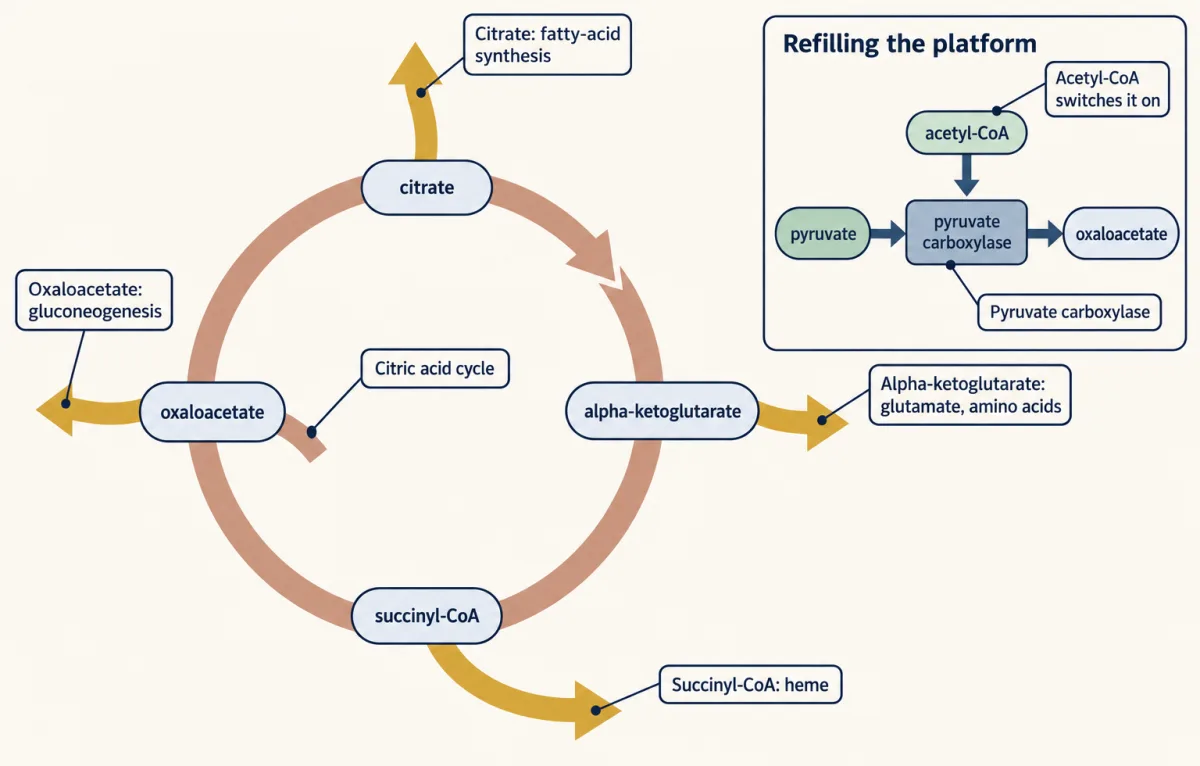
In a real cell, intermediates are drawn off. The cycle is amphibolic: it serves both breakdown and building. Citrate is exported for fatty-acid synthesis, α-ketoglutarate becomes glutamate and other amino acids, succinyl-CoA builds heme, and oxaloacetate (OAA) feeds gluconeogenesis. Each withdrawal takes carbon that would have become OAA, so the pool would shrink. The cell refills it by anaplerosis: in many tissues chiefly pyruvate carboxylase (glutamine is a major source in dividing cells), which adds CO₂ to pyruvate to make OAA and is switched on by acetyl-CoA, a feedforward signal (“fuel is arriving; build more of the platform”).
When the cycle’s enzymes break, its intermediates can drive cancer. Mutations in succinate dehydrogenase and fumarase let succinate and fumarate pile up as oncometabolites in paragangliomas and kidney cancer. Mutant IDH1 or IDH2, the NADP⁺-dependent cousins of the cycle’s NAD⁺-dependent IDH3, gain a new activity: they make 2-hydroxyglutarate, scrambling the epigenome in gliomas and leukemias, while IDH3 still runs step 3. IDH inhibitors are now real drugs.
Going deeper
The main line above does not depend on these details.
Citrate synthase’s pull
Citrate synthase works by ordered induced fit: binding oxaloacetate (OAA) makes the enzyme clamp shut, creating the acetyl-CoA site. The citryl-CoA intermediate is hydrolyzed while still bound, so the thioester energy is not wasted. The step is one of the cycle’s most exergonic (ΔG°′ ≈ −31.4 kJ/mol) and effectively irreversible: the committed step that pulls the whole cycle forward.
Pyruvate dehydrogenase’s twin
The α-ketoglutarate dehydrogenase complex shares pyruvate dehydrogenase’s E1/E2/E3 architecture, its five cofactors (TPP, lipoic acid, CoA, FAD, NAD⁺) and its substrate channeling, which tunnels intermediates from one active site to the next without ever letting them diffuse free.
Synthase versus synthetase
A synthetase, unlike a synthase, uses or makes a nucleotide triphosphate. Succinyl-CoA synthetase (step 5) runs in the direction that makes GTP, through a phosphohistidine intermediate: a histidine in its active site is phosphorylated on the way.
The Warburg effect
In the Warburg effect, tumors run glycolysis hard even with oxygen available. It is a related rewiring at the cycle’s entrance: more pyruvate is turned into lactate rather than entering the cycle as acetyl-CoA, although many tumors keep a working cycle, often fed by glutamine.
Krebs and the urea cycle
Krebs had already found the urea cycle in 1932, five years before this one. That work taught him what to look for in the pigeon-muscle experiments: find the molecule that comes out unchanged, and you have found the catalyst at the heart of a cycle.
Your notes
Select any text in the lesson to highlight it or add a note to it. Your highlights and notes are saved in this browser and collected in your notebook.
This browser is not letting the site save anything (a private window or strict privacy settings), so highlights and notes will be lost when you leave the page.
How we measure it
Warburg manometry (respirometry)
A sealed flask on a manometer measures the gas a tissue exchanges — O2 consumed, CO2 released — in real time. Krebs used minced pigeon-breast muscle on Warburg's manometer to watch respiration speed up when he added an intermediate, the assay that built the cycle. Its modern descendant is the Seahorse analyzer, which reads cellular oxygen consumption to fingerprint mitochondrial function.
Selective enzyme inhibition (pathway dissection)
Jam one step with a specific poison, then see which intermediate floods and which runs dry — that pattern reveals the order of the steps. Malonate blocks succinate dehydrogenase and backs up succinate; fluoroacetate, once the cell converts it to fluorocitrate, blocks aconitase and backs up citrate. Krebs used this 'poison and watch the traffic jam' logic with malonate, alongside evidence that citrate forms from oxaloacetate and that small amounts of intermediates boost respiration far beyond their own oxidation, to show the sequence was a cycle.
Isotopic carbon tracking
Label a carbon with ¹³C or ¹⁴C and trace where it lands turn by turn. This is how experiments showed that the carbons leaving as CO2 in one turn are not the carbons that just entered — and that from succinate on the molecule is symmetric, so the two ends become indistinguishable. It turns 'memorize the cycle' into 'reason about the cycle.'
Practice questions on this lesson (3) → MCAT-style, original, each with an explanation
Where this lesson fits
Before thisReview first
- The Pyruvate Dehydrogenase Complex: The One-Way Gate to the CycleThis course · Lesson 18
It makes the acetyl-CoA that enters the cycle and works the same way as step 4 here.
- Glycolysis: The Investment-and-Payoff PathwayThis course · Lesson 16
It supplies the pyruvate and shows why NAD+ is the bottleneck that the cycle's carriers must solve.
- Metabolism: Basic Concepts and DesignThis course · Lesson 15
You need its ideas of electron carriers, coupling and oxidation state to follow how the cycle banks electrons.
After thisStudy next
- Oxidative Phosphorylation: The Electron-Transport ChainThis course · Lesson 20
The chain empties the NADH and FADH2 loaded here, and oxygen's role at its end is explained there.
- The Proton-Motive Force and ATP SynthaseThis course · Lesson 21
It turns the electrons from the cycle into ATP, completing the count of about 10 ATP per acetyl-CoA.
- Integration of Metabolism: How the Body Switches FuelsThis course · Lesson 30
It shows how the cycle's control points and drawn-off intermediates are set across fed and fasting states.
Suggested by an AI model from the lessons themselves, then checked. How we use AI
Finish line
Test yourself
8 questions
Practice and MCAT-style, with explained answers.
Play it · about 3 min
Ledger Rush: Citric acid cycle
Count every NADH, FADH₂, GTP and CO₂ in one turn, and toss the myths.
Play →Next · Lesson 20
Oxidative Phosphorylation: The Electron-Transport Chain
Electron flow and ATP synthesis are two separate machines linked by one thing: the proton gradient.
Continue →Also in the arcade for this lesson: Metabolic Autopsy: Citric acid cycle
← Lesson 18 · The Pyruvate Dehydrogenase Complex: The One-Way Gate to the Cycle