Take It Apart, Build It Again
Read the transcript of “Take It Apart, Build It Again”
Film transcript: Take It Apart, Build It Again
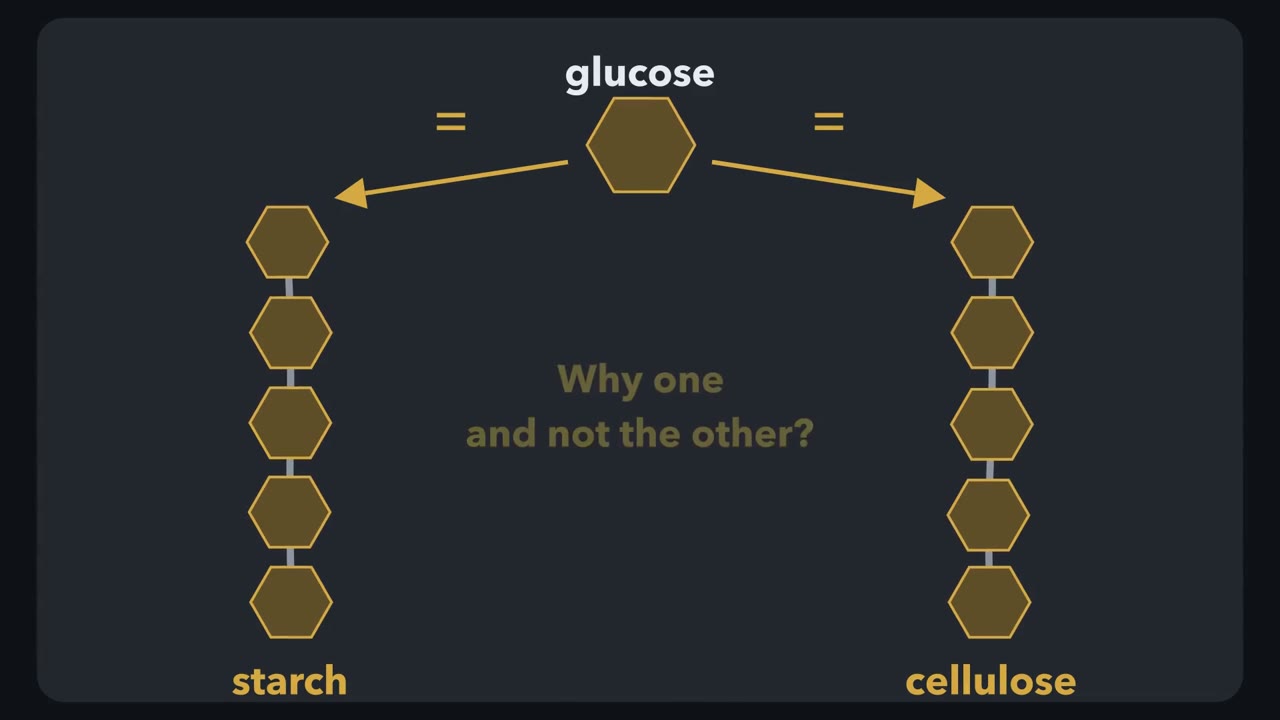
You eat a turkey sandwich, and some of it goes on to become part of you. How can a wheat plant and a bird turn into part of a person? Zoom into the bread. Its starch is a long chain of small sugar blocks. Now zoom into the turkey. Its proteins are chains of a different kind of block, amino acids of many kinds. Each small block is called a monomer. A long chain of them is a polymer. Think of beads on a necklace, though real chains fold and coil.
In your gut, the chains come apart. A water molecule slips into one link, and the link breaks. Splitting with water is called hydrolysis. One water, one broken link. Here is a chain of six sugar blocks. How many water molecules will it take to break every link?
Five. Six blocks have only five links between them. Each water breaks one link. So it is one water per link, not one per block. The freed blocks leave the gut and reach your body's cells. There, the job turns around. Instead of taking chains apart, the cell builds new ones. Inside the cell, the blocks join into new chains.
Compare the free blocks with the finished chain. One water's worth of atoms is missing at each link. Building by removing water is called dehydration synthesis. Now count it the other way. Breaking a chain of six blocks took five waters. A chain of six built from free blocks is five waters short. One per link, either way. Joining blocks does not happen for free. Joining takes energy. In cells, each kind of molecule is built by its own energy-using route. So the real steps usually release other products, not water. The water count is bookkeeping for the atoms. Taking apart adds water. A built chain is one water short per link. Look at the new protein.
Its amino acids sit in a different order from the turkey's. A turkey protein does not become your protein. Its blocks are reused. Cells use four kinds of block: simple sugars, amino acids, nucleotides, and the fatty acids and glycerol of fats. They build four classes of large molecule. The text sorts out which block builds which. So the sandwich does become you, block by block. Digestion adds one water for each link it breaks. Counted from its free blocks, each new chain is one water short per link.
How can a turkey sandwich on whole-wheat bread end up as part of your own body?
Continue in the lesson: What Am I Made Of? →
3:15 · Free, with captions and a transcript. The lesson has the full text, the questions and the sources.
More films from this lesson
How this film was made. Narration: written from this lesson's text and read by an AI narrator voice (Kokoro, af_heart). Animation: AI-generated in code (Manim) by Claude, a schematic with no drawn molecular structures. Captions come from the narration script. See something wrong? Report it.