Sensory Systems · Skim version
Proprioception: Sensing the Body's Own Position
Read the full lesson → Skim the whole course →
The guiding idea
Vibrate a tendon at 100 Hz and a person with their eyes closed misjudges the position of the elbow, by as much as 40 degrees when the muscle is contracting.
Limb position is an estimate built mainly from muscle spindle length signals, which carry no label of cause, so vibrating a tendon of an unseen, still limb usually biases it toward stretch of that muscle.
From the film: Read as Stretch
- Limb position is an estimate built mainly from muscle spindle signals of muscle length.
- A spindle's firing carries no label of its cause, so vibrating one tendon of a still, unseen limb usually biases the estimate toward that muscle being stretched.
- When proprioceptive input is severely impaired, accurate movement depends heavily on vision.
From the film: The Channel on the Line
- Deleting Piezo2 with two Cre lines, neither specific to proprioceptors, sharply reduced stretch-evoked firing in mouse muscle, so Piezo2 is the principal transducer on the stretch line.
- A small stretch response remained, which may be Piezo2 left by incomplete deletion; it neither proves nor rules out a second channel.
- How a channel whose current fades within milliseconds in cultured cell bodies supports a held stretch is still open.
From the film: When the Line Goes Quiet
- When proprioceptive input is lost, vision does much of the work of knowing where the arm is, and without sight reaching becomes far less accurate.
- Two people with inactivating PIEZO2 variants and a man without large-fibre sensation show this, though neither case silences spindles alone.
- In mice, deleting Piezo2 with a parvalbumin driver curved the spine in some animals by postnatal day sixty, and how the signal reaches the skeleton is not known.
-
The illusion, and the rule it reveals
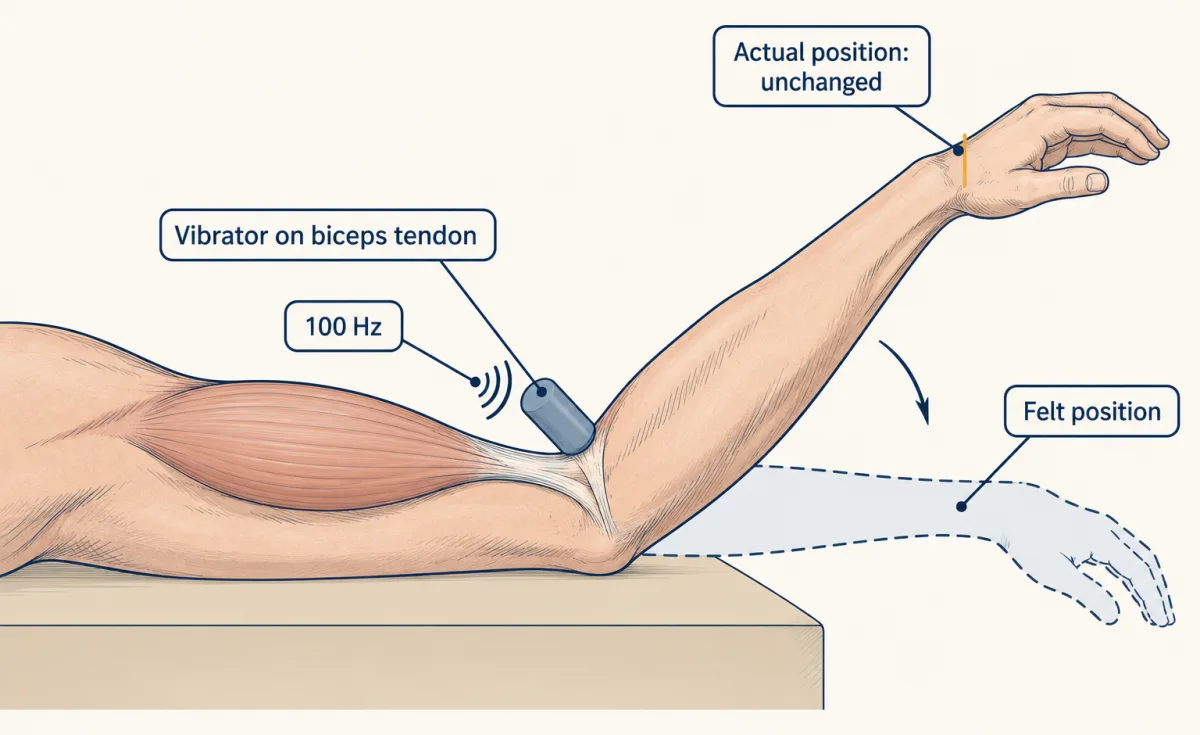
Vibrating the biceps tendon at 100 Hz, Goodwin, McCloskey and Matthews found that subjects judged a position consistent with stretching the vibrated muscle, though the joint had not moved. The illusion shows that muscle afferent signals bias the percept. AI-generated illustration -
Which lines feed the estimate
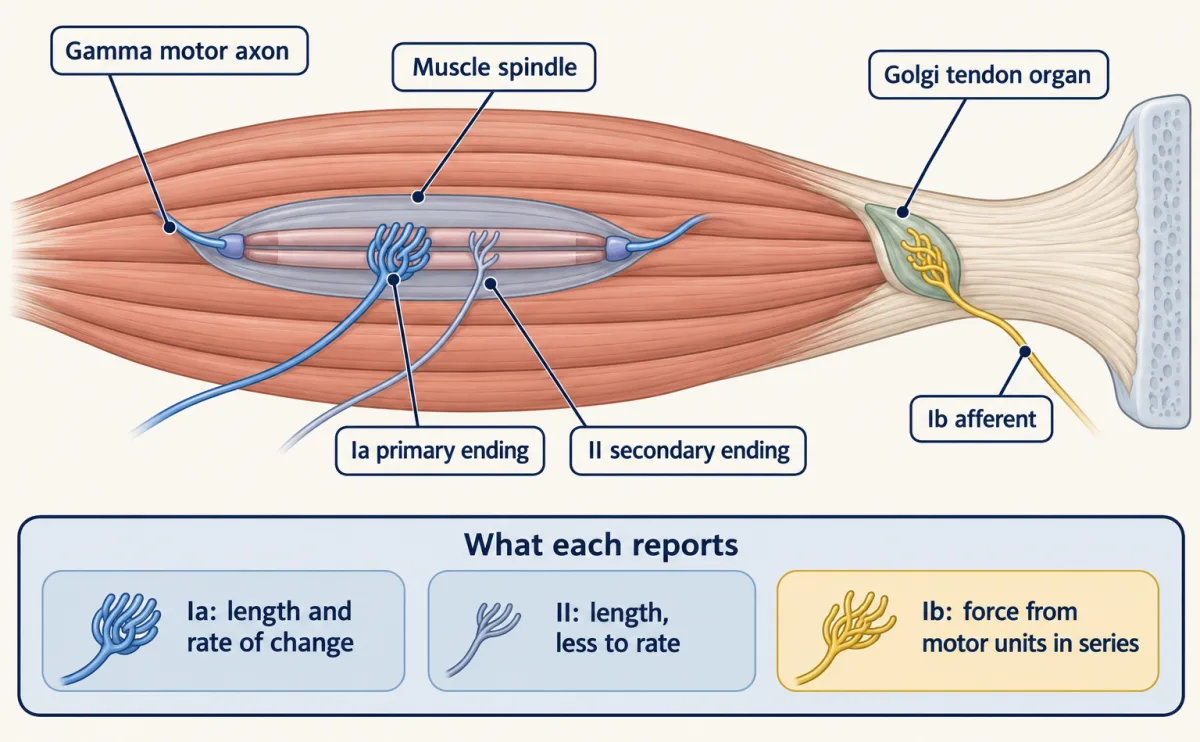
A muscle spindle has one primary Ia ending and usually one or more secondary II endings, set in gain by gamma motor neurons at its polar ends. Both signal static muscle length and Ia adds sensitivity to its rate of change. A Golgi tendon organ at the myotendinous junction reports force from the motor units in series with it. AI-generated illustration -
The transducer: Piezo2 on the stretch line
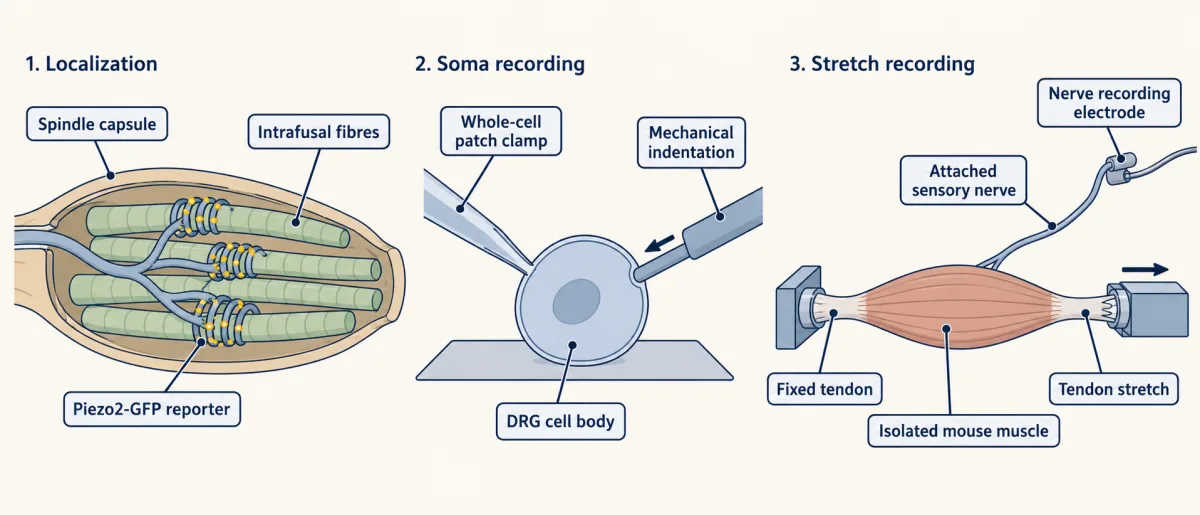
Woo and colleagues used three setups in mouse: a Piezo2-GFP reporter for where the protein sits, patch clamp with mechanical indentation of dissociated neurons for the current it carries, and stretch of an isolated muscle with its nerve for whether the ending needs it. A small stretch response remained after deletion, which may reflect incomplete deletion, so Piezo2 is called the principal transducer. AI-generated illustration -
Take the line away: people
-
What else the line is for: the skeleton
-
Where the idea stops
-
Going deeper
Where this lesson fits
Before thisReview first
- Piezo Channels and the Physics of ForceThis course · Lesson 2
You need how Piezo channels turn force into current to follow the Piezo2 transducer argument here.
- The Low-Threshold Mechanoreceptors: One Touch, Several SignalsThis course · Lesson 4
This lesson builds on reading what a sensory line signals, as touch neuron classes do for skin.
- Sensory Neurons by Their Genes: the Atlas EraThis course · Lesson 3
The proprioceptor atlas disagreement here assumes you know how single-cell clusters define sensory neuron groups.
After thisStudy next
- Vagal Sensory Neurons: The Body Reports to the BrainThis course · Lesson 16
It extends the study of Piezo-dependent body sensing from limb position to internal organs.
- Balance: Two Codes for Every Head MovementThis course · Lesson 25
It takes the same body-position estimate further, with balance signals combined with other senses.
- Combining Senses and Predicting ThemThis course · Lesson 29
It builds on the vibration illusion and vision taking over when proprioception is lost, as senses are weighted.
Elsewhere on the siteFilms, simulations and method films in other courses
- Where Every Command EndsFilm · Neuroscience
It shows how the stretch signal from the spindle drives reflex action on motor neurons.
- A Predictor That Learns from ErrorFilm · Neuroscience
It shows how movement prediction uses sensory feedback, and what clumsiness follows when that estimate fails.
- Every Response Has a Running TimeFilm · Organismal Biology
It follows the stretch-reflex route from receptor through sensory neuron to effector that carries the spindle signal.
Suggested by an AI model from the lessons themselves, then checked. How we use AI