Where Every Command Ends
Read the transcript of “Where Every Command Ends”
Film transcript: Where Every Command Ends
Lifting a cup and lifting a suitcase can use the same muscle. Who decides how hard it pulls? The decision ends in the spinal cord, at cells called alpha motor neurons. Each motor neuron's axon branches to many muscle fibres. The neuron and its fibres make one motor unit. One spike normally makes every fibre of its unit twitch. All the motor neurons that supply one muscle make up its motor pool. Commands come from the brain, stretch sensors, pain and rhythm circuits. All of them end on the motor neurons. Sherrington called them the final common path. Picture one motor neuron's voltage as a bar, with a line at threshold. Excitation pushes the bar up, toward the line.
Inhibition holds it back. Usually it pulls the bar down. Its open channels also blunt excitation. When the net current lifts the bar to the line, the cell fires. So ask two questions of any spinal circuit. Which motor pools does it push up, and which down? And within a pool, which cells reach threshold first? Take a pool of small cells, which make weak units, and large cells, which make strong units. The input to the whole pool rises a little at a time. Which cells fire first?
The small ones. Many people guess the large ones, because big seems strong. Firing depends on how far the input moves the voltage. The same input moves a small cell further. A small cell has less membrane, so fewer ways for current to leave. Its input resistance is higher. Think of a bathtub with fewer drains. The same inflow raises the water higher. On screen is Ohm's law for a motor neuron. Higher input resistance means less current is needed. That order, small before large, is the size principle. Under shared input it is a strong tendency, not a law. There is a catch. A large cell has room for more synapses, so it can collect more input. In this simple model, small cells still go first if effective current grows less steeply with size than input resistance falls.
Real current distributions depend on the pathway. So, with equal thresholds, the small cells still go first. A pool has a second way to add force. Active units fire faster, so their twitches add up. Every command ends as current on motor neurons. Which pools go up or down, and who fires first?
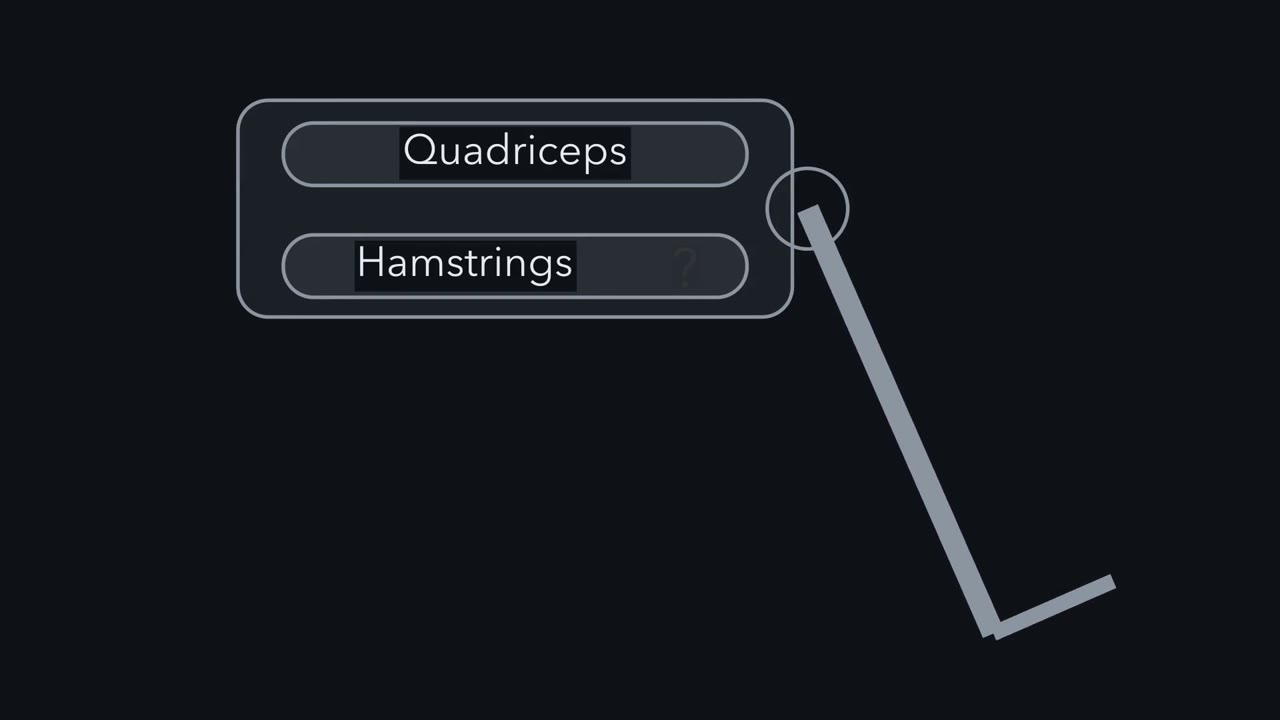
A knee tap makes the quadriceps kick and inhibits the hamstrings, yet the sensory axon that starts both only ever excites. How?
Continue in the lesson: Motor Units, Reflexes and Locomotion →
2:45 · Free, with captions and a transcript. The lesson has the full text, the questions and the sources.
More films from this lesson
How this film was made. Narration: an AI narrator voice (Kokoro, af_heart) reading narration written from this lesson's text. Animation: AI-generated in code (Manim) by Claude, a schematic with no drawn molecular structures. Captions come from the narration script. See something wrong? Report it.