Developmental Neuroscience · Skim version
Choosing a Partner: Layers, Self-Avoidance and Smell
Read the full lesson → Skim the whole course →
The guiding idea
How does a neuron stop in the right layer, find the right partner and keep its own branches from tangling? One fly gene that can make tens of thousands of different surface proteins is part of the answer.
A match between identical surface proteins only says the cells are the same, and the cell decides what that means: stick when a group shares the label, retreat when each cell carries its own.
From the film: Same Means Stick
- A gradient suits continuous order but is poor at discrete choices such as which layer, so discrete labels are often needed.
- In chick retina, making neurons produce a Sidekick they normally lack shifted their processes toward the sublamina rich in that Sidekick.
- A match between identical proteins only says the cells are the same, and the cell decides what same means.
- When a group of cells shares a sticky label, their processes are drawn together; such labels help layers form alongside other cues.
From the film: A Badge Only You Wear
- Self-avoidance means a neuron's own sister branches move apart while its branches still overlap those of other neurons.
- Fly Dscam1 can be spliced into 38,016 isoforms that bind mainly to identical isoforms, and matched branches pull apart.
- Which isoform a neuron carries matters little; what matters is that its own branches match and its neighbours carry different ones.
- In the mouse starburst amacrine cells tested, gamma protocadherins are needed for a cell's own dendrites to avoid each other.
From the film: A Receptor That Is Also an Address
- In mouse, olfactory sensory neurons that express the same odorant receptor are scattered in the nose, yet their axons gather in about two glomeruli per bulb.
- Deleting the P2 receptor left its axons wandering without forming a P2 glomerulus, so the receptor is needed.
- Putting M12 in place of P2 sent axons near the P2 glomerulus, not M12's own, so the receptor helps choose the target and other features of the neuron also count.
-
Labels, not gradients
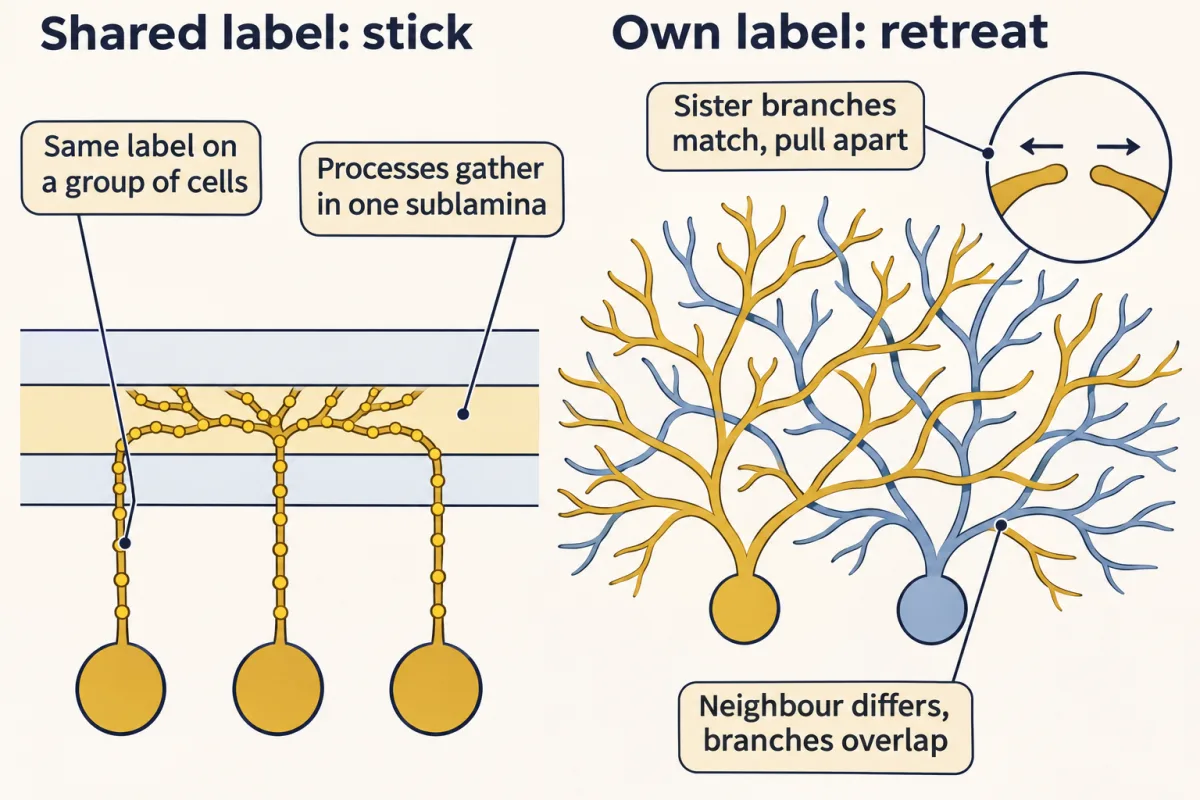
The same kind of match can mean opposite things. When a group of cells shares a label and responds by sticking, their processes gather in one sublamina; when each cell carries its own label and responds by retreating, its own branches spread apart while still overlapping a neighbour that carries a different label. AI-generated illustration -
Same means stick: layers in the retina
-
A badge only you wear: self-avoidance
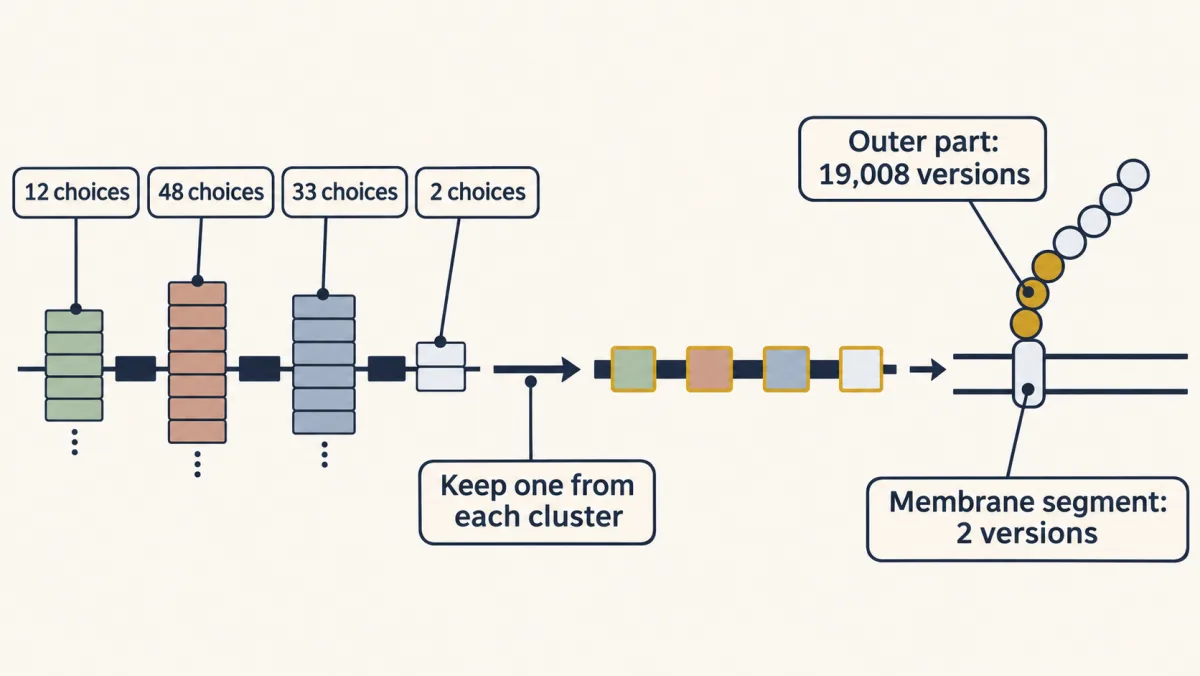
Each Dscam1 messenger RNA keeps one exon from each of four clusters. The first three clusters build the outer part, giving 19,008 versions that meet other cells; the fourth changes only the stretch inside the membrane, for 38,016 isoforms in all. AI-generated illustration -
Same problem, different molecules: the mouse
-
A receptor that is also an address: smell
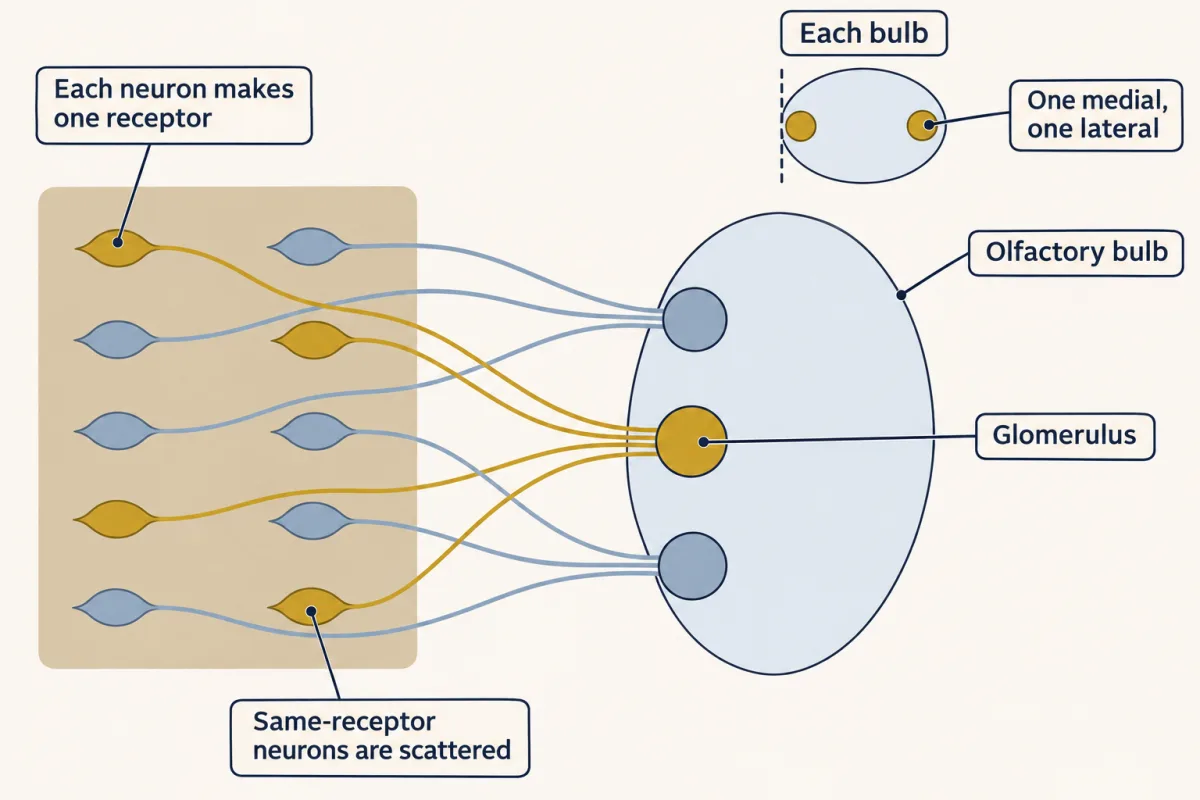
Neurons that express the same odorant receptor are scattered in the epithelium, yet their axons gather in a few glomeruli of the olfactory bulb, about two per bulb, one medial and one lateral. AI-generated illustration -
Putting it together
-
Going deeper
Where this lesson fits
Before thisReview first
- Pioneers, Guideposts and the Logic of Guidance CuesThis course · Lesson 22
It sets out how axons read cues along their path, which this lesson extends to the final choice of layer and partner.
After thisStudy next
- Synapse Elimination: One Muscle Fiber, One AxonThis course · Lesson 37
It takes the matching of axon and target further, as competing axons on one muscle fiber lose or keep their synaptic sites.
- Synapses in the Brain: Adhesion, Scaffolds and AstrocytesThis course · Lesson 36
It builds on partner choice by showing how adhesion proteins and scaffolds then turn a contact into a synapse.
- Activity Before Experience: Spontaneous Retinal WavesThis course · Lesson 38
It covers the activity-driven refinement of maps that this lesson says follows label-based targeting.
Elsewhere on the siteFilms, simulations and method films in other courses
- One in Two ThousandFilm · Sensory Systems
It shows how each olfactory neuron picks one receptor gene, the choice that later sets its glomerulus address.
- What the Bulb SendsFilm · Sensory Systems
It follows the glomerular map of receptor identity that these axons build in the bulb.
- A Cell Cannot Name a MoleculeFilm · Neuroscience
It shows one receptor type per olfactory neuron, with separate lines for each receptor, the basis of glomerular sorting.
Suggested by an AI model from the lessons themselves, then checked. How we use AI