Biochemistry · Skim version
Oxidative Phosphorylation: The Electron-Transport Chain
Read the full lesson → Skim the whole course →
The guiding idea
Electron flow and ATP synthesis are two separate machines linked by one thing: the proton gradient.
The whole point of oxidative phosphorylation is that electron flow and ATP synthesis are two separate machines linked by one thing: a proton gradient across the inner mitochondrial membrane.
-
The energy ladder
-
The chain, in order
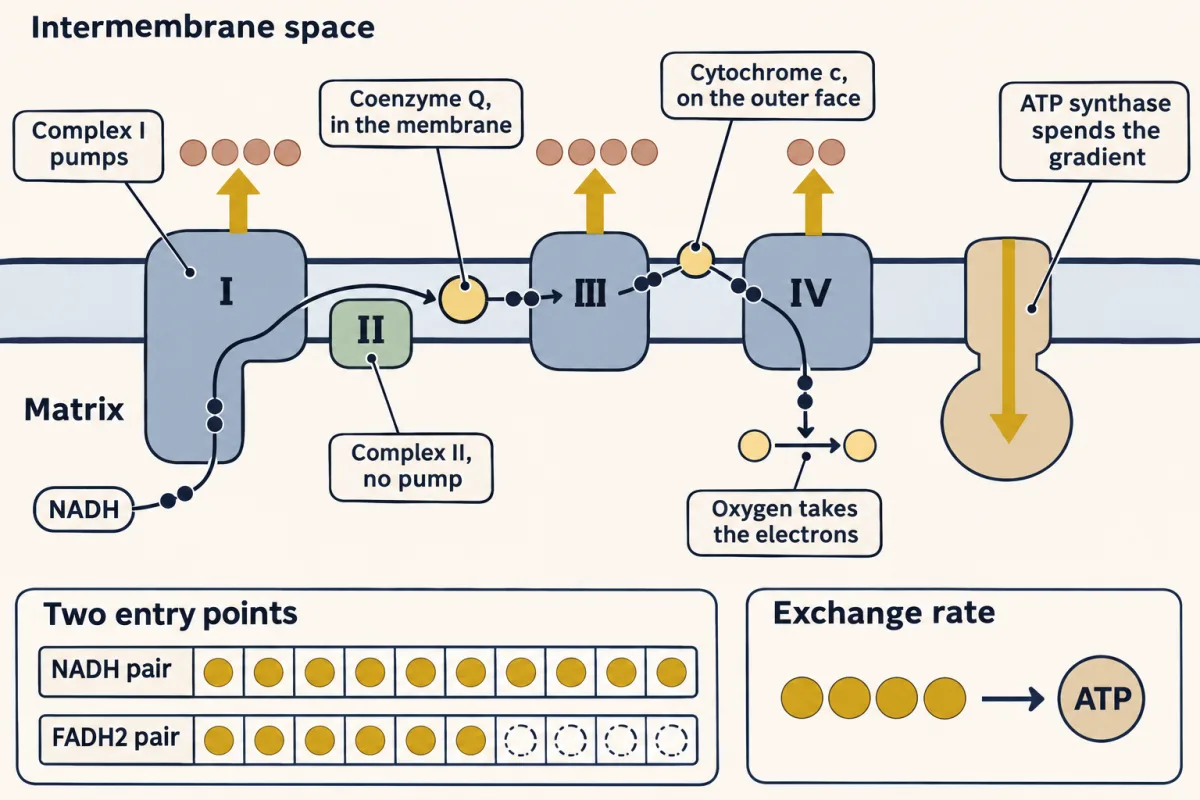
One pair of electrons, three pumps. A pair from NADH passes Complexes I, III and IV and moves 4 + 4 + 2 = 10 protons out of the matrix; a pair from FADH2 joins at Q, skips Complex I and moves 6. ATP synthase, a separate machine, spends about 4 protons per ATP. AI-generated illustration 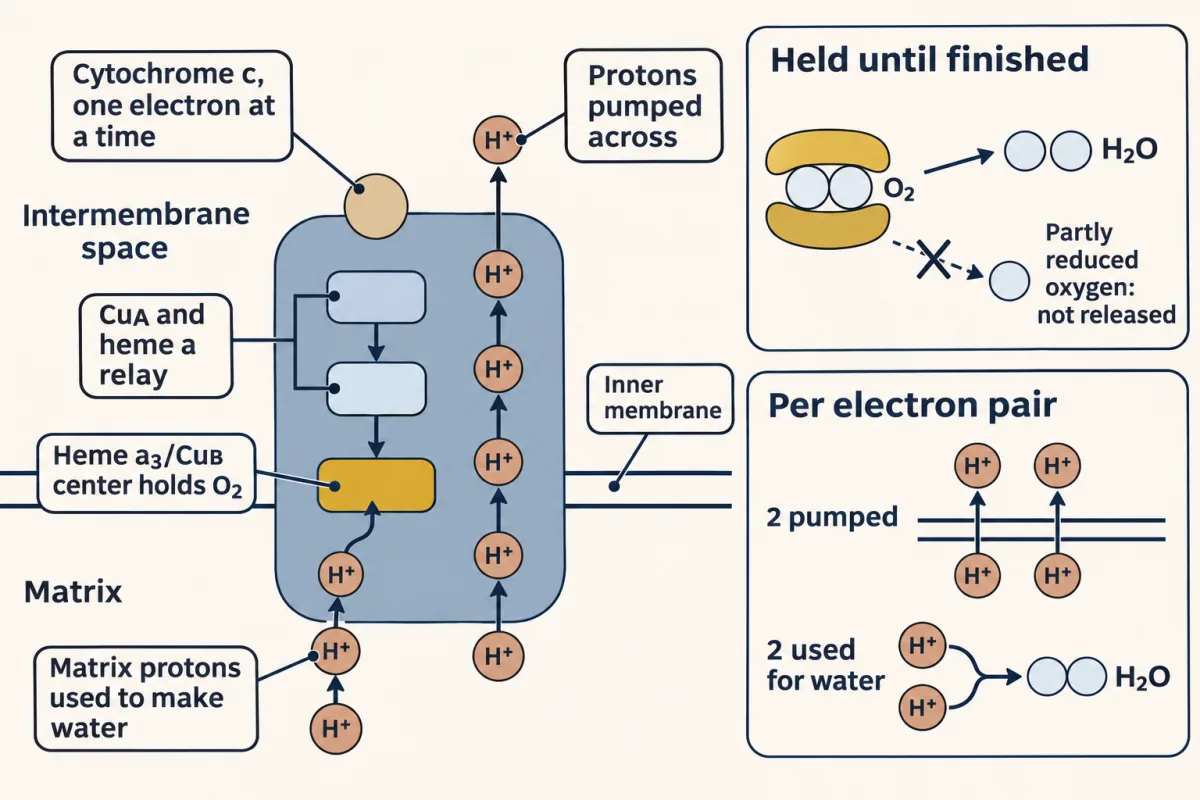
Electrons pass from cytochrome c through CuA and heme a to the heme a3/CuB center, which grips O₂ and every partly reduced form of it until all of it is water. Per electron pair, Complex IV pumps 2 protons across and uses 2 more from the matrix to make water. AI-generated illustration -
The proton ledger
-
Two machines that keep each other in step
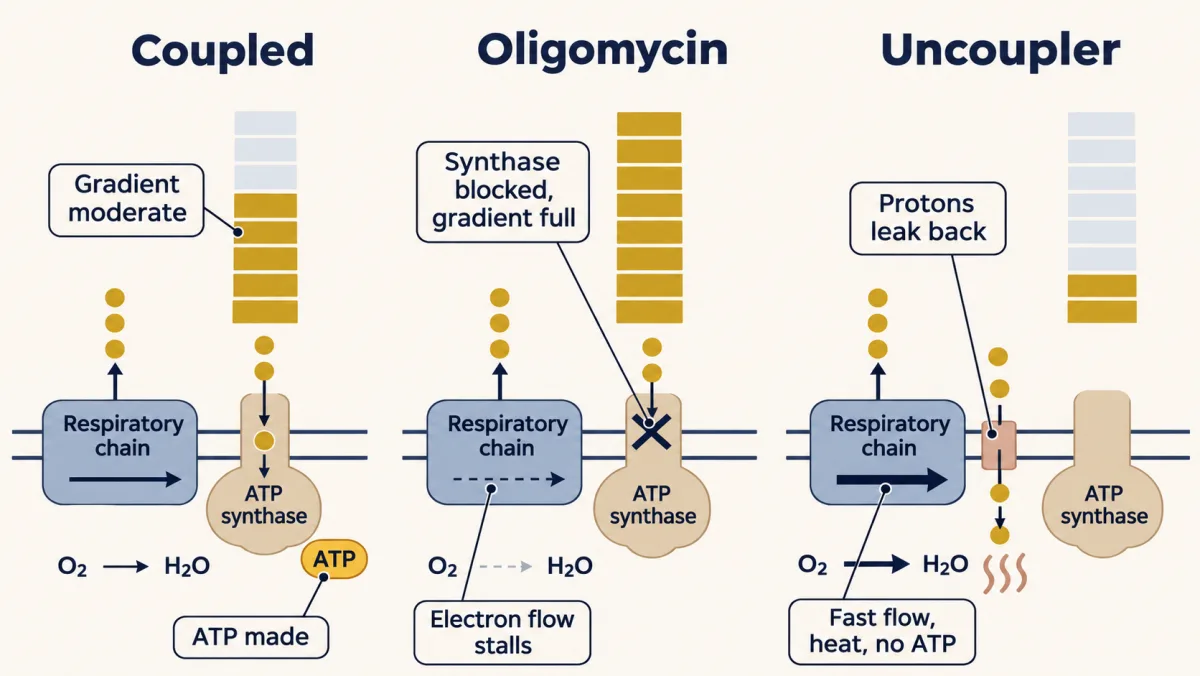
The gradient sets the pace. Block ATP synthase with oligomycin and the gradient fills until the pumps can push no more, so electron flow and oxygen use nearly stop. Add an uncoupler and protons leak back without making ATP, so the gradient stays low, electrons race and the energy leaves as heat. AI-generated illustration -
Reading the order of the chain
-
The price of running on oxygen
-
Where the oxygen, and the mitochondria, came from
-
Going deeper
Where this lesson fits
Before thisReview first
- The Citric Acid Cycle: Harvesting ElectronsThis course · Lesson 19
It makes the NADH and FADH2 whose electrons start the chain, and Complex II is also a cycle enzyme.
- Metabolism: Basic Concepts and DesignThis course · Lesson 15
You need its energy coupling and free-energy ideas to follow how electron drops pay for pumping protons.
- Membranes: The Impermeable Sheet That Builds ItselfThis course · Lesson 12
The gradient only works because the inner membrane is impermeable to ions, which this lesson explains.
After thisStudy next
- The Proton-Motive Force and ATP SynthaseThis course · Lesson 21
It follows the gradient into ATP synthase, the machine that spends the proton battery built here.
- Integration of Metabolism: How the Body Switches FuelsThis course · Lesson 30
It shows how the body tunes fuel use around the oxygen-dependent ATP supply this chain provides.
- Photosynthesis: The Light ReactionsThis course · Lesson 22
Photosynthetic electron transport uses the same redox ladder and proton gradient, pointing the opposite way.
Elsewhere on the siteFilms, simulations and method films in other courses
- A cell’s energy budgetSimulation · Biology
It lets you budget a cell's ATP spending and rebuilding, the demand that electron transport and ATP synthase meet.
- Two Jobs in One Green CellFilm · Life Science
It shows mitochondria using oxygen day and night in the same cell where chloroplasts make it.
- Spending ATP, Rebuilding ATPFilm · Biology
It shows how a cell keeps rebuilding ATP from ADP, the job the proton gradient does here.
- A Tap, a Hole, a LevelFilm · Cell Biology
It shows that a membrane leaks, so a pump must keep paying to hold a gradient, as with protons here.
Suggested by an AI model from the lessons themselves, then checked. How we use AI