Cell Biology · Skim version
Organelles as Distinct Environments
Read the full lesson → Skim the whole course →
The guiding idea
A lysosome near pH 4.7 and a mitochondrial matrix near pH 8 share one cytosol near 7.2. What holds each at its own number?
A eukaryotic cell keeps several chemistries side by side: an acid lysosome, a calcium-rich ER store and an alkaline mitochondrial matrix, all sharing one cytosol near pH 7.2.
From the film: A Tap, a Hole, a Level
- A membrane leaks, so each gradient here lasts only while a pump keeps paying to balance the leak.
- Block the pump and the gradient runs down: bafilomycin made the HeLa Golgi less acid, and thapsigargin, by blocking SERCA, lets the ER's calcium store drain.
- Small ions pass quickly through nuclear pores, so the nucleus stays close to the cytosol's pH.
- While respiration runs, and in chloroplasts in the light, pumps push protons out of the matrix and stroma, once a bacterium's cytoplasm, so those spaces are alkaline.
From the film: Follow the Markers
- Cell fractionation separates broken cells by repeated centrifuge spins; crude fractions overlap and are not assumed pure.
- Marker proteins of known home, such as histone H3, cathepsin D and pyruvate kinase, each spread across the fractions in their own shape.
- An unknown protein is assigned provisionally by comparing its whole profile with marker groups; split locations can yield mixed, uncertain profiles.
- Latency supports membrane enclosure: if detergent does not alter the enzyme itself, opening the membrane lets an outside substrate reach it.
-
A toy model with numbers
-
The pH ladder
-
Turning the knobs
-
Same pump, different rungs
-
Pumps facing out, because they were bacteria
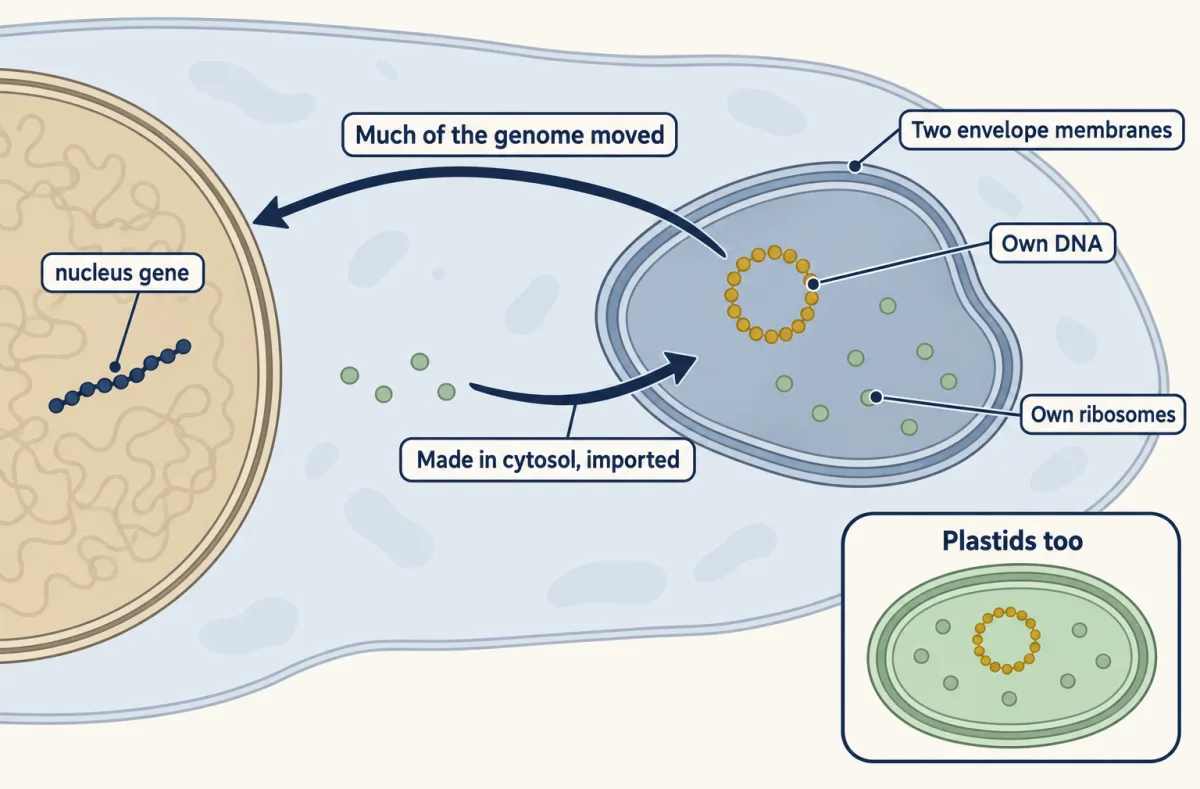
Mitochondria and plastids keep their own DNA and ribosomes inside two envelope membranes (more around some algal plastids), but much of the ancestral genome was lost or moved to the nucleus, and most mitochondrial proteins are made in the cytosol and imported. The DNA is drawn as a loop for simplicity; some mitochondrial genomes are linear. AI-generated illustration -
Which compartment holds a protein?
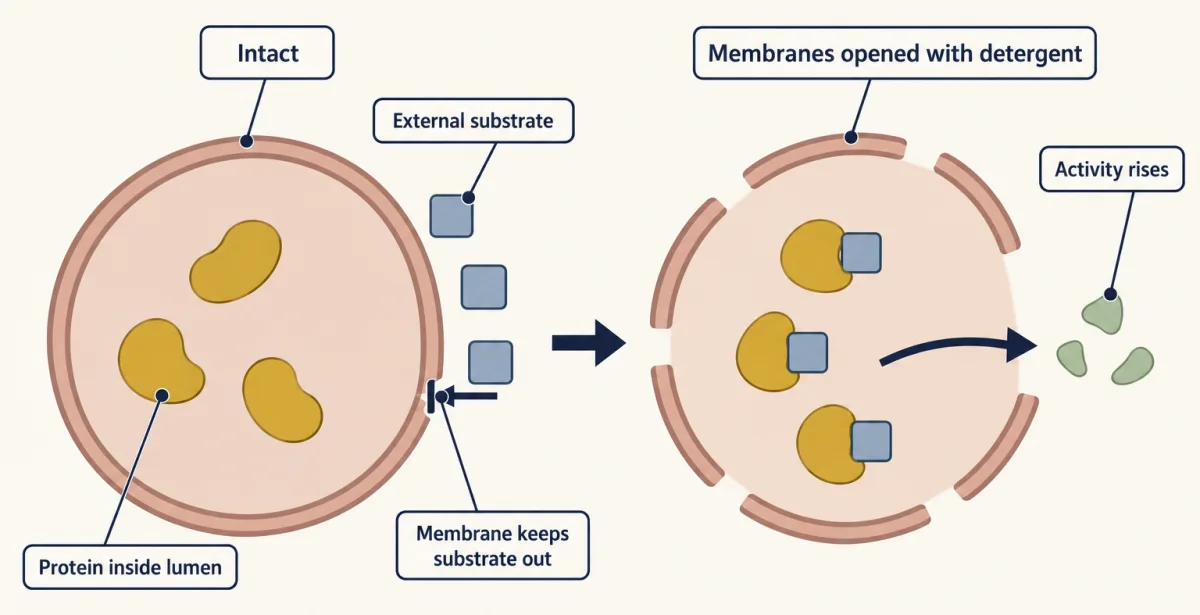
Latency as a test of location. An enzyme sealed inside a lumen cannot act on a substrate outside; when detergent opens the membranes its activity rises. AI-generated illustration -
Going deeper
Where this lesson fits
Before thisReview first
- Transport Across MembranesThis course · Lesson 5
You need pumps, leak fluxes and gradients across a membrane from there to model each organelle's level here.
- Experiments That Distinguish MechanismsThis course · Lesson 3
The fractionation profiles and latency test here apply its logic of choosing experiments that separate mechanisms.
- Membrane Organization and TopologyThis course · Lesson 4
This lesson uses the idea that a bilayer keeps its two faces and lumen separate.
After thisStudy next
- Protein Sorting into CompartmentsThis course · Lesson 7
It explains how proteins made in the cytosol reach the compartment where you have just assigned them.
- Protein Quality Control and Organelle TurnoverThis course · Lesson 9
It builds on the acid lysosome whose pump-maintained pH lets hydrolases degrade material.
- Endocytosis, Recycling and DegradationThis course · Lesson 13
It follows cargo through endosomes whose falling pH, set by the V-ATPase, releases ligands and receptors.
Elsewhere on the siteFilms, simulations and method films in other courses
- The proton-gradient battery — a cross-section of the inner membrane: run electrons through Complexes I→III→IV to charge the gradient, mint ATP, then add an uncoupler and watch ATP collapse while electrons keep flowing as heatSimulation · Biochemistry
It shows the respiratory chain pumping protons out of the matrix, which sets the alkaline matrix pH here.
- Breaking the proton gradientFilm · Biochemistry
It shows how a proton gradient across the inner membrane is built and broken, as with ionophores here.
- A Path Is Not a PumpFilm · Biochemistry
It shows how a leaky bilayer needs pumps to keep a gradient, the core idea of this lesson.
Suggested by an AI model from the lessons themselves, then checked. How we use AI