Cell Signaling · Unit 8: Evolution, disease and tools
Oncogenes: When the Switch Sticks
Rewritten on : new text and film. Your notes and highlights stay, but the text around them may have moved.
A chicken virus causes cancer with a gene healthy birds already carry—how does a cell's own signalling switch get stuck on?
The main idea, the figures and what the films show. Under each heading, "Read this part" opens it.
Both films in order, 6 minutes. Each one ends with what to take from it.
The whole lesson: about 22 minutes of reading and 6 of film.
Pause when the reading reaches a film, and offer to play it. Saved on this device.
Watch the film now, or keep listening
That is the end of the reading
This idea at other levels
This lesson teaches oncogenes in Cell Signaling, a graduate course. Simpler: Cancer as a Genetic Disease (college core), or read a short college version here.
The college version · about 1 minute to read
A proto-oncogene is a normal gene, usually for a signalling protein, that becomes an oncogene when a change makes its product active without input, or makes far too much of it. The changes fall into a short list: a point mutation that blocks the off-step (Ras G12V hydrolyses GTP only slowly, even with a GAP), loss of an autoinhibitory piece (v-Src lacks the tail tyrosine that its SH2 domain binds), gene amplification (HER2), and gene fusion (BCR-ABL, in which the BCR part holds ABL kinase domains together). These are gains of function and act as dominants, so one altered copy is enough. Tumour suppressors such as PTEN, neurofibromin and APC are the off-steps of their pathways. Their loss is usually recessive in the cell, so both copies must go, as Knudson's two-hit analysis of retinoblastoma proposed. One oncogene seldom transforms a normal cell, because checkpoints such as p53 answer excess growth signalling with arrest or apoptosis, and tumours therefore carry several cooperating changes. Many tumours still depend on one activated oncogene, which is why inhibiting that one protein can shrink them.
See every levelHide the levels
This lesson also teaches two more ideas; their ladders are below.
Oncogenes
An oncogene is a normal growth-signal gene, altered so it stays switched on and pushes a cell to divide.
Taught at two levels: college core and graduate level.
Graduate · the level you chose
Oncogenes: When the Switch Sticks · this lesson
A chicken virus's src was the hen's own gene; five ways a switch sticks.
Cell Signaling · about 22 min · film 3:10 · 3 practice questions
College, the core · the level you chose
HRAS Val12 ignores the GAP that switches it off; MYC is amplified or moved.
Genetics and Molecular Biology · about 22 min · film 3:34 · 3 practice questions
Play the ladder · 2 films, about 7 min, from college core to graduate level. Each film waits for you to press play.
Next door to oncogenes
- Cancer as a genetic diseaseCancer starts when changes like these let a cell's descendants grow where they should not.Nearest lesson: Cancer as a Genetic Disease (college core)
- MutationAn oncogene begins as a DNA change in a normal growth gene that leaves it stuck on.Nearest lesson: Mutation: Where Variation Comes From (college core)
Cancer as a genetic disease
Cancer starts when DNA changes in one body cell let its descendants grow where they should not.
Taught at two levels: college core and graduate level.
Graduate · the level you chose
Oncogenes: When the Switch Sticks · this lesson
Five ways a growth switch sticks: Ras G12V, v-Src, extra HER2, BCR-ABL, lost PTEN.
Cell Signaling · about 22 min · film 3:10 · 3 practice questions
College, the core · the level you chose
Two hits in retinoblastoma, loss of heterozygosity, and variant fractions in tumor sequencing.
Genetics and Molecular Biology · about 22 min · film 3:34 · 3 practice questions
Play the ladder · 3 films, about 10 min, from college core to graduate level. Each film waits for you to press play.
Next door to cancer
- OncogenesA growth gene stuck in the on position is one of the two main kinds of change that start a tumour.Nearest lesson: Cancer as a Genetic Disease (college core)
- Tumour suppressorsThe other main kind of change removes a brake on division, which is why cancer often needs both copies lost.Nearest lesson: Cancer as a Genetic Disease (college core)
Tumour suppressors
A tumour suppressor gene makes a brake on cell division, and cancer usually needs both copies of it lost.
Taught at two levels: college core and graduate level.
Graduate · the level you chose
Oncogenes: When the Switch Sticks · this lesson
Losing PTEN, neurofibromin or APC takes both copies: Knudson's retinoblastoma ages.
Cell Signaling · about 22 min · film 3:10 · 3 practice questions
College, the core · the level you chose
Two hits on RB1: carriers average about three tumors, so penetrance is near 95%.
Genetics and Molecular Biology · about 22 min · film 3:34 · 3 practice questions
Play the ladder · 2 films, about 7 min, from college core to graduate level. Each film waits for you to press play.
Next door to tumour suppressors
- Cell cycle checkpointsMany suppressors are the brakes that hold a cell at a checkpoint until damage is mended.Nearest lesson: Checkpoints and Irreversible Transitions (college core)
- DNA repairSome suppressors keep repair working, so losing both copies lets damage build up.Nearest lesson: DNA Repair and Recombination (college core)
Short versions inside this lesson
The plainest version · about 1 minute to read
Every cell has go switches and stop switches that tell it when to grow. A go switch is supposed to flip back off after each use. Sometimes a go switch gets stuck on, or a stop switch breaks, and the cell keeps growing when nobody asked it to. It usually takes several broken switches in the same cell before that cell becomes a cancer.
Find an idea: every idea, searchable
Which lessons teach an idea, and the notes on each level, were written by AI models from the lessons and checked by a second model. A person has not yet read every one. How we use AI
About this lesson goals, parts
What you'll learn
- Explain that an oncogene is an altered copy of a normal cell gene, using the Rous sarcoma virus and src story, and define proto-oncogene, oncogene and tumour suppressor.
- Sort five ways a signalling switch can stick on, with an example of each: Ras, Src, HER2, BCR-ABL, and the loss of PTEN, neurofibromin or APC.
- Explain why a gain of function acts when one copy of a gene is changed and why loss of an off-switch usually needs both copies gone.
- Explain why one stuck switch is seldom enough to make a tumour and why a tumour can come to depend on the one it has.
Builds on:GTPase Switches: The Timer (read)Protein Modules: SH2, SH3, PTB, PDZ and PH (read)Receptor Tyrosine Kinases (read)Why these?
Rewritten on : new text and film. Notes and highlights stay, but the text around them may have moved.
The main idea. One altered copy jams a switch, while off-switch loss usually needs both; tumours usually need several changes, yet often depend on one stuck switch.
The films
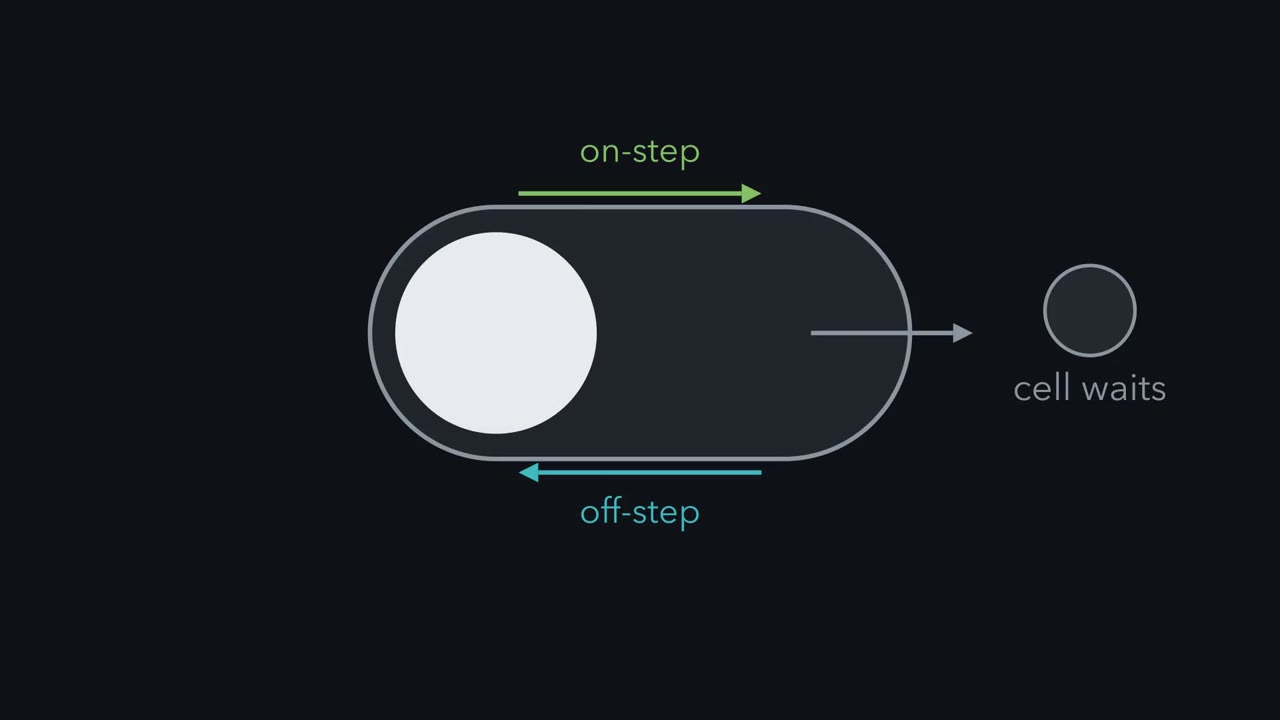 ▶ Watch How a Normal Switch Sticks On · 3:10
Read the transcript of “How a Normal Switch Sticks On”
Film transcript: How a Normal Switch Sticks On
A chicken virus causes cancer using a gene healthy birds already carry. How does a cell's own switch get stuck on, and how many copies does it take? Let us watch one growth switch inside a single cell to find out. A healthy cell divides only when told to. Every growth pathway therefore uses an on-step and an off-step. A growth signal flips the switch on. When the signal leaves, an off-switch flips it back off. A normal gene of this kind, able to become a cancer gene when altered, is a proto-oncogene. Surprisingly, cancer genes are rarely foreign invaders, but altered copies of the cell's own genes. Take the signalling kinase called Src. Normally a phosphate sits on its tail.
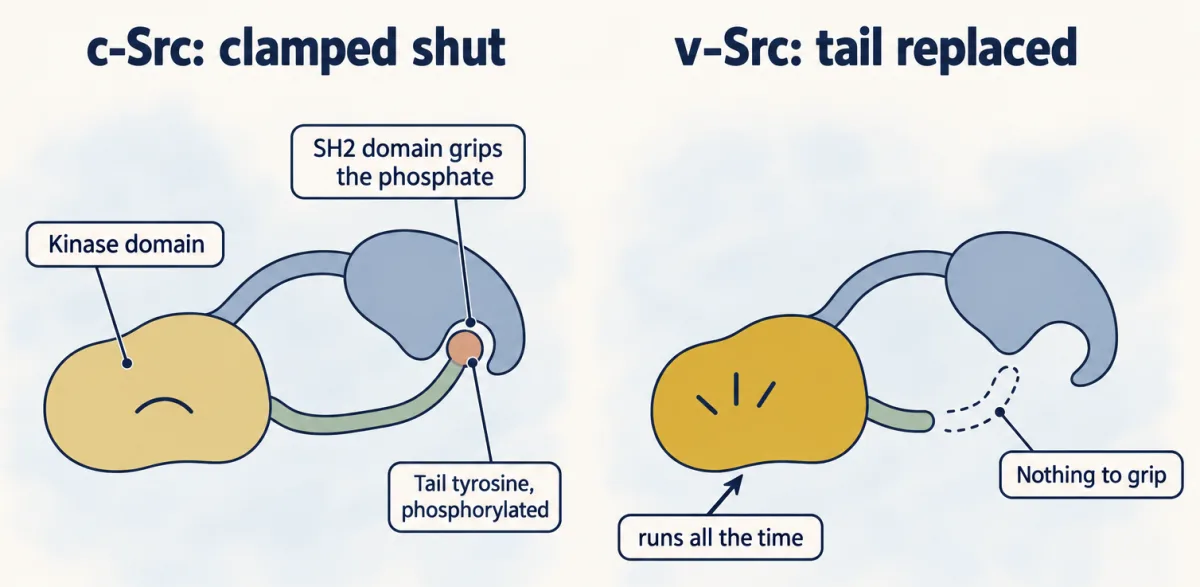
Another part of the same protein grips that phosphate, holding the kinase shut. Replace that tail, and the grip has nothing to hold. The kinase runs all the time, and that altered gene copy is an oncogene. A second switch jams differently.
Ras is on while it holds GTP. It turns itself off by breaking that GTP down. A helper protein called a GAP triggers the breakdown. One changed amino acid gets in the helper's way. Ras then breaks its GTP down only slowly, even with a GAP, so it stays on. Now count the gene copies. You carry two copies of nearly every gene, one from each parent. Alter one copy of Ras, and its protein signals nonstop. The normal protein from the other copy cannot turn it off. That is a dominant gain of function. There is a second route. Instead of jamming Ras, remove its off-switch, the GAP helper. A gene whose loss lets cells grow when they should not is a tumour suppressor.
Suppose a cell loses one of its two off-switch copies. Does the switch stick on? Usually, no, because one working copy still makes enough helper protein to clear the signal. So the switch stays mostly off; losing one copy stays hidden at the cell level. Only when the cell loses the second copy does the off-step fail completely. That is a recessive loss of function. Jamming an on-step needs only one altered copy, because the normal protein from the other copy cannot switch the stuck one off. Removing an off-step usually needs both copies lost, because one good copy still clears the signal. One altered copy jams a switch, while off-switch loss usually needs both.
From the film: four take-homes
- One altered copy jams a switch, while off-switch loss usually needs both.
- Cancer genes are usually altered copies of the cell's own signalling genes, not foreign parts.
- A switch sticks on either when an on-step is jammed or when an off-step is removed.
- One altered on-step copy pushes the pathway on beside a normal copy, while one good off-step copy usually keeps the switch in check.
A chicken virus causes cancer using a gene healthy birds already carry. The first film showed how a signalling switch sticks on and why copy number separates gains from losses; here is the experiment that showed this cancer gene was one of the cell’s own genes, followed by the five molecular ways a switch jams.
The story: the cancer gene was the chicken’s own
In 1911 Peyton Rous ground up a sarcoma (a cancer of connective tissue) from a hen’s breast and passed it through a filter he had first tested against a bacterium. The filter stopped the bacterium, yet injecting the clear filtrate into healthy hens grew new sarcomas at the needle site. Something smaller than a bacterium, the size of a virus, had carried the cancer from bird to bird—all the filter could say—and by Rous’s account the result was doubted for about fifteen years.
The agent is now called Rous sarcoma virus. By the early 1970s Peter Vogt and others had isolated mutants that still multiplied without transforming normal cells, and Peter Duesberg and his colleagues found their RNA was missing a piece carrying a gene named src (say “sark”) for sarcoma. A gene that can turn a cell cancerous is an oncogene.
Sixty-five years after Rous’s paper, in Michael Bishop and Harold Varmus’s San Francisco laboratory, French postdoctoral fellow Dominique Stehelin built a radioactive single-stranded DNA probe matching src and no other part of the virus. Because a single strand sticks to its matching sequence, it could ask whether normal DNA held a src relative. It stuck to DNA from uninfected chickens—yet that alone fit two competing hypotheses: an ancient viral infection left behind in chicken chromosomes (the leading idea of the day), or a normal bird gene the virus had picked up.
Predict. Stehelin next tested his src probe—and a probe for the virus’s other genes—on DNA from duck, quail and emu, a flightless bird at a great evolutionary distance from chickens. What does each hypothesis predict for emu DNA?
Check your prediction
An ancient chicken infection predicts poor matching in a distant bird such as the emu, just as for the virus’s other genes. A cellular gene predicts that the src probe should still match emu DNA closely while the rest of the virus matches poorly outside chickens.
The src probe stuck closely to duck, quail and emu DNA while the virus’s other genes did not. From the match, Varmus judged the sequence had been conserved for at least 100 million years—older than any chicken infection. It was a gene of the birds themselves, later found in mammals, people included. A normal gene that can become an oncogene when altered is a proto-oncogene. The virus had picked up the cell’s c-src by accident and now carries an altered copy, v-src.
Src is a tyrosine kinase (the phosphorylation lesson). As the interaction-modules lesson showed, c-Src clamps itself shut when its SH2 domain grips a phosphorylated tail tyrosine (tyrosine 527 in chicken). In v-Src the tail is replaced and that tyrosine is gone, so nothing closes the clamp, and a few changes elsewhere raise its activity further.
The one idea. One altered copy jams a switch, while off-switch loss usually needs both; tumours usually need several changes, yet often depend on one stuck switch. Scope: The copy-number rule assumes diploid cells in which one working copy of an off-switch is enough to restrain the pathway; dosage effects and mutants that interfere with the normal copy are exceptions covered under Going deeper.
The idea: five ways to stick a switch
Jamming an on-step or removing an off-step—pushing a cell to divide unless its checkpoints stop it—falls into five molecular routes across this course:
| What changes | Example | Why the switch sticks | Pathway taught in |
|---|---|---|---|
| One amino acid, breaking the off-step | Ras G12V or Q61 | Ras hydrolyses its GTP only slowly, even with a GAP | GTPase switches, Ras to MAPK |
| The piece that holds a kinase shut is lost | v-Src | No tail tyrosine for the SH2 domain to grip | Interaction modules |
| Too many copies of a normal gene | HER2 | HER2 needs no growth factor of its own, and crowded receptors pair unaided | Receptor tyrosine kinases |
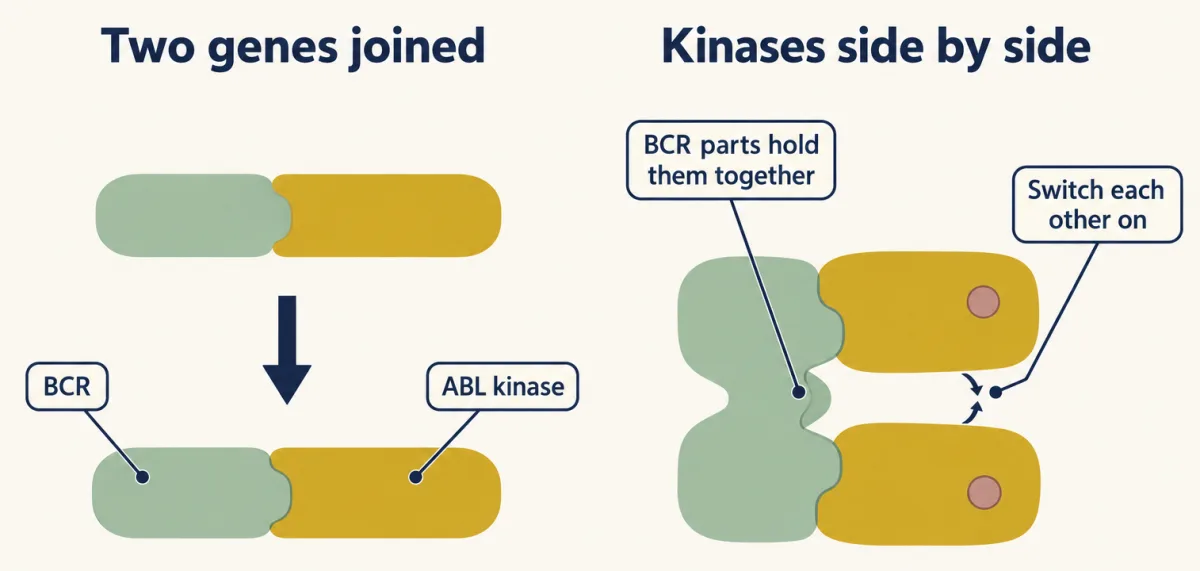
| Two genes joined | BCR-ABL | The BCR part holds ABL kinases together | Receptor tyrosine kinases, the phosphorylation switch |
| The off-protein is lost | PTEN, neurofibromin, APC | PIP3, Ras-GTP or β-catenin is not cleared | PI 3-kinase and Akt, GTPase switches, Wnt signalling |
Rows one and two alter the protein’s own off-mechanism. Rows three and four activate a tyrosine kinase without mutating its catalytic site.
Predict. In roughly 15 to 20 percent of breast cancers the HER2 gene is copied many times over with its normal sequence; in chronic myeloid leukaemia BCR is fused to the ABL kinase. How can extra normal HER2 receptors signal without a growth factor, and what receptor step does BCR imitate?
Check your prediction
Receptor tyrosine kinases switch on when two receptors pair and phosphorylate each other. HER2 has no growth factor of its own—normally it pairs with a relative such as EGFR after that partner binds ligand—so crowding too many HER2 receptors into the membrane lets them pair unaided. In BCR-ABL, the BCR segment makes the fusion proteins stick together, imitating ligand-driven pairing.
That BCR-ABL fusion arises in chronic myeloid leukaemia when chromosomes 9 and 22 swap tips: a piece of chromosome 22 attaches to chromosome 9 while ABL (encoding a tyrosine kinase related to Src) moves from chromosome 9 onto chromosome 22 beside BCR, fusing them on the shortened chromosome 22 so their kinase domains sit side by side and switch each other on. (Other receptor tyrosine kinases stuck on in human tumours appear under Going deeper.)
Row five is different in kind: Phosphatase and tensin homolog (PTEN) removes the phosphate PI 3-kinase adds to make phosphatidylinositol 3,4,5-trisphosphate (PIP3), neurofibromin is a GAP for Ras, and APC helps mark β-catenin for destruction. Here an off-step is missing. A gene whose loss lets cells grow when they should not is a tumour suppressor.
One copy or two: gain acts alone, loss needs both
You carry two copies of nearly every gene, one from each parent. For rows one to four, one altered or amplified copy signals without input and the normal copy cannot shut it off—a dominant gain of function. For row five, one working copy usually supplies enough off-protein, so loss is usually recessive inside the cell:
| Cell genotype | Pathway state (no growth factor) | Cell-level effect |
|---|---|---|
| 2 normal Ras, 2 normal NF1 | Off | Wild type |
| 1 altered Ras + 1 normal Ras | Stuck on | Dominant gain |
| 1 lost NF1 + 1 normal NF1 | Usually off | Silent in most cells |
| 2 lost NF1 | Stuck on (Ras-GTP not cleared) | Recessive loss |
Exceptions the lesson names. A broken protein can still act through one copy if it gets in the way: the laboratory tool Ras S17N stays in its GDP form and ties up the exchange factor that normal Ras needs, and many p53 missense mutants poison the tetramer they form with normal subunits, so they behave as dominant negatives. Two-hit behaviour holds only when one copy gives enough protein, and that does not always hold: PTEN shows dosage effects in mice. The lamp here follows the usual rule only.
Rule to keep: one altered copy of an on-step is enough, while an off-step usually has to lose both copies. In this sketch the lamp shows one step stuck on, not a tumour, because one stuck switch is seldom enough for a tumour.
Although off-switch loss is recessive inside each individual cell, inheriting one broken copy still raises cancer risk across a body of billions of cells.
Predict. Retinoblastoma, an eye tumour, occurs in an inherited form (often in both eyes) and a non-inherited form (one eye). If a retinal cell loses control only when both copies of a tumour suppressor are lost, which form should appear earlier and follow a single-chance-event schedule?
Check your prediction
The inherited form. A child born with one broken copy already has the first hit in every retinal cell, so only one later chance event is needed in a cell to lose the second copy, whereas a child born with two good copies needs two independent hits in the same cell.
Alfred Knudson deduced this in 1971 from children’s diagnosis ages: the inherited form fitted one chance event and the non-inherited form fitted two, and his two “hits” proved to be the two copies of one gene. The same asymmetry shapes where mutations fall: because few changes jam a protein on while many break it, tumour mutations in Ras cluster at positions 12, 13 and 61, whereas tumour suppressor mutations scatter along the gene (exceptions sit under Going deeper).
A single altered gene copy can jam a switch on—yet most cells with one stuck switch never become a tumour, and a multi-mutation tumour can still collapse when just one switch stops.
Read the transcript of “Many Mutations, One Weak Point”
Film transcript: Many Mutations, One Weak Point
In the first film, one altered gene copy jammed a growth switch on. Why does one stuck switch rarely make a tumour? And why can blocking just one switch shrink a tumour with many mutations? Let us zoom out from that switch and watch the whole cell. You might expect a stuck growth switch to make a normal cell divide nonstop. Surprisingly, the cell usually stops instead. A healthy cell reads a nonstop growth signal as a dangerous fault, not a normal order. Internal safety guards called checkpoints catch the fault before the cell runs away. One major guard is the checkpoint protein p53. A nonstop growth signal alarms it much like damaged DNA does.
It halts cell division at once or triggers apoptosis, which is programmed cell death. Even cells that slip past it still need survival signals to stay alive. That is why one stuck switch is seldom enough for cancer. To become a tumour, a cell usually collects several cooperating changes over time. It may pair a stuck on-switch with a lost off-switch, a broken checkpoint, and blocked cell death. Step by step, those combined faults let a tumour grow. Now picture a tumour that already carries all of those mutations. Its checkpoint is gone, its off-switch is missing, and one growth switch is jammed on. Suppose a targeted drug shuts off only that one stuck switch, leaving every other mutation untouched.
Will the tumour keep growing, or will it shrink? Often, the tumour shrinks, because its cells have come to lean on that one signal. Their other mutations stay untouched inside every cell, yet the cells stop dividing or die. Scientists call this dependence oncogene addiction. That is why one targeted drug can sometimes shrink a tumour carrying many mutations. Why does turning off one switch hit so hard? The exact cause is still debated, and two ideas lead. First, a stuck pathway keeps feedback brakes high, which may quiet nearby backup routes. Second, once the signal stops, survival signals may fade faster than death signals. Either way, the cell tips toward death.
Normal checkpoints guard a cell against a single jammed switch, so cancer usually requires several cooperating changes. Yet a tumour built around one loud driver can stay hooked on that single signal. Put both halves together clearly: tumours usually need several changes, yet often depend on one stuck switch.
From the film
- Tumours usually need several changes, yet often depend on one stuck switch.
- Normal cells read a nonstop growth signal as a fault, so checkpoints such as p53 halt or kill the cell.
- To become a tumour, cells usually collect cooperating changes across growth switches, off-switches and checkpoints.
- Shutting off one driving oncogene can still shrink a multi-mutation tumour, a dependence called oncogene addiction whose exact cause is debated.
Why one stuck switch is not enough
The second film showed why a nonstop growth signal trips a normal cell’s alarms; here are the experiments that showed a tumour usually needs cooperating changes.
In 1983 Robert Weinberg’s laboratory (Hartmut Land, Luis Parada and Weinberg) put an always-on ras gene and myc—a nuclear transcription factor that drives growth—into fresh primary rat embryo cells.
Predict. What happened in fresh rat embryo cells given always-on ras alone, myc alone, or both together?
Check your prediction
Neither ras alone nor myc alone transformed the fresh embryo cells; only both together did, because transformation here needs two cooperating changes.
In normal cells, p53 (the stress lesson) treats excess growth signalling like damaged DNA, halting or killing the cell, and cells escaping p53 still need survival signals (the cell death lesson) or die by apoptosis. Tumours therefore accumulate cooperating changes; in the colon a common order is loss of APC early, always-on Ras later and loss of p53 later still.
A tumour that needs its oncogene
In mice where an engineered oncogene can be switched off at will, tumours that grew with it on have shrunk when it was turned off, although their other mutations were unchanged—the cells stopped dividing or died. This dependence, oncogene addiction, explains why a drug targeting one protein—above all imatinib against BCR-ABL (from the biochemistry course; the next lesson covers such drugs)—can sometimes shrink a multi-mutation tumour.
Its cause is still debated between two non-exclusive ideas: chronic negative feedback (the circuits lesson), in which a stuck pathway keeps feedback inhibitors high and may quiet parallel routes, or survival signals fading faster than death signals once the oncogene shuts off. Which matters may differ from tumour to tumour.
Predict. If chronic negative feedback keeps a tumour addicted to one oncogene, what should be true of parallel growth pathways before a drug is given—and how might that hint at later resistance?
Check your prediction
Before the drug arrives, high feedback inhibitors should quiet parallel growth pathways. After the drug shuts the oncogene off, those inhibitors can fall, so surviving cells—or cells gaining a parallel mutation—may wake another pathway and resume growth.
Together, both halves of our rule link molecular switches to therapy: one altered copy jams a switch while off-switch loss usually needs both, and though tumours usually need several changes, they often depend on one stuck switch.
Design problem
Take the chain receptor, Ras, Raf, MAPK/ERK kinase (MEK), extracellular signal-regulated kinase (ERK), with an off-switch at each step. List every kind of single change you can think of that would leave ERK on with no growth factor present. Sort your list into changes that work when one copy of a gene is altered and changes that need both copies lost. Then say which kind you would expect to find more often as an inherited risk for cancer, and why.
Saved in this browser only.
One way to do it
One altered copy is enough (gain). A receptor that pairs without growth factor, because of a point mutation, a missing outer part, too many copies, or fusion to a partner that pairs it. A Ras that a GAP cannot turn off. A Raf or a MEK fixed in its active shape (BRAF V600E, common in melanoma, is one).
Both copies usually must be lost (loss). The GAP for Ras, neurofibromin. The phosphatases that strip phosphate from the receptor, MEK or ERK. The ligase that tags an active receptor for removal.
Inherited risk. Expect the loss kind more often. An inherited change is in every cell from the first division. A strongly stuck on-switch in every cell disturbs the embryo, and the milder inherited activating changes in this pathway cause developmental syndromes called RASopathies. One lost copy of an off-switch is mostly silent while the second copy works, so most such people are born without tumours. Every cell is then one hit away from having no off-switch, and in a body of many billions of cells a second hit somewhere becomes likely. Neurofibromatosis type 1, one inherited bad copy of the neurofibromin gene, works this way. There are exceptions: inherited activating changes in the receptor RET cause a cancer syndrome.
Going deeper
How src was found, with names and dates
The 1976 hybridisation paper appeared in Nature in March 1976 under Stehelin, Varmus, Bishop and Vogt. In 1978 Marc Collett and Ray Erikson, and Art Levinson with colleagues in the Bishop and Varmus laboratory, showed Src is a kinase; two years later Tony Hunter and Bart Sefton showed it phosphorylates tyrosine.
How the BCR-ABL join was found
Peter Nowell and David Hungerford reported a small chromosome in chronic myeloid leukaemia blood cells in 1960. In 1973 Janet Rowley showed the missing piece of chromosome 22 was attached to chromosome 9; later work showed the reciprocal swap places ABL from chromosome 9 beside BCR on chromosome 22.
Other receptor tyrosine kinases stuck on in cancer
HER2 sits within a wider group of receptor tyrosine kinases found stuck on by gain-of-function alterations in particular human tumours, including EGFR and its relatives, KIT, MET and RET.
Exceptions to the one-copy rules
The normal copy is not always irrelevant: in mice, normal Kras restrains tumours driven by mutant Kras, and such tumours often lose the normal copy later. A broken protein can also act through one copy if it interferes with the normal copy: Ras S17N stays in its GDP form and, by one model, ties up the exchange factor normal Ras needs, and many p53 missense mutants poison the tetramer they form with wild-type subunits as dominant negatives. Finally, two-hit kinetics assume one copy supplies enough protein: Phosphatase and tensin homolog (PTEN) shows dosage effects in mice, and a single lost copy of neurofibromin can have milder effects in some cells.
Your notes
Select any text in the lesson to highlight it or add a note to it. Your highlights and notes are saved in this browser and collected in your notebook.
This browser is not letting the site save anything (a private window or strict privacy settings), so highlights and notes will be lost when you leave the page.
Try the Predict questions again
Five Predict questions from this lesson, on their own. Answer each one first, then open its check.
Stehelin next tested his src probe—and a probe for the virus’s other genes—on DNA from duck, quail and emu, a flightless bird at a great evolutionary distance from chickens. What does each hypothesis predict for emu DNA?
From: The story: the cancer gene was the chicken's own
Check your prediction
An ancient chicken infection predicts poor matching in a distant bird such as the emu, just as for the virus’s other genes. A cellular gene predicts that the src probe should still match emu DNA closely while the rest of the virus matches poorly outside chickens.
In roughly 15 to 20 percent of breast cancers the HER2 gene is copied many times over with its normal sequence; in chronic myeloid leukaemia BCR is fused to the ABL kinase. How can extra normal HER2 receptors signal without a growth factor, and what receptor step does BCR imitate?
From: The idea: five ways to stick a switch
Check your prediction
Receptor tyrosine kinases switch on when two receptors pair and phosphorylate each other. HER2 has no growth factor of its own—normally it pairs with a relative such as EGFR after that partner binds ligand—so crowding too many HER2 receptors into the membrane lets them pair unaided. In BCR-ABL, the BCR segment makes the fusion proteins stick together, imitating ligand-driven pairing.
Retinoblastoma, an eye tumour, occurs in an inherited form (often in both eyes) and a non-inherited form (one eye). If a retinal cell loses control only when both copies of a tumour suppressor are lost, which form should appear earlier and follow a single-chance-event schedule?
From: One copy or two: gain acts alone, loss needs both
Check your prediction
The inherited form. A child born with one broken copy already has the first hit in every retinal cell, so only one later chance event is needed in a cell to lose the second copy, whereas a child born with two good copies needs two independent hits in the same cell.
What happened in fresh rat embryo cells given always-on ras alone, myc alone, or both together?
From: Why one stuck switch is not enough
Check your prediction
Neither ras alone nor myc alone transformed the fresh embryo cells; only both together did, because transformation here needs two cooperating changes.
If chronic negative feedback keeps a tumour addicted to one oncogene, what should be true of parallel growth pathways before a drug is given—and how might that hint at later resistance?
From: A tumour that needs its oncogene
Check your prediction
Before the drug arrives, high feedback inhibitors should quiet parallel growth pathways. After the drug shuts the oncogene off, those inhibitors can fall, so surviving cells—or cells gaining a parallel mutation—may wake another pathway and resume growth.
How we measure it
Cell-free filtration
Grind up a tissue and pass it through a filter with channels too narrow for cells or bacteria. If the filtrate still causes the disease, the agent is smaller than a bacterium. The test gives a size limit and says nothing about what the agent is.
Hybridisation with a radioactive probe
Make a labelled single strand of DNA for one gene, mix it with single-stranded DNA from a sample, and measure how much pairs. Matching strands pair and unrelated ones do not. The temperature at which the pairs come apart also reports how similar the two sequences are.
Chromosome banding
Stain dividing cells so that each chromosome shows its own pattern of light and dark bands, then compare the chromosomes one by one. Banding let Janet Rowley see that the small chromosome of chronic myeloid leukaemia was a chromosome 22 whose missing piece was attached to chromosome 9.
Focus assay for transformation
Put a gene into normal cells growing as a flat single layer and look for piles of cells, called foci, that keep dividing when their neighbours have stopped. Counting foci measures how well a gene, or a pair of genes, transforms cells.
Method films · the methods library
- Bioassays 1:35
- Clinical trials and epidemiology 4:02
- Clonal and colony assays 3:43
- Engineered mutants: site-directed, dominant-negative and constitutively active 4:25
- In vitro kinase assay 3:42
- Karyotyping and chromosome FISH 3:49
- Next-generation sequencing and genome assembly 3:50
- Southern and northern blots 3:46
- Transgenic animals 3:28
- X-ray crystallography 4:06
Practice questions on this lesson (3) → MCAT-style, original, each with an explanation
Where this lesson fits
Before thisReview first
- GTPase Switches: The TimerThis course · Lesson 7
You need to know how Ras hydrolyses GTP and how a GAP speeds it to see why G12 and Q61 changes stick.
- Protein Modules: SH2, SH3, PTB, PDZ and PHThis course · Lesson 9
It shows how the SH2 domain grips the tail tyrosine of Src, which v-Src has lost.
- Receptor Tyrosine KinasesThis course · Lesson 18
Paired receptors switch each other on, which explains HER2 overproduction and the BCR-ABL fusion.
After thisStudy next
- Drugs Against a PartThis course · Lesson 42
It takes up drugs aimed at a single stuck kinase, which a tumour dependent on its oncogene can be shrunk by.
Elsewhere on the siteFilms, simulations and method films in other courses
- One Cell, Two RoutesFilm · Genetics and Molecular Biology
It shows how mutations that are not inherited, including oncogene gain and tumour-suppressor loss, drive tumours.
- Two hits or one — who gets retinoblastoma, and whenSimulation · Genetics and Molecular Biology
Its two-hit simulation lets you test why tumour-suppressor loss needs both gene copies.
- Pedigree analysisMethod film
Family trees show the recessive-like two-copy loss of tumour suppressors behind inherited cancer risk.
Suggested by an AI model from the lessons themselves, then checked. How we use AI
That is the skim: you have the shape of it.
That is both films: the lesson in pictures.
The rest of the lesson is here when you want it.
Finish line
Test yourself
8 questions
Practice and MCAT-style, with explained answers.
Next · Lesson 42
Drugs Against a Part
About five hundred human kinases hold ATP in nearly the same pocket. How do you drug just one?
Continue →Rewritten on : new text and film. Notes and highlights stay, but the text around them may have moved.