Films · Genetics and Molecular Biology
One Cell, Two Routes
Read the transcript of “One Cell, Two Routes”
Film transcript: One Cell, Two Routes
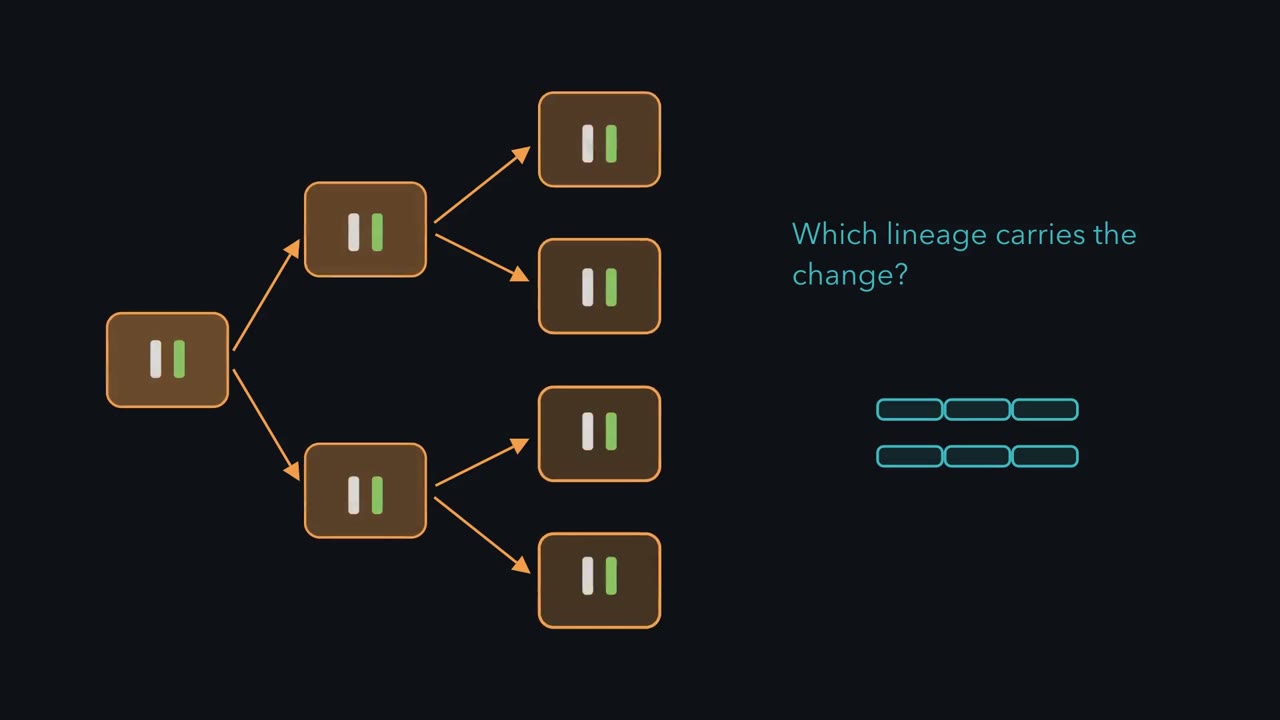
If cancer is genetic, why is it usually not inherited? Watch one pale tissue cell as a clay-colored DNA change appears. That cell divides, and the change follows its daughters. Nearby cells lack it. This is a somatic change, acquired during life, not a change carried in every cell.
The change matters only if it changes the lineage's future. A driver lets cells divide more or die less. Its branch widens while other branches continue nearby. A passenger may ride with that branch, but it did not cause the widening.
Selection acts on cells, and their DNA marks spread with them. One route changes an accelerator. A proto-oncogene normally promotes growth when signals call for it. A gain-of-function change can make an oncogene overactive.
Picture two gene copies, with one switch locked on. One altered allele is usually enough to change the cell's behavior. Extra gene copies or a translocation can also activate this route. The other route changes a brake. Here are two tumor-suppressor copies. One turns red and loses function, while the other remains green.
Predict: does the cell lose the brake now, or can the working copy still hold it? Usually, one working copy still provides enough brake. A second loss removes that remaining function. This can give the cell a growth or survival advantage, so its branch may expand. It does not by itself guarantee cancer. Tumor-suppressor changes are therefore usually recessive within one cell. Later, the text adds exceptions to these rules. RB1 makes the two-hit logic visible. A child may inherit one nonworking copy. Gold first-hit badges then appear in every cell, including every retinal cell. That inheritance raises risk, but it does not make every cell a tumor.
Each cell still has one working copy. This germline first hit can also pass to the next generation. A rare somatic second hit removes the working copy in one retinal cell. Only that cell's descendants expand. Without an inherited first hit, both hits must arise in the same body-cell lineage. This is why inherited risk can look dominant in a family while the change remains recessive within a cell. Cancer is genetic because altered DNA passes through dividing cell lineages. It is usually not inherited because most relevant changes arise somatically. The route may activate an accelerator or remove a brake. Cell lineages expand when their DNA changes improve growth or survival.
Every change a lineage carries, driver or passenger, spreads with it.
If cancer is a genetic disease, why are most of the DNA changes in a tumor not inherited?
Continue in the lesson: Cancer as a Genetic Disease →
3:29 · Free, with captions and a transcript. The lesson has the full text, the questions and the sources.
More films from this lesson
How this film was made. Narration: written from this lesson's text and read by an AI narrator voice (Kokoro, af_heart). Animation: AI-generated in code (Manim) by Claude, a schematic with no drawn molecular structures. Captions come from the narration script. See something wrong? Report it.