Cell Signaling · Skim version
Oncogenes: When the Switch Sticks
Read the full lesson → Skim the whole course →
The guiding idea
A chicken virus causes cancer with one gene. The chicken already had that gene.
Many cancers trace back to signalling proteins whose switch is stuck on.
-
The story: the cancer gene was the chicken’s own
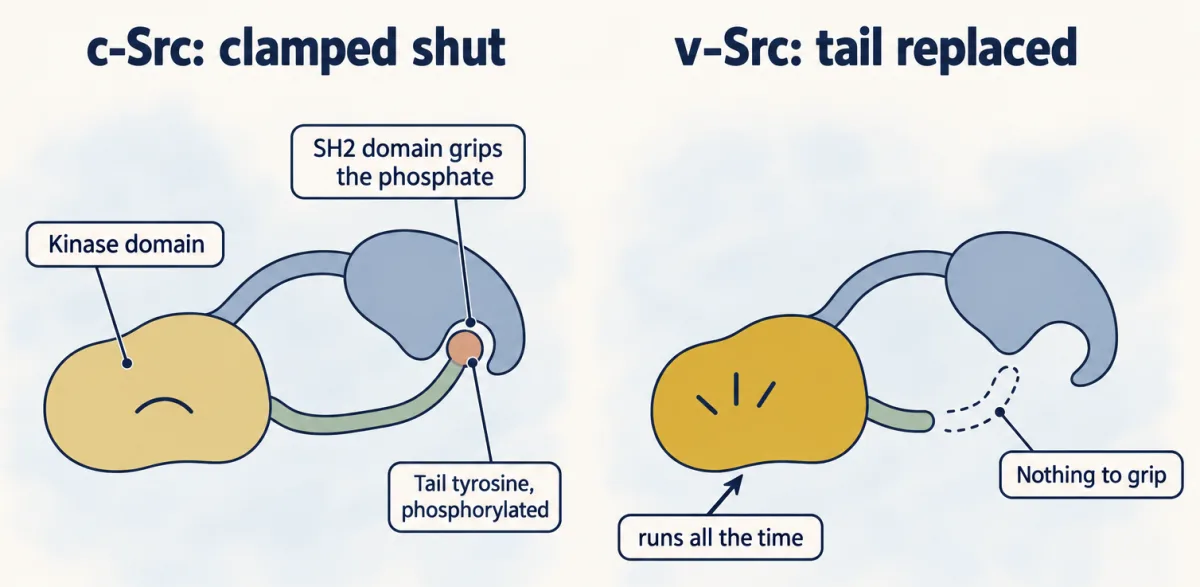
c-Src is clamped shut when its own SH2 domain grips the phosphate on a tail tyrosine. In v-Src the tail has been replaced and that tyrosine is gone, so nothing closes the clamp and the kinase runs all the time. AI-generated illustration -
The idea: five ways to stick a switch
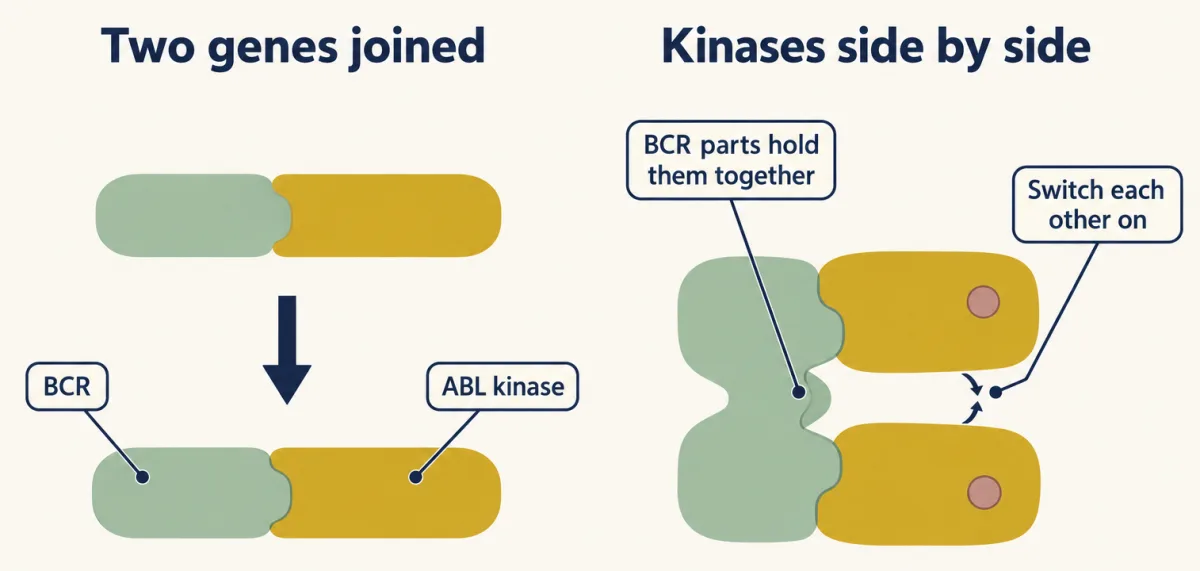
The join of two genes makes a fusion protein. The BCR part makes the fusion proteins stick to each other, so their ABL kinase domains sit side by side and switch each other on, as paired receptors do. AI-generated illustration -
One copy or two: gain acts alone, loss needs both
-
Why one stuck switch is not enough
-
A tumour that needs its oncogene
-
Going deeper
Where this lesson fits
Before thisReview first
- GTPase Switches: The TimerThis course · Lesson 7
You need to know how Ras hydrolyses GTP and how a GAP speeds it to see why G12 and Q61 changes stick.
- Protein Modules: SH2, SH3, PTB, PDZ and PHThis course · Lesson 9
It shows how the SH2 domain grips the tail tyrosine of Src, which v-Src has lost.
- Receptor Tyrosine KinasesThis course · Lesson 18
Paired receptors switch each other on, which explains HER2 overproduction and the BCR-ABL fusion.
After thisStudy next
- Drugs Against a PartThis course · Lesson 42
It takes up drugs aimed at a single stuck kinase, which a tumour dependent on its oncogene can be shrunk by.
Elsewhere on the siteFilms, simulations and method films in other courses
- One Cell, Two RoutesFilm · Genetics and Molecular Biology
It shows how mutations that are not inherited, including oncogene gain and tumour-suppressor loss, drive tumours.
- Two hits or one — who gets retinoblastoma, and whenSimulation · Genetics and Molecular Biology
Its two-hit simulation lets you test why tumour-suppressor loss needs both gene copies.
- Pedigree analysisMethod film
Family trees show the recessive-like two-copy loss of tumour suppressors behind inherited cancer risk.
Suggested by an AI model from the lessons themselves, then checked. How we use AI