Sensory Systems · Unit 7: Smell and taste
One Receptor per Neuron: How Olfactory Neurons Choose
Rewritten on : new text, flashcards and film. Your notes and highlights stay, but the text around them may have moved.
A mouse olfactory neuron holds about a thousand receptor genes and uses one copy of one. How does it choose, and what keeps it from changing its mind?
Pause when the reading reaches a film, and offer to play it. Saved on this device.
Watch the film now, or keep listening
Builds on:Smell and TasteEukaryotic Gene Regulation and EpigeneticsFive Ways to Turn a Stimulus into a CurrentWhy these?
 ▶ Watch One in Two Thousand · 3:29
Read the transcript of “One in Two Thousand”
Film transcript: One in Two Thousand
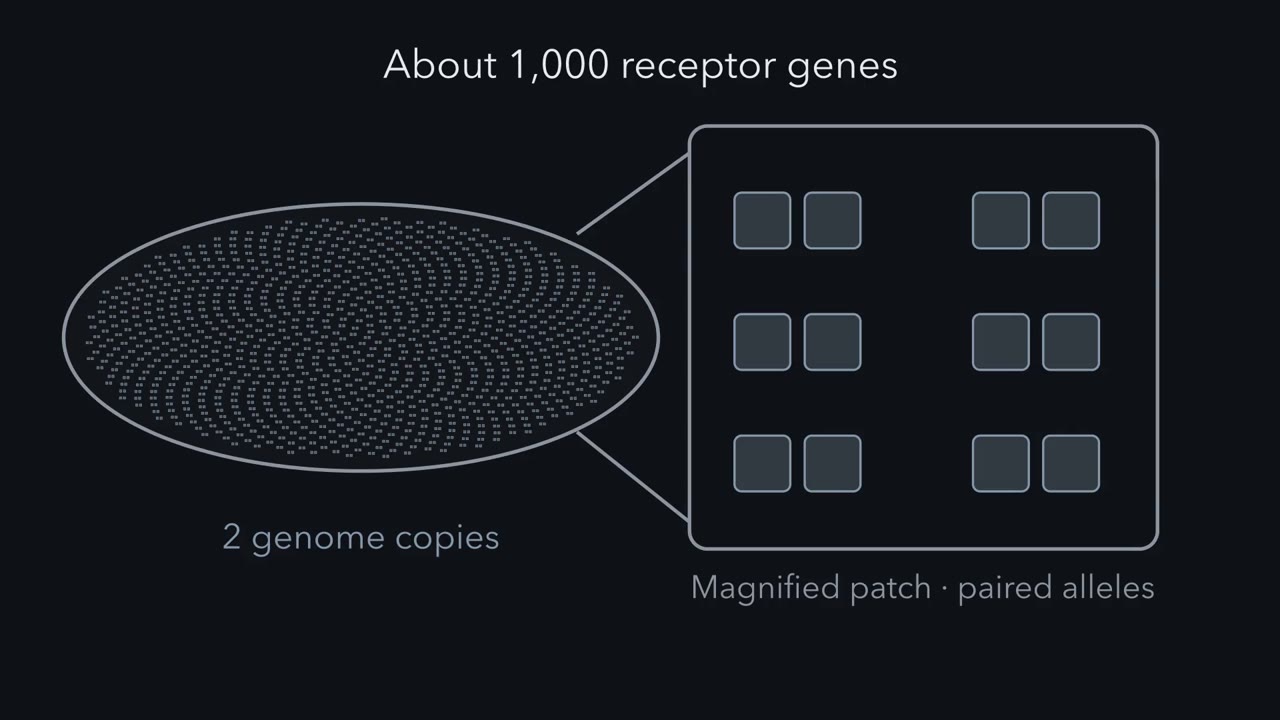
A mouse olfactory neuron carries about a thousand receptor genes, in each of its two genome copies. It uses one copy of one gene. In 1994, Chess and colleagues, in Richard Axel's laboratory, made the puzzle sharp. A neuron's receptor transcript comes from just one of its two alleles. So the neuron faces about two thousand candidates. A mature neuron uses one, and keeps using it. This is called singular choice. One gene, from one allele, in nearly every mature mouse neuron. It describes where development ends, not every stage on the way. Picture three broad phases. In early progenitors, the receptor genes are silenced, and little or no receptor RNA is detected.
From late precursors into immature neurons, several receptors are transcribed weakly. Single-cell data infer competing enhancer hubs. In mature neurons, one gene from one allele is expressed, and feedback helps hold the choice. Why is this hard? Suppose each gene had a small chance of escaping silence, independent of every other gene. And suppose nothing afterwards shuts off extra genes or removes any neurons, and every neuron is counted at the same time. Then the number of escapes per neuron is close to a Poisson distribution. You can set the average to anything. What is the largest fraction of neurons that can have exactly one receptor?
In this model, about 37 percent at most. The exactly-one bar peaks at an average of one escape per neuron. Make escapes much rarer, and most neurons express nothing. Make them much more common, and most express two or more. Yet mature mouse neurons nearly all express exactly one. So this simple, unregulated model is insufficient.
Mouse experiments support competition and receptor-dependent stabilization, but the arithmetic alone does not identify the mechanism. Here is the one idea for this lesson. Silence every gene, let a few compete, and lock in the winner. Repressive chromatin covers the receptor genes first. A few are transcribed weakly and compete at enhancer hubs. The leading gene's RNA helps quiet its rivals. Then its receptor protein sets off a stress signal. That signal turns down Lsd1, an enzyme that new receptor expression depends on. Further escapes become rare. Picture a library where every book is chained shut. A key frees a few, and they compete to be read.
The loudest reader drowns out the others. Then a bell rings and the key is taken away, so new books rarely open. In the mouse, the chains are repressive chromatin. The key is a step that depends on Lsd1. The bell is a stress pathway. The chapters ahead follow each step: the silence, the competing hubs, and the lock.
From the film
- A mature mouse olfactory neuron expresses one receptor gene from one allele, out of about two thousand candidates, and keeps using it.
- A simple model of rare, independent, unregulated escapes from silence gives at most about 37 percent of neurons with exactly one receptor, so it is insufficient.
- The rule is to silence every gene, let a few compete, and lock in the winner.
In 1994 Chess and colleagues, in Richard Axel’s laboratory, found that a mouse olfactory neuron’s receptor transcript comes from just one of its two alleles, the gene copies inherited from each parent.
That made an old puzzle sharper. A mouse olfactory neuron holds about a thousand odorant-receptor genes in each of its two genome copies, so about two thousand candidates. A mature neuron uses one copy of one gene, and it keeps using it. How does a cell make a choice that complete, and how does it keep it?
The core course states the rule and moves on: smell and taste covers the Buck and Axel cloning, one receptor and two glomeruli, and the combinatorial code. The rule matters because the receptor a neuron chooses fixes which odorants it responds to and helps set where its axon goes. This lesson starts where that one stops, with the mechanism.
One in two thousand: the puzzle
Singular choice means that in nearly every mature mouse olfactory sensory neuron, one receptor gene is transcribed from one allele (Chess and colleagues, 1994; Monahan and colleagues, 2017). It describes where development ends, not every stage on the way. Three broad phases, without sharp boundaries, frame the whole lesson.
| Phase | Receptor genes | What the mouse evidence suggests |
|---|---|---|
| Early progenitor | silenced; little or no receptor RNA | repressive chromatin covers receptor loci, apparently before receptor expression is detectable |
| Late precursor to immature neuron | several transcribed weakly, then one comes to dominate | single-cell data infer several competing enhancer hubs |
| Mature neuron | one gene, one allele, kept | feedback helps hold the choice |
Singular choice does not mean one receptor molecule or one odour: an insect receptor near the end of the lesson binds chemically unrelated molecules.
Why is singular choice hard? Suppose a neuron let receptor genes out of silence at random: each candidate gene has a small chance of escaping, independent of every other gene, and nothing afterwards shuts off extra genes or removes the neurons that have them. Then the number of escapes in a neuron is close to a Poisson distribution with some average, m, and the fraction of neurons with exactly one escape is m × e−m.
Predict. You may set m to anything you like. What is the largest fraction of neurons that can end up with exactly one receptor gene?
Check your prediction
In this model, about 37 percent, never more. The fraction m × e−m peaks at m = 1, where it equals 1/e.
| Average escapes per neuron, m | No receptor | Exactly one | Two or more | Exactly one, counting only neurons that express any |
|---|---|---|---|---|
| 0.1 | 90% | 9% | 0.5% | 95% |
| 0.5 | 61% | 30% | 9% | 77% |
| 1 | 37% | 37% | 26% | 58% |
| 3 | 5% | 15% | 80% | 16% |
Make escapes rare enough that 95 percent of expressing neurons have only one (m ≈ 0.1), and nine neurons in ten express nothing. Make them common enough that 95 percent express something (m = 3), and most express two or more, only 15 percent exactly one.
Mature mouse neurons nearly all express exactly one receptor, so this toy model leaves out important biology: rare, independent, unregulated escapes cannot give nearly universal singular expression in an unselected population counted at one time. The calculation alone does not say what is missing, or tell regulation apart from selection of neurons during maturation. Mouse experiments support two mechanisms: competition at enhancer hubs and receptor-dependent stabilization.
The paradox breaks into five puzzles.
- Escape. If the genes are silenced, how does any of them get out?
- One winner. Why does only one of about two thousand candidates win?
- Staying chosen. Why does the choice stay made?
- Address. How does the choice become a destination for the axon?
- Payoff. What does the choice give the neuron?
The one idea to carry through this lesson. Silence every gene, let a few compete, and lock in the winner. Repressive chromatin covers the receptor genes before any one is strongly expressed. A few are transcribed weakly and compete at enhancer hubs (clusters of DNA switches), and the leading gene’s RNA helps quiet its rivals. Once its receptor protein is made, it sets off a stress signal that turns down Lsd1, an enzyme that new receptor expression depends on, so further escapes become rare. The broad silence was there before any winner; the winner adds suppression and stability on top of it.
Picture a library. Every book is chained shut. A key frees a few, and those books compete to be read; the loudest reader drowns out the rest. Once the winner is read aloud, it rings a bell that takes the key away, so new books rarely open. In the mouse, the chains are repressive chromatin, the key an Lsd1-dependent step, the competition happens at enhancer hubs, the drowning out is the winner’s RNA, and the bell is a stress pathway. Bell and lost key together are what this lesson calls the lock.
Silence first
Read the transcript of “Silence First”
Film transcript: Silence First
If one gene wins, does the winner silence the others? Or was the silence already there? Heterochromatin is tightly packed, silenced chromatin. Certain chemical marks on histones flag it. Magklara and colleagues sorted olfactory neurons from mice aged six to ten weeks. They pulled down the DNA wrapped around histones carrying a chosen mark. This is chromatin immunoprecipitation. Receptor genes were enriched for two repressive marks. Their data suggested silencing comes before detectable receptor expression. Then they compared the two alleles of one receptor gene, called P2. The active allele carried less of the repressive marks than its inactive partner.
A common picture says the chosen gene silences the others. If the winner caused the first silencing, when should the marks appear? Only after a receptor was expressed. Instead, the silence seems to come first. So the winner did not start the broad silence by itself.
And the P2 comparison cannot settle the question. Comparing two alleles is an association. It shows the chosen allele is less repressed. It does not say which change starts the choice. A second, separate line of evidence shows the silent genes gathered together. Clowney and colleagues found receptor genes from different chromosomes collecting in a few dense foci as neurons mature. That happens in step with the loss of the lamin B receptor. Forcing the lamin B receptor back broke up the foci, and singular expression was disrupted. If every gene starts silent, something must let one out. In the model, the candidate key is the enzyme Lsd1. Lyons and colleagues deleted it early in the mouse epithelium, then read the RNA of the whole tissue.
The knockout tissue detected about a third as many receptor genes. Early loss impaired the start of receptor expression. But this is dependence, not mechanism. The enzyme's chemistry gives a reason for care. Lsd1 can remove one or two methyl groups from a lysine. It cannot remove a third. So on its own it cannot strip a trimethyl mark. That would need another demethylase or an intermediate step. And a count from bulk tissue depends on the assay and on which cells were in the sample. So the key is shorthand for an Lsd1-dependent step. So the broad silence comes first, and a key is needed to escape it. The winner acts later, quieting rivals and holding its place.
From the film
- Receptor genes carry repressive marks, and the silence appears to come before detectable receptor expression, so the winner did not start the broad silence by itself.
- Comparing the two alleles of one receptor gene is an association, so it does not say which change starts the choice.
- Early loss of LSD1 left about a third as many receptor genes detected, which shows dependence, not mechanism.
The first stage is silence. Magklara and colleagues (2011) sorted olfactory neurons from the epithelium of mice aged 6 to 10 weeks and used chromatin immunoprecipitation, which pulls down the DNA wrapped around histones that carry a chosen chemical mark. Receptor loci were enriched for two repressive marks of heterochromatin (tightly packed, silenced chromatin), H3K9me3 and H4K20me3.
They then compared the two alleles of one gene. In neurons labelled for the receptor P2, the active P2 allele carried less of the repressive marks than its inactive partner.
Predict. A common picture says the chosen gene silences the others. If the winner caused the first silencing, when should the repressive marks appear? And can the P2 comparison decide the question?
Check your prediction
If the winner caused the first silencing, the marks would appear only after a receptor was expressed. Instead, Magklara’s data suggested that silencing comes before detectable expression. That argues against receptor expression being the sole source of the initial broad repression, while leaving room for later receptor-dependent suppression or reinforcement of it. The P2 comparison alone cannot establish the causal order: the chosen allele sits in a less repressed state, but a comparison of two alleles is an association and does not say which change starts the choice.
A second, separate line of evidence shows the silent genes gathered together. Clowney and colleagues (2012) found that receptor genes from different chromosomes collect in a few dense heterochromatic foci as mouse neurons mature, in step with the loss of the lamin B receptor. Forcing lamin B receptor back into mature neurons broke up the foci and disrupted singular receptor expression.
Lsd1, the candidate key
In the model, the candidate key that lets a gene out of silence is the histone demethylase Lsd1 (see eukaryotic gene regulation). Lyons and colleagues (2013) deleted Lsd1 early in the mouse epithelium and read the RNA of the whole tissue at embryonic day 18.5. Control tissue yielded 662 detected receptor genes and the knockout 212, about a third as many (212 / 662 = 0.32). The authors concluded that early Lsd1 deletion impaired initiation of receptor expression.
This is dependence, not mechanism, and the chemistry gives a reason for care. LSD1 is an FAD-dependent amine oxidase. It removes one or two methyl groups from a lysine, but it cannot remove a third, because its oxidation needs a free lone pair of electrons on the lysine nitrogen, and a trimethylated lysine, with a fixed positive charge, has none to spare. So the result does not show that LSD1 itself removes H3K9me3 at receptor loci; clearing that mark would need another demethylase or an intermediate step. And a count from bulk tissue depends on the assay and the cells in the sample. In this lesson, then, “the key” is shorthand for an Lsd1-dependent step.
Escaping the silence: enhancer hubs that compete
Read the transcript of “Hubs That Compete”
Film transcript: Hubs That Compete
Once a few genes slip out of the silence, how does just one of them win? An enhancer is a stretch of DNA that raises transcription of a gene it contacts. The receptor genes have candidate enhancers, which the field calls the Greek Islands. Contacts in trans are contacts between different chromosomes. A hub is a cluster of enhancers, often from different chromosomes. An active hub sits around the gene it drives. Markenscoff-Papadimitriou and colleagues linked receptor transcription to contacts between enhancers on different chromosomes. A chromatin remodeler, Bptf, helped make those contacts. Disrupting the contacts was linked to weak expression of several receptors at once.
What builds the hubs? Two transcription factors, Lhx2 and Ebf, bind cooperatively at enhancer motifs with a set spacing. Nearly every Ebf site in the receptor clusters was also bound by Lhx2. An inserted array of enhancer elements raised how often linked receptors were chosen. That is a sufficiency-style test. Monahan, Horta and Lomvardas then extended the contact maps across the whole genome. Receptor clusters on 18 chromosomes contacted one another. The factors LHX2 and LDB1 regulated how these hubs assemble and are maintained. But a contact map from many cells is an average. It cannot show that each cell has a single hub. So look inside one developing neuron.
Is there one hub, or several? Several, before one gene wins. Pourmorady and colleagues inferred competing hubs in single developing neurons. They combined single-cell readouts of RNA and open chromatin with single-cell contact maps.
Their evidence supported two further steps. First, receptor RNA suppressed transcription of competing receptors at a distance. The machinery behind that long-range suppression is still unidentified. Second, translation of the receptor then stabilized transcription at the winning hub. So competition can work without receptor protein, and protein then helps stabilize the winner. One receptor per neuron is the endpoint.
From the film
- Enhancers from different chromosomes form hubs, and LHX2 and EBF help build them.
- Single-cell data inferred several competing hubs in developing neurons before one gene wins.
- Receptor RNA suppressed competing receptors at a distance, and translation of the receptor then stabilized transcription at the winning hub.
Three terms carry this section.
- An enhancer is a DNA element that raises transcription of a gene it contacts. The receptor genes have candidate enhancers, which the field calls the Greek Islands.
- Contacts in trans are contacts between different chromosomes.
- A hub is a cluster of enhancers, often from different chromosomes. An active hub sits around the receptor gene it drives.
Many factor and method names follow. Keep the idea, not the list: enhancers from many chromosomes gather into hubs.
Markenscoff-Papadimitriou and colleagues (2014), working in adult mouse epithelium with 4C-seq (which maps contacts made by one chosen DNA site) and DNA FISH (which labels loci to see how near they sit), associated receptor transcription with contacts between candidate enhancers on different chromosomes. The chromatin-remodeling factor Bptf facilitated those contacts, and disrupting them was associated with weak expression of several receptors at once.
What assembles the hubs? Monahan and colleagues (2017) found that the factors Lhx2 and Ebf bind cooperatively at enhancer motifs with a stereotyped spacing. In their ChIP-seq of sorted mature neurons, Lhx2 marked nearly every Ebf site in the receptor clusters, but not the other way round: 63 of 65 Ebf peaks (97 percent) were also bound by Lhx2, against 63 of 114 Lhx2 peaks (55 percent) bound by Ebf. An array of enhancer elements inserted into the mouse genome raised the frequency with which linked receptors were chosen, which is a sufficiency-style test of the idea.
Monahan, Horta and Lomvardas (2019) extended these contact studies across the genome with in situ Hi-C, which captures DNA segments that were close together in the nucleus and counts the pairs. In sorted mouse neurons and their progenitors, receptor clusters on 18 chromosomes made contacts with one another, and LHX2 and LDB1 regulated assembly and maintenance of these compartments and hubs. A population contact map averages over many cells, though, and cannot show that each cell has a single hub.
Predict. Look inside one developing neuron. Is there one hub, or several?
Check your prediction
Several. Pourmorady and colleagues (2024) inferred several competing hubs in developing neurons before one gene became dominant, combining single-cell multiomes (RNA plus chromatin accessibility) of 5- and 12-week-old mouse olfactory epithelium with single-cell Hi-C (Dip-C) on sorted mouse neurons.
Their evidence supported two further steps. Receptor RNA suppressed the transcription of competing receptors at a distance, and translation of the receptor then stabilized transcription at the prevailing hub. The machinery that carries out the long-range suppression is still unidentified. So competition can work without receptor protein, and protein then helps stabilize the winner.
The lock: the winner’s protein holds the choice
Read the transcript of “The Lock”
Film transcript: The Lock
One gene has prevailed at its hub. What keeps that choice stable, so no new gene escapes later? Competition helps one gene prevail. Holding the choice is a different question. Part of the answer is the lock. In the model, the receptor the winning gene makes closes it. So what should a neuron do if its chosen gene cannot make a working receptor?
In the model, the lock does not close, so the neuron should choose again. It does. Such neurons often express a second receptor gene. The converse agrees. Neurons given a working receptor transgene early rarely express their own receptor genes. So the lock depends on receptor protein. Dalton, Lyons and Lomvardas traced the lock to the unfolded protein response. That is how a cell reacts to misfolded protein in its endoplasmic reticulum. Step one is the alarm. Receptor expression engages the response. Step two is the relay. PERK-dependent phosphorylation of eIF2α slows most translation but favours a few messages. One favoured message makes the transcription factor ATF5.
Step three is the order. ATF5 turns on the gene for adenylyl cyclase 3. Step four has two effects. The cyclase helps turn down Lsd1, the candidate key. With the key withdrawn, later escapes become unlikely. The cyclase also relieves the stress, so the alarm switches itself off.
The lock works on top of the earlier silence, and alongside the RNA step that quiets rivals. Experiments in mutant mice put these steps in order. They do not show how a receptor activates PERK. This cyclase also carries odour signals in the cilia. But in this model, receptor protein sets the lock. You can look at each neuron only once. How could you tell it had switched receptors?
Leave a permanent mark. In lineage tracing, a recombinase made from one receptor's locus marks the neuron for good. A marked neuron that now expresses a different receptor has switched. In two-day-old pups lacking the cyclase, the ratio of singly to doubly labelled neurons was about twice the control. That points to a less stable choice. Was the cyclase step slowed, or lost? This ratio alone cannot tell. A lock need not be perfect. Other steps, such as the RNA competition, may still limit expression. So receptor protein sets off a stress relay that turns down the key. That helps lock in the winner.
From the film
- In the model, the receptor made by the winning gene closes the lock, so a neuron whose chosen gene cannot make a working receptor often expresses a second one.
- The lock runs through the unfolded protein response, Perk, ATF5 and adenylyl cyclase 3, which helps turn down LSD1 and makes later escapes unlikely.
- A lock need not be perfect, because other steps such as the RNA competition may still limit expression.
Recall the rule: silence every gene, let a few compete, and lock in the winner. One gene has prevailed at its hub. What keeps that choice stable, so that no new gene escapes later? Part of the answer is the lock.
Predict. If the lock is closed by the receptor the winning gene makes, what should a neuron do when its chosen allele cannot supply that stabilizing feedback, for example because the receptor coding sequence is deleted?
Check your prediction
In the model the lock does not close, so the neuron should keep going and choose again. It does: when the chosen allele cannot supply the feedback, as with a coding deletion, the neuron often expresses a second receptor gene as well. Sensory dysfunction alone does not establish loss of feedback: a receptor that cannot respond to odorants may still hold the lock. Conversely, neurons given a functional receptor transgene early rarely express their own receptor genes, as if the lock had closed before any of them escaped (reviewed by Monahan and Lomvardas, 2015). So the lock depends on receptor protein.
What the lock is made of. Dalton, Lyons and Lomvardas (2013) traced it to the unfolded protein response, the pathway by which a cell reacts to misfolded protein in its endoplasmic reticulum (stress signals). In developing mouse neurons each step has one job.
- The alarm. Receptor expression engages the response.
- The relay. PERK-dependent phosphorylation of eIF2α slows most translation but favours a few messages, including the one for the transcription factor ATF5.
- The order. ATF5 promotes transcription of the gene for adenylyl cyclase 3, Adcy3.
- Two effects. Adcy3 helps turn down Lsd1 after choice (Lyons and colleagues, 2013), so, in the model, the key that let a receptor gene out of silence is withdrawn and later escapes become unlikely. Adcy3 induction also relieves the stress response. This is the two-step model: the alarm goes on, and the response it causes switches the alarm off, so the stress is brief.
The lock did not create the broad silence, which came first, and it works alongside the RNA step that quiets rivals; these experiments do not test whether feedback also adds repression. The evidence for the order comes from epistasis experiments in mice (which order genes in a pathway by asking which defect another gene can rescue), including newborn eIF2α-mutant animals rescued with ATF5. They place the signals in order, but they do not show how a receptor activates PERK.
Adcy3 is also the cyclase that serves odour transduction in the cilia (vision, smell and cyclic nucleotides). In this model, though, the lock is set by receptor protein and needs no odour, though odour-driven activity may still play a part.
Predict. You can look at each neuron only once. How could you tell that it had switched receptors?
Check your prediction
Leave a permanent mark. In lineage tracing, a recombinase made from one receptor’s locus, here MOR28, permanently marks any neuron that has activated that locus long enough for recombination, which takes hours. A marked neuron that now expresses a different receptor has switched. In neurons lacking Adcy3, lineage tracing of MOR28 at postnatal day 2 showed more switching, at an age when most neurons are still immature: the ratio of singly labelled neurons (the mark without MOR28, or MOR28 without the mark) to doubly labelled ones was about twice that in controls (Lyons and colleagues, 2013).
| Neuron (mouse) | Receptor protein made? | The lock | What was seen |
|---|---|---|---|
| Normal | yes, from the chosen gene | closes | one receptor, kept |
| Chosen allele cannot supply stabilizing feedback (for example, its receptor coding sequence is deleted) | absent, or altered so that feedback fails | choice not stably held | more switching, or a second receptor gene expressed |
| Functional receptor transgene, early | yes, before the neuron’s own genes | closes early | own receptor genes rarely expressed |
| Lacking Adcy3 | yes | weakened | singly-to-doubly labelled MOR28 lineage ratio about twofold higher at postnatal day 2 |
How leaky could a lock be? Suppose further escapes form a homogeneous Poisson process (independent events at a constant rate λ), and the lock closes a fixed time τ after the first escape. The chance that another gene escapes in that window is 1 − e−λτ. With illustrative values, a mean wait of 48 hours for an escape and 2.4 hours for the lock to close, λτ = 0.05 and about 5 percent of neurons let a second gene through. Double τ and that rises to about 9.5 percent, close to double: while λτ is small, the leak grows in proportion to the delay, so a lock need not be perfect. The numbers are invented, and the model computes a second escape, not the measured lineage ratio. It therefore cannot say whether the Adcy3 step was slowed or lost in the mutant, while other steps, such as the RNA-level competition, may still limit expression.
The choice becomes an address
Read the transcript of “The Choice Becomes an Address”
Film transcript: The Choice Becomes an Address
A neuron has chosen its receptor. How does its axon know where to go? The core rule is one receptor and two glomeruli. That needs each neuron's axon to find the right target. In 1996, Mombaerts and colleagues swapped receptor genes in mice. The results suggested that receptor identity is instructive in axon targeting, but not the only factor. So the receptor is one input among several. If the receptor helps choose the target, how could it change what the growing axon carries?
One route runs through cAMP. Imai and colleagues reported receptor-derived cAMP signals shift guidance molecule expression. It also shifts where axons project in the bulb, along the front-to-back axis. Serizawa and colleagues found four adhesion and guidance molecules whose levels vary with receptor activity. How such molecules build the map is covered in the lesson on topographic maps. Now recall the lock. Its relay ran through the kinase PERK. The lock's own pathway reaches the wiring too. Shayya and colleagues reported that different receptor sequences produce different patterns of stress in developing neurons. A gene called Ddit3 links PERK signalling to guidance and adhesion genes.
So the stress signal that helps hold the choice can also influence where the axon goes. These are mouse reports. They show a link, not the full rules for building the map. The choice and the address can share a signal. Choosing a receptor helps set where the axon goes.
From the film
- In mice, receptor identity is instructive in axon targeting but not the only factor.
- Receptor-derived cyclic AMP signals and receptor-dependent stress signals link to guidance and adhesion gene expression.
- The choice and the address can share a signal, but these mouse reports show a link, not the full rules for building the map.
The core course’s rule of one receptor and two glomeruli needs each neuron’s axon to find the right target. Receptor identity helps it do so. The 1996 receptor-swap experiments (Mombaerts and colleagues, mice) suggested an instructive but nonexclusive role for receptor identity in axon targeting. Imai and colleagues (2006) reported that receptor-derived cAMP signals shift expression of guidance molecules and bulb projection sites along the anterior-posterior axis, and Serizawa and colleagues (2006) found that Kirrel2, Kirrel3, ephrin-A5 and EphA5 vary with receptor activity.
The lock’s own pathway reaches the wiring too. Shayya and colleagues (2022) reported that different receptor sequences produce different ER-stress patterns in developing mouse neurons, and that Ddit3 links PERK signalling to guidance and adhesion genes. The map-building rules are in partners, layers and self-avoidance and topographic maps; here the point is that the choice and the address can share a signal.
What the choice buys: one pocket
Read the transcript of “What the Choice Buys: a Pocket”
Film transcript: What the Choice Buys: a Pocket
Each neuron ends up with one kind of receptor. Does that mean it responds to only one odour? The choice gives the neuron one kind of receptor. That receptor's binding pocket sets which molecules it responds to. But one pocket does not mean one odour. Del Mármol, Yedlin and Ruta solved structures of an insect receptor from the bristletail, called MhOR5. It is built of four identical subunits, and it is itself an odorant-gated ion channel. The plant compound eugenol and the repellent DEET sat in the same pocket. They are chemically unrelated. This insect channel is a contrast, not a template. Mammals use G-protein-coupled receptors. Billesbølle and colleagues solved the active human receptor OR51E2, bound to propionate.
It was a purified, engineered complex with a mini G protein. Humans carry about four hundred odorant receptors of this type. Mice carry about a thousand. In a cAMP assay, two pocket mutants gained responses to longer-chain fatty acids. So is the mutant simply a better receptor? Take the mutant F155A, and give it propionate. The EC50 is the dose giving half the maximum. At the wild-type EC50, what fraction does the mutant give?
In this model, about 6 percent of its own maximum. Its EC50 is about 15 times higher. So the mutant is not simply better. It lost potency for propionate and gained responses to longer chains. Its selectivity shifted. The size of the shift is uncertain. A second table in the paper gives a smaller one. These are functional values from cultured cells. They are not binding constants. And a flat response would not prove a ligand cannot bind. Coupling, trafficking or the assay could be failing instead. Now look back at the three phases. Silence every gene. Let a few compete. Lock in the winner. The lock holds one receptor in place. That receptor's pocket decides which molecules the neuron responds to.
From the film
- A receptor's binding pocket sets which molecules a neuron responds to, but one pocket does not mean one odour.
- In cultured cells, a pocket mutant lost potency for propionate and gained responses to longer-chain fatty acids, so its selectivity shifted.
- A flat response would not prove a ligand cannot bind, and these are functional values, not binding constants.
The choice gives the neuron one kind of receptor, and that receptor’s binding pocket sets which molecules the neuron responds to. Del Mármol, Yedlin and Ruta (2021) solved cryo-EM structures of the bristletail receptor MhOR5, expressed in human cultured cells: a homotetramer (four identical subunits) that is itself an odorant-gated ion channel, with eugenol and the repellent DEET bound in the same pocket, one in each subunit. In a calcium-imaging screen MhOR5 responded to more than 65 percent of the odorants in a 54-molecule panel. It is an atypical insect receptor, from a lineage without Orco, the co-receptor that partners with the odorant-specific subunit in most insect receptors, and an ion channel, not a G-protein-coupled receptor, so it is a contrast, not a template.
Mammals use the other design. Billesbølle and colleagues (2023) solved active human OR51E2 bound to propionate, as a purified, engineered complex with a mini G protein. The human genome encodes about 400 odorant GPCRs; that is the human repertoire, not the mouse count. In a cAMP assay, the pocket mutants F155A and L158A gained responses to longer-chain fatty acids. Read that as a shift in selectivity, not a better receptor. F155A also lost potency for propionate, its small ligand, and the worked problem measures that loss.
Worked problem: reading a dose-response shift. In the cAMP assay, propionate gave a half-maximal effective concentration (EC50) (the concentration giving half the maximum response) of 0.824 mM for wild-type OR51E2 and 12.3 mM for F155A. Assume a Hill slope of 1 (the simplest curve shape), zero baseline, and each construct normalized to its own maximum, so the response is
R(c) = c / (EC50 + c)
The responses calculated below are model values, not measured light outputs.
Predict. At 0.824 mM, wild type gives half its maximum. Roughly what fraction will F155A give?
Check your prediction
About 6 percent of its maximum. Step 1: both at 0.824 mM. Wild type: R = 0.824 / (0.824 + 0.824) = 0.500. F155A: R = 0.824 / (12.3 + 0.824) = 0.824 / 13.124 = 0.063.
Step 2: the potency shift. 12.3 / 0.824 = 14.9, a rightward shift of about 15-fold.
Step 3: both at 12.3 mM. Wild type: R = 12.3 / 13.124 = 0.937. F155A: R = 12.3 / 24.6 = 0.500.
Step 4: check. For wild type to give R = 0.063, c = EC50 × R / (1 − R) = 0.824 × 0.063 / 0.937 = 0.055 mM, and 0.824 / 0.055 = 15, matching the shift.
The size of the shift is uncertain (see Going deeper). Two more cautions: these are functional EC50 values, not binding constants, and they say nothing about the airborne concentration a human nose detects.
- R at c, wild type
- 0.500
- R at c, F155A
- 0.063
- c for target R, wild type
- 0.824 mM
- c for target R, F155A
- 12.3 mM
- Ratio of the two concentrations
- 14.9-fold
In this sketch: Hill slope 1, zero baseline, each construct normalized to its own maximum, a cAMP assay in cultured cells (Billesbølle and colleagues, 2023); model values, not measured light outputs.
This sketch cannot say: that an EC50 is a binding constant; what airborne concentration a nose detects; whether concentrations this high (the axis runs to 1000 mM) could be tested, since values far above the lesson’s are model arithmetic only; whether the two maxima were equal (each curve is scaled to its own, so a drop in maximum cannot be read here); or that the mutant’s gain for longer-chain fatty acids follows from this curve.
Rule to keep: with a Hill slope of 1, R = c / (EC50 + c), so the concentration that gives any chosen response is EC50 × R / (1 − R), and the shift between two constructs equals the ratio of their EC50 values at every response. Even so, the size of the shift is uncertain.
Design problem
A structure predicts that changing one residue to widen the pocket should let a receptor respond to a longer-chain ligand. Design the test, and say what a non-response would and would not mean.
Saved in this browser only.
One way to do it
Make the point mutant and confirm that it reaches the cell surface, since a protein that never arrives cannot respond. Compare it with wild type in the same assay, with empty-vector and mock-transfected controls, so that background and the host cell’s own cAMP signalling are accounted for. Run full dose-response curves instead of one concentration, and report EC50 and maximum response separately: a shift in EC50 and a drop in maximum mean different things. Include a ligand the wild type already responds to as a positive control for the mutant’s coupling.
A non-response in this assay would not show that the ligand cannot bind. A flat curve can mean no binding, no G-protein coupling, no trafficking to the surface, or an assay ceiling, so a negative in vitro is not a deorphanization, the assignment of a ligand to a receptor. Nor would either outcome show what the receptor does in an olfactory neuron, where chaperones, cilia and the feedback pathway above are present.
Going deeper
Where the guiding rule applies
The one-gene, one-allele endpoint applies to mature canonical olfactory sensory neurons of the mouse main olfactory epithelium; the three-part rule summarizes their path there, including the immature phase when several receptor genes are transcribed at low levels. Other animals reach one receptor per neuron by other routes. In the fruit fly, developmental programs of transcription factors do much of the choosing, so the mouse model is not a template there, though this does not exclude receptor feedback in flies. Some mouse chemosensory neurons, such as the MS4A-expressing necklace neurons, are reported to express several chemoreceptors and fall outside the rule. In humans, single-cell data are consistent with mostly one receptor per neuron, but the chromatin, hub and feedback steps described here have been studied mainly in mice.
A step after transcription: Mex3a
A 2025 mouse study (Duffié and colleagues) added a Mex3a-dependent step that acts after transcription. Its conditional deletion caused premature ER stress, the alarm of the lock, during the stage when several receptors are transcribed. So something must also keep the early, weak transcripts from setting off the alarm too soon.
Two tables, two shifts
The worked problem uses the mean half-maximal effective concentration (EC50) values in Extended Data Table 2 of the OR51E2 paper. Its Table 3 gives 1.40 mM and 9.13 mM for the same two constructs, a shift of about 6.5-fold, and the F155A pEC50 in Table 2 has a standard error of 0.77 log units. That is why the size of the shift is uncertain.
Where the OR51E2 structure and screen came from
The active human OR51E2 structure was solved at 3.1 angstroms, with the complex made in HEK293-derived Expi293F cells and the cAMP assays done in HEK293T cells. The 511 clones of a human screening library (Mainland and colleagues, 2015) are a screening set, not the human repertoire.
Engineered consensus receptors
Consensus-sequence structures from 2024 (de March and colleagues) extend structural coverage of the family, but they are engineered sequences, not natural receptors.
Your notes
Select any text in the lesson to highlight it or add a note to it. Your highlights and notes are saved in this browser and collected in your notebook.
This browser is not letting the site save anything (a private window or strict privacy settings), so highlights and notes will be lost when you leave the page.
How we measure it
ChIP-seq and in situ Hi-C
Chromatin immunoprecipitation pulls down DNA bound to a chosen histone mark or transcription factor, and sequencing says where it sat. In situ Hi-C ligates DNA segments that were close together in the nucleus and counts the pairs, giving a genome-wide contact map. Applied to sorted mouse olfactory cells, they show where repressive marks and factors sit and which receptor gene clusters touch.
Conditional genetics and lineage tracing
A gene is deleted in a chosen cell population at a chosen time, or a recombinase permanently marks neurons that activated a given receptor locus long enough for recombination, which takes hours. Comparing the mark with the receptor a neuron expresses now reveals whether it switched. Each result holds for that deletion, age and assay.
Single-cell chromatin contact and expression assays
Single-nucleus assays read, in one cell, which receptor genes are transcribed and which regions are accessible or in contact. They let the population averages of Hi-C be broken down into cells at different stages, including cells that have not yet settled on one receptor.
Cryo-EM with mutagenesis and a cAMP assay
A purified receptor is frozen and imaged to give a three-dimensional map, a pocket residue is changed, and a luciferase reporter of cAMP in cultured cells reports whether the response to a ligand shifts. Structure suggests a prediction and the assay tests it, in cells and not in neurons.
Practice questions on this lesson (3) → MCAT-style, original, each with an explanation
Where this lesson fits
Before thisReview first
- Smell and TasteNeuroscience · College: going further
This lesson starts where it stops: one receptor per neuron, two glomeruli and the combinatorial code are assumed.
- Eukaryotic Gene Regulation and EpigeneticsGenetics and Molecular Biology · College: the core
Silenced chromatin, enhancers and histone demethylation are used here without being re-taught.
- Five Ways to Turn a Stimulus into a CurrentThis course · Lesson 1
Comparing an insect receptor channel with a G-protein receptor assumes the strategies for turning odorant binding into current.
After thisStudy next
- From Glomeruli to Piriform CortexThis course · Lesson 27
It follows the receptor-defined axons to the glomeruli, where the choice made here becomes a map.
Suggested by an AI model from the lessons themselves, then checked. How we use AI
Finish line
Test yourself
9 questions
Practice and MCAT-style, with explained answers.
Next · Lesson 27
From Glomeruli to Piriform Cortex
The bulb hands piriform cortex a tidy map of receptor identity, and the cortex scatters it. How can a scattered pattern still carry which odours are alike, and come to mean something?
Continue →