Developmental Neuroscience · Skim version
Ocular Dominance and the Critical Period
Read the full lesson → Skim the whole course →
The guiding idea
Why does closing one eye of a kitten for a week rewire its cortex, when closing both eyes shifts the balance much less?
While the cortex develops, the two eyes compete for the cells they share, and each cell keeps the eye, or both eyes, that help it fire.
From the film: One Cell, Two Eyes
- The two eyes' pathways stay apart through the LGN and the layer 4 stripes of primary visual cortex.
- Above and below layer 4, many cells in cats and monkeys can be driven by both eyes, and the eyes compete for these shared cells.
- An ocular-dominance histogram sorts cells into seven groups, and in a normal adult cat it is a hump leaning toward the contralateral side.
From the film: Six Days at Four Weeks
- In kittens, closing one eye for a few days in the fourth or fifth week moves most of the histogram toward the open eye.
- Susceptibility in kittens rises from about the fourth week and declines through the third month, while months of closure in an adult cat leave the cortex looking normal.
- The closed eye's retina still responds, so the loss is in the brain, not the eye.
- Closure also changes the territory each eye's axons hold, not only how cells respond.
From the film: Two Closed Eyes
- Closing both eyes shifts the balance between the eyes far less than closing one.
- What cost the single closed eye its cells was mainly the open eye's advantage, so the eyes compete for the cells they share.
- Going without vision is not harmless, since some cells respond abnormally or not at all.
From the film: Out of Step
- In strabismic kittens each eye sends a normal amount of activity, yet most cells answer to one eye or the other and few to both.
- Amount matters, but only activity in step with the cell's strong responses helps an eye keep it.
- The cell keeps the eye, or both eyes, that help it fire, and which eye leads differs from cell to cell.
From the film: Silence Is Not Noise
- Silencing one eye of kittens with tetrodotoxin shifts cortical responses toward the eye that kept firing, so an imbalance of activity is enough to cause a shift.
- In kittens, lid suture weakens the closed eye's responses more than tetrodotoxin does.
- A sutured eye's leftover activity is out of step with the cells it drives, while a silent eye is not active at the wrong moments, so silence is not the same as noise.
From the film: The Window and the Patch
- A sensitive period is a window of unusually strong effect of experience, and a critical period is one in which the experience is essential and its effects last.
- The window differs between species, so name the species with every number.
- Amblyopia usually arises when the two eyes give the young brain unequal input, and patching the good eye tilts the contest toward the weak eye.
- Treatment generally works best in young children, though trials have found that some older children still improve.
-
The layout
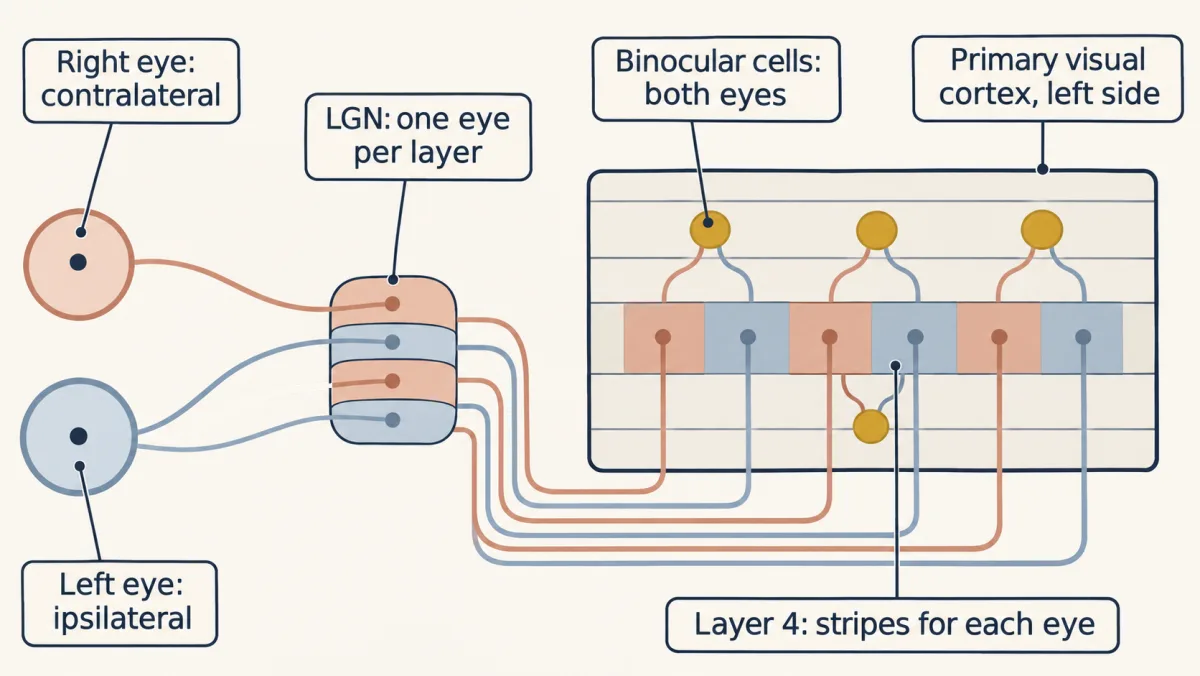
The two eyes' pathways stay apart through the LGN layers and the layer 4 stripes of primary visual cortex. Above and below layer 4, many cells combine the two eyes. These shared, binocular cells are what the eyes compete for. AI-generated illustration -
Measuring ocular dominance
-
One closed eye
-
Disuse or competition?
-
Out of step
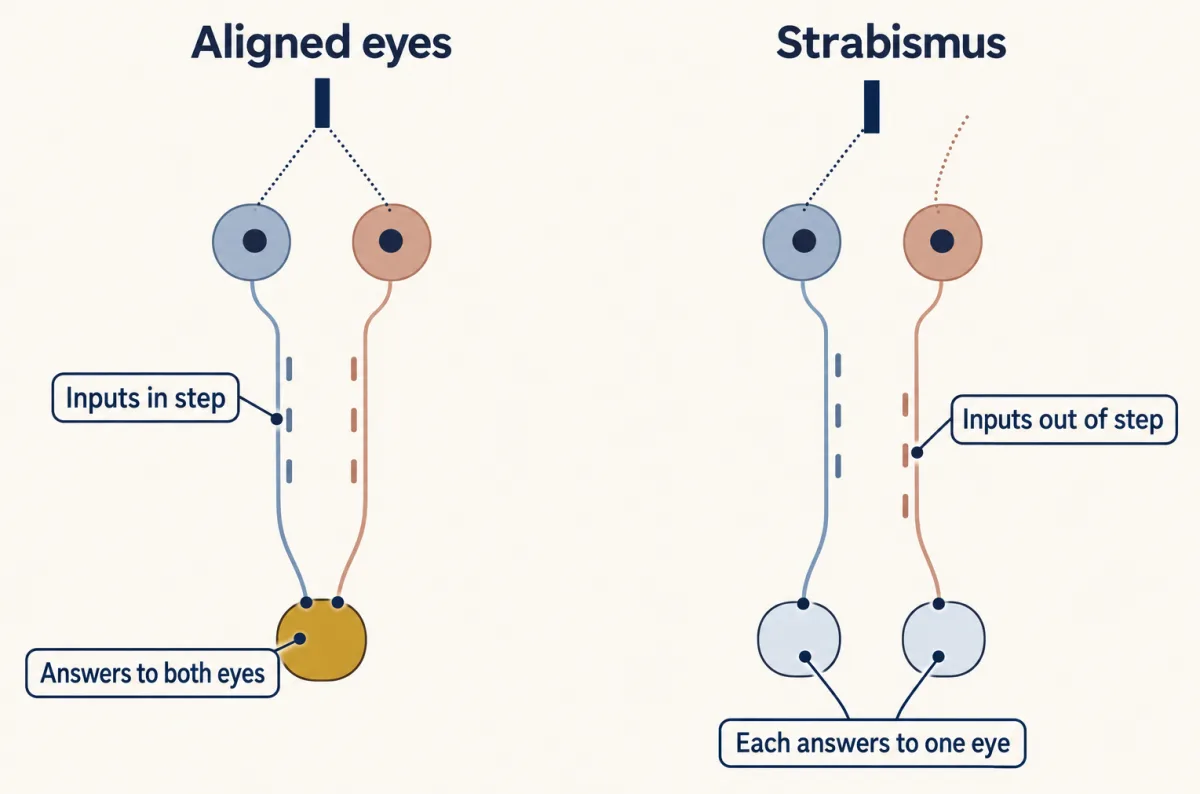
With aligned eyes, a moving edge excites both eyes' inputs to a shared cell at nearly the same moments. With misaligned eyes each eye can still send a similar amount of activity, but the two signals are unrelated. Most cells then answer to one eye or the other and few to both, while neither eye takes over. AI-generated illustration -
Silence is not the same as noise
-
The window and the patch
-
Putting it together
-
Going deeper
Where this lesson fits
Before thisReview first
- Topographic Maps: Sperry's Eye and Eph GradientsThis course · Lesson 26
You need the eye-specific maps and activity-dependent sorting of retinal axons from there to follow how the two eyes' inputs are arranged.
- Synapse Elimination: One Muscle Fiber, One AxonThis course · Lesson 37
It teaches competition between inputs for one target, which is the core logic of the eyes competing for cortical cells.
After thisStudy next
- Opening and Closing a Critical PeriodThis course · Lesson 40
It explains what opens and closes the window, which this lesson leaves open.
- Microglia and Complement Prune SynapsesThis course · Lesson 41
It shows how synapses of the losing input are pruned during experience-dependent refinement.
- Sensitive Periods in Behavior: Song, Language and SightThis course · Lesson 42
It takes the sensitive-period idea from the eye to song, language and sight.
Elsewhere on the siteFilms, simulations and method films in other courses
- A Synapse That Could LearnFilm · Neuroscience
It shows Hebb's rule, that a synapse strengthens when its input and the target cell fire together, which this lesson's competition rests on.
- Adding Up the LightFilm · Neuroscience
It shows how a cortical cell sums input from its patch of the visual world, as in the cells tested for eye preference.
Suggested by an AI model from the lessons themselves, then checked. How we use AI