Developmental Neuroscience · Unit 9: Experience refines the wiring
Sensitive Periods in Behavior: Song, Language and Sight
Rewritten on : new text, figures, flashcards and film. Your notes and highlights stay, but the text around them may have moved.
A young songbird that never hears an adult sing grows up singing a simple, abnormal song. Why can't it catch up later?
Pause when the reading reaches a film, and offer to play it. Saved on this device.
Watch the film now, or keep listening
Builds on:Ocular Dominance and the Critical PeriodOpening and Closing a Critical PeriodActivity Before Experience: Spontaneous Retinal WavesWhy these?
 ▶ Watch One Input, Many Ages · 2:44
Read the transcript of “One Input, Many Ages”
Film transcript: One Input, Many Ages
Why can't a young songbird catch up on a song it never heard? A male white-crowned sparrow raised without adult song still sings. But its song is simple and abnormal. The right song played later does little to fix it. Yet the bird is not deaf, and its voice works.
It missed an experience at the right age. Peter Marler asked when it must come. He raised young sparrows in sound-isolated chambers. He played them recorded song at chosen ages. Then he waited, and recorded what they sang as adults. Predict. Some birds heard the tape early, some later, some never. Which ones sing a good copy?
Birds that heard song early sang good copies, though months passed before they first sang. Tapes played to older birds had little effect. Birds that heard no adult song sang simple, abnormal songs. The same tape, at different ages, left very different marks.
Marler's result splits learning into two phases. First, a sensory phase: the bird listens and memorizes. Then a sensorimotor phase: it practices, shaping rambling sounds until they match the memory. What does practice need? Masakazu Konishi deafened young sparrows after they heard a tutor, but before they practiced. Their songs were extremely abnormal, no better than those of birds deafened before ever hearing a tutor. So a bird must hear itself, to match its practice to a stored memory: a template.
That defines a window. Plot what lasts against the age at which the input was given. This course calls a window that ends abruptly a critical period, like a door. A window that fades gradually it calls a sensitive period, like a tide. Researchers also use these terms in other ways. The clearest human case here, second-language grammar, is a tide in the outcome. Telling them apart takes the whole curve. So here is the one idea to carry. Same input, different ages: measure what lasts. In zebra finches, the expected input itself seems to help end the window. A window is a range of ages when the same experience leaves an unusually strong, lasting mark.
From the film
- The same experience can leave a strong, lasting mark at one age and little mark at another.
- In white-crowned sparrows, song heard early is copied well months later, while recordings played to older birds had little effect.
- To define a window, measure what lasts against the age at which the input was given.
A male white-crowned sparrow raised without hearing adult song still sings as an adult, but its song is simple and abnormal. Playing it the right song later in life does little to fix it.
The bird is not deaf and its vocal organ works. What it missed was an experience at the right age. Many behaviors, from song to grammar to fine vision, are built this way: the nervous system expects certain input during a window of development, and what arrives in that window shapes the circuit. This lesson asks how sharp those windows are, what sets their edges, and how much of the evidence from animals carries over to people.
Song: listen first, practice later
Songbirds give the clearest case of a window for learning. White-crowned sparrows from different places sing recognizably different dialects, a hint that the song is learned. In the 1960s and 1970s Peter Marler set out to find when. He raised young white-crowned sparrows in sound-isolated chambers, played them recorded song at chosen ages, and recorded what they sang as adults.
Predict. Some birds hear the tape early in life, some when they are older, and some hear no adult song at all. Which birds will sing a good copy as adults?
Check your prediction
Birds that heard song early in life later sang good copies, even though months passed before they first sang. Recordings played to older birds had little effect. Birds that heard no adult song developed simple, abnormal songs. The young birds also learned their own species’ song far more readily than another species’ song.
The same tape, played at different ages, left very different marks.
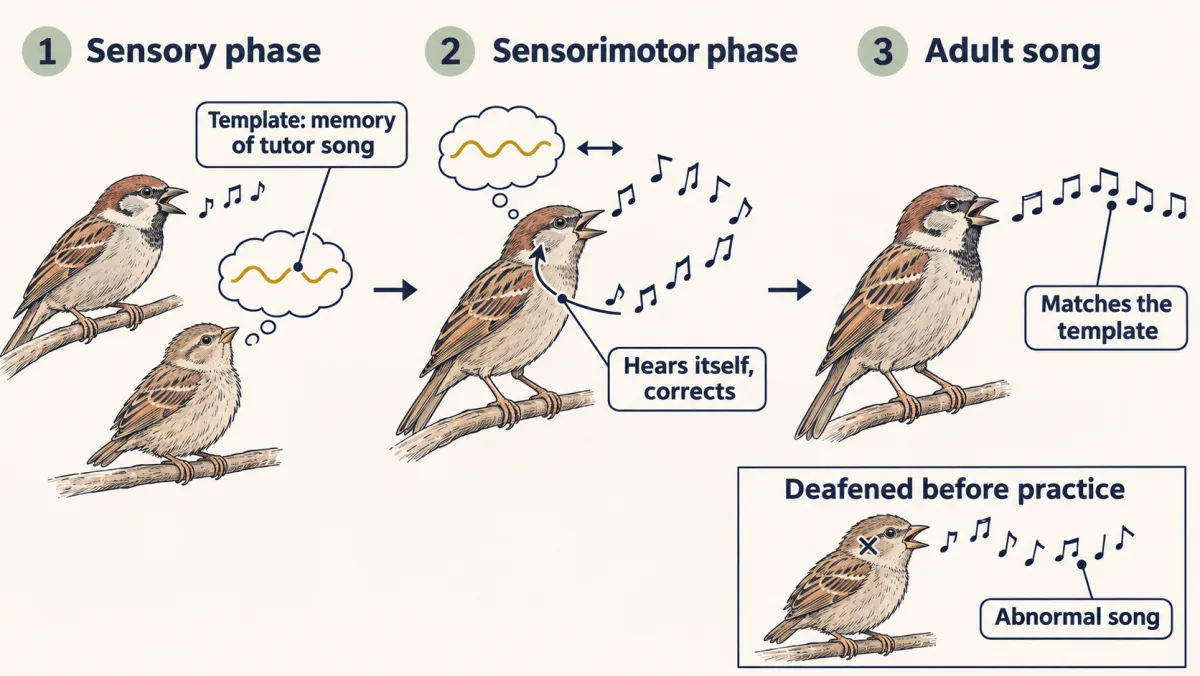
Marler’s result splits song learning into two phases. In the sensory phase the bird listens and memorizes. In the sensorimotor phase it practices, producing rambling sounds that it gradually shapes until they match the memory.
So what does practice need? Masakazu Konishi deafened young sparrows at different stages.
Predict. A bird hears adult song, so it has the memory. It is then deafened before it starts to practice. Will it sing a good copy?
Check your prediction
No. Its song is extremely abnormal, no better than that of a bird deafened without ever hearing a tutor. Hearing the tutor was not enough: the bird must hear itself to correct its voice.
Konishi’s result led to the idea of a template: an auditory memory, laid down in the sensory phase, against which the bird compares and corrects its own practice. Memory first, then matching.
How sharp is the window?
Marler’s design defines a window. Plot a lasting outcome, such as how much of the tutor’s song the adult copies, against the age at which the input was given (or, in studies of late onset, the age at which it first arrived). That plot can take two broad shapes, and this course names each.
| Name | Picture | How the lasting effect falls with later input |
|---|---|---|
| Critical period | a door that shuts | abruptly: high, then a sudden drop |
| Sensitive period | a tide going out | gradually: high early, then a steady decline |
These names are this course’s convention for the shape of an outcome curve; researchers also use the terms in other ways (see Going deeper). Both kinds are windows of opportunity and of vulnerability. Telling them apart takes the shape of the whole curve, not a single summary number. The one case here with a measured outcome curve, second-language grammar, is graded; for song and cataracts the lesson gives only a few ages, so their sharpness is not settled by these data.
The one idea to carry through this lesson. Same input, different ages: measure what lasts. A developmental window is a range of ages when an experience has an unusually strong lasting effect, compared with the same experience at other ages under comparable conditions. In zebra finches the expected input itself appears to help end that range.
What the rule covers.
- Which behaviors. Learned behaviors that need a specific input: song in songbirds, grammar in people, particular visual functions. It does not cover behaviors that develop without input, such as the spontaneous movements of chick embryos (see Going deeper).
- Which experiments. The core design is that age plot, with outcomes such as adult song, grammar years after arrival, or vision years after surgery. Matched-age rearing asks what experience does to the window, deafening, lesions and drugs ask what each step of learning needs, and the human studies compare histories people happened to have, not ones assigned to them.
Who closes the window?
Read the transcript of “Who Closes the Window?”
Film transcript: Who Closes the Window?
Does a window close on its own, like a clock? Or does experience help close it? A young male zebra finch memorizes his tutor, usually his father, between about day 25 and 65. He settles on a fixed, or crystallized, song by about three months. Now take two groups. One hears its father sing. The other is raised without adult males. Both get a new tutor at the same late age. By then, normally reared males have stopped copying new song. Predict. Which group copies the new tutor? What would a clock set by age predict?
A clock predicts neither copies. But Lucy Eales reported that only the birds raised without adult males copied. That was in 1985. Later studies gave mixed results. Same age, different history. So age alone may not set the window. Hearing a tutor seems to help close it. But missing input delays the closing; it does not abolish it. These birds eventually crystallize a song of their own.
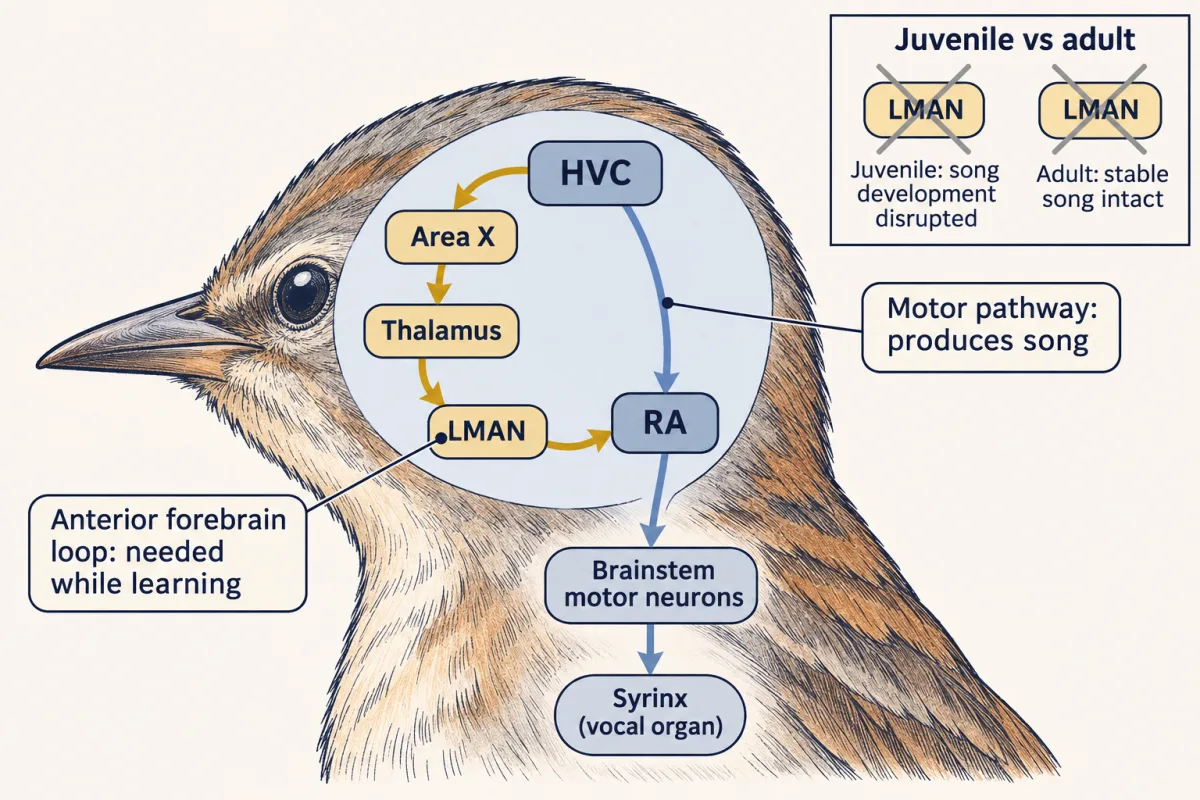
So experience seems to help set the window. Now, which part of the brain does the learning? The motor pathway runs from HVC to RA, to brainstem neurons that drive the vocal organ. A second loop leaves HVC. It runs through area X and the thalamus to LMAN, then back to RA. LMAN lesions disrupted song development in young finches, but left stable adult song intact. This loop matters while song is learned. In this loop, NMDA receptors were a natural suspect. Glutamate and a helper molecule, a co-agonist, activate them. But at normal magnesium levels, magnesium plugs the pore until the receiving cell is depolarized.
So current flows mainly when glutamate is released and the receiving cell is depolarized at about the same time. In many brain regions, that strengthens the active synapse. Mark Basham and colleagues infused a blocker, AP5. Predict. Which birds copy poorly? Blocker in the anterior forebrain before tutoring, there on other days only, or in the cerebellum?
Only the first group copied less. Birds given AP5 on other days copied normally. That counts against lost practice alone, though birds could catch up between infusions. Cerebellum infusions left learning normal. And the A P five treated birds could still tell finch song from canary song, so they were not simply deaf to it. So NMDA receptors there are needed while the song is memorized. Where the memory is stored is not shown.
From the film
- In zebra finches, hearing a tutor seems to help close the window, though later studies gave mixed results.
- Missing input delays the closing of the window but does not abolish it.
- NMDA receptors in the anterior forebrain are needed while the song is memorized, but where the memory is stored is not shown.
The zebra finch, now the standard laboratory songbird, runs a faster schedule than the sparrow. Only males sing. A young male memorizes a tutor, usually his father, between about 25 and 65 days after hatching, overlaps the two phases, and settles on a fixed, or crystallized, song by about three months.
Is the end of that window set by age alone, like a clock, or does the experience it is waiting for help close it? To ask, you need birds of the same age with different histories. Raise one group normally and one without adult males, then give each a new tutor at the same late age, after socially reared males have stopped taking up new song.
| Group | Early life | New tutor at the same late age | Copies the new tutor? |
|---|---|---|---|
| Socially reared | hears his father sing | yes | ? |
| Reared without adult males | hears no adult male song | yes | ? |
Predict. Fill in the last column. What would a clock set by age alone predict? What would you see if hearing a tutor helps close the window?
Check your prediction
A clock predicts that neither group copies, because both are the same age. Lucy Eales reported in 1985 that males reared without adult males can still copy a new tutor after the age at which socially reared males stop.
Same age, different history, different outcome. This suggests that age alone does not set the window and that hearing a tutor helps close it, although later studies gave mixed results and the groups differ in more than tutor exposure, such as social and visual contact with adults.
The result has a limit. Missing input delays the closing but does not abolish it: birds kept without a tutor eventually crystallize a song of their own. And a late copy can be less complete than the copy of a bird tutored at the normal age.
This is where the old argument of nature vs. nurture becomes an experiment. Genes build the circuit that can learn and set roughly when it can learn. Experience supplies what is learned, and in zebra finches it also appears to help decide when the window closes; in people that has not been shown causally. Neither can be removed without changing the outcome.
Which circuit matters while song is learned?
Is the part of the brain that learns the song the same part that sings it?
The song circuit was mapped in adult canaries by Fernando Nottebohm, Tegner Stokes and Christiana Leonard in 1976. Lesions of the forebrain nucleus HVC, or of the nucleus RA to which it projects, disrupted song, and RA sends fibers to the brainstem motor neurons that control the syrinx, the bird’s vocal organ. The letters abbreviate anatomical names (see Going deeper); here they are used simply as names. Two routes leave HVC.
- The motor pathway: HVC to RA to the brainstem motor neurons of the syrinx.
- The anterior forebrain pathway: HVC to area X, then the thalamus, then the nucleus LMAN, and from LMAN back to RA. It is a loop that leaves the motor pathway and rejoins it.
If LMAN belongs to the learning machinery rather than the singing machinery, damaging it should matter more in a young bird than in an adult. In 1984 Sarah Bottjer, Elizabeth Miesner and Arthur Arnold tested this in male zebra finches: LMAN lesions in juveniles disrupted song development but did not affect stable song in adults. The anterior forebrain pathway matters while song is learned, though the lesions alone cannot say where the tutor memory is kept.
What do the loop’s synapses need while the bird memorizes? A natural suspect is the N-methyl-D-aspartate (NMDA) receptor, a glutamate receptor (see the lesson on ion channels as receptors). It works as a coincidence detector:
- Glutamate and a co-agonist, glycine or D-serine (a second molecule that must bind alongside glutamate), activate the receptor.
- At normal magnesium levels, a magnesium ion plugs the pore while the receiving cell is near rest.
- Depolarization of the receiving cell drives the magnesium out, and current flows.
The glutamate comes from the cell sending the signal, and the depolarization reflects activity in the receiving cell. So the receptor reports that two cells were active at about the same time. In many brain regions that current triggers strengthening of the active synapse, a leading model of how memories are written.
In 1996 Mark Basham, Ernest Nordeen and Kathy Nordeen infused the NMDA receptor blocker AP5 into the brains of juvenile zebra finches, either into the anterior forebrain near LMAN or into a control region, and later scored how much of the tutor song each bird copied as an adult.
Predict. Which of these groups copied the tutor poorly?
- AP5 into the anterior forebrain before each of ten tutoring sessions.
- AP5 into the anterior forebrain, but only on non-tutoring days.
- AP5 into the cerebellum.
Check your prediction
Only the first group copied significantly less of the tutor song than controls. The other groups learned normally, and each argues against an alternative explanation.
| Group | Copied normally? | What it argues against |
|---|---|---|
| AP5 in the anterior forebrain before tutoring | no, significantly less | — |
| AP5 in the anterior forebrain on non-tutoring days only | yes | a deficit caused by the drug disrupting singing or practice rather than memorizing (weakens it without fully excluding it, since birds could make up practice on drug-free days) |
| AP5 into the cerebellum | yes | an effect of the drug wherever it is infused |
Treated birds could also still tell zebra finch song from canary song, so they were not simply deaf to it.
The result places a requirement for NMDA receptors in that region, during tutoring, in the step of memorizing, without showing where the memory is stored. Hearing a tutor also stabilizes dendritic spines on HVC neurons in young zebra finches (Roberts, Tschida, Klein and Mooney, 2010), a possible structural correlate of the memory forming. The cortical brakes that close windows in mammals are taken up in critical period control.
Language: what the age effects do and do not show
Read the transcript of “What Lasts Is Not What Can Be Learned”
Film transcript: What Lasts Is Not What Can Be Learned
Do people have windows like a songbird's? And what does an age curve tell us? In 1967, Eric Lenneberg proposed a critical period for language, from early childhood to puberty. The main natural test is deaf children of hearing parents who first meet a signed language late. Delayed access to sign does affect later proficiency. Mayberry compared adults who learned sign at the same age. Some already had English before losing their hearing. Those with no accessible language before sign did worse. The groups also differed in when they lost hearing, so it is not a perfect control. But it suggests missing early language, not only age, leaves a lasting mark.
Johnson and Newport tested English grammar in adults who arrived in the United States at ages 3 to 39. Predict. Plot adult grammar scores against age of arrival. Do scores hold until puberty, then drop? Or fall earlier? Early arrivals scored like native speakers. Then scores fell steadily with later arrival, up to about puberty. Later arrivals scored lower, and varied widely. The outcome curve was graded, falling from childhood.
But a huge online grammar quiz suggested that grammar-learning ability stays high until about seventeen. So how can a twelve-year-old arrive with full learning ability, yet end below native level? Grammar takes years to learn. A later starter gets fewer full-speed years before the slowdown. Suppose, as a toy, native-like grammar takes 7 full-speed years. A 12-year-old gets only 5. If later learning is slow enough, that shortfall lasts. So what lasts can start to fall before the ability to learn does. A curve of what lasts is not a curve of learning ability. Why learning slows is still debated. In sight, infants treated for dense cataracts showed some improvement in acuity after as little as an hour.
Yet processing of the spacing between facial features stayed impaired years later. Separate abilities have separate windows. So ask what input arrives, at what age, and what lasts.
From the film
- Delayed access to a first language does affect later proficiency, and missing early language, not only age, seems to leave a lasting mark.
- In second-language grammar, scores fall steadily with later age of arrival from childhood, a graded outcome rather than a sudden step.
- What lasts can start to fall before the ability to learn does, so a curve of what lasts is not a curve of learning ability.
- Different visual abilities have separate sensitive periods.
In 1967 Eric Lenneberg proposed a critical period hypothesis for language: a first language can be acquired only between early childhood and puberty. It is hard to test, because nearly every child is exposed to language from birth.
The case of a girl known as Genie, found at age 13 after years of severe isolation and abuse, is often cited. But a child deprived so completely was deprived of much more than language, and such cases cannot isolate a language window.
The main natural test is deaf children of hearing parents who first meet a signed language late. They are deprived mainly, though not only, of an accessible language, rather than of the whole range of care and social contact, and delayed access to sign does affect later proficiency.
- In 1990 Elissa Newport compared learners of American Sign Language first exposed from birth, at ages 4 to 6, or after 12. On the grammar of word structure (morphology), those first exposed later fell progressively further below native signers.
- In 1993 Rachel Mayberry compared adults who learned American Sign Language late as a first language with adults who learned it at the same age as a second language. The second-language group had learned English before losing their hearing; the first-language group had no accessible language before sign. The first-language group did worse.
The groups also differed in when they lost their hearing, so this is not a perfect control. Still, it is some of the cleanest human evidence that missing early language, not only age, leaves a lasting mark.
What a second language can and cannot show
Second languages are easier to study than late first languages, because there are many learners and they arrive at every age. They answer a narrower question, though: these learners already speak a first language, so a decline with age could come from a brain that has become less plastic or from a first language that gets in the way.
In 1989 Jacqueline Johnson and Elissa Newport tested 46 adults whose first language was Korean or Chinese and who had moved to the United States between the ages of 3 and 39. Each listened to English sentences and judged whether each one was grammatical.
Predict. Sketch adult score against age of arrival. What would the outcome curve look like if it were a door at puberty? What if it were a tide?
Check your prediction
A door in the outcome would be a flat, native-level line until puberty and then a drop. A tide would start falling earlier and decline gradually.
The data look like the second. People who arrived at ages 3 to 7 scored like native speakers. Scores then fell steadily with age of arrival up to about puberty. Among later arrivals, scores were lower and varied widely, and no longer tracked age of arrival. The authors reported that years of residence did not explain the age effect.
The age effect is strong, and the evidence that it is graded lies in the steady fall among the early arrivals; a single correlation across all arrivals could come out much the same for a sudden step as for a steady slope. But this is a curve of what lasts, and by itself it cannot say when, or how sharply, the ability to learn changes.
Nearly thirty years later a much larger study seemed to say something different. In 2018 Joshua Hartshorne, Joshua Tenenbaum and Steven Pinker gave an online grammar quiz to about 670,000 people and estimated how fast people learn grammar at each age. Their answer: grammar-learning ability stays high until about age 17, then declines.
So how can a 12-year-old arrive with undiminished learning ability and still end up below native level?
Grammar takes years to learn. Take a toy model, for illustration only: suppose learning runs at full speed until 17 and much more slowly after that. Suppose too that native-like grammar takes about 7 years at full speed. That number is not a measurement: it is picked so the toy matches the model’s conclusion below, and in the fitted model the time needed is far longer, on the order of decades of experience.
| Starts at | Full-speed years before 17 | Against the 7 needed |
|---|---|---|
| 5 | 12 | 5 to spare |
| 10 | 7 | exactly enough |
| 12 | 5 | 2 short |
| 14 | 3 | 4 short |
| 25 | 0 | all 7 still to learn, at the slower rate |
The 12-year-old starts with the same ability as the 5-year-old but runs out of full-speed time. If later learning is slow enough, and the learner does not keep at it long enough, the gap remains. So the curve of what lasts can start to fall in late childhood even if the ability to learn falls only in late adolescence. On Hartshorne and colleagues’ model, reaching native-like grammar needs a start by about age 10. The toy gives a curve that is flat to about 10 and then bends; it does not reproduce the decline Johnson and Newport already found among arrivals aged 8 to 10, or the wide variation among later arrivals, which would need people to differ in the years they need.
Taken together, the graded outcome curves and the late-signer studies do not fit a simple boundary at puberty, though they do not show how learning ability itself changes.
Two questions remain open. Where the slowdown begins depends on the model’s assumptions (see Going deeper). And neither study says why learning slows: whether from a change in the brain’s plasticity, competition from an entrenched first language, or differences in the kind and amount of input is still debated.
Sight: separate windows for separate abilities
A newborn sees, but coarsely. Acuity, the finest detail the eye can resolve, and contrast sensitivity, the ability to detect faint differences in brightness, both improve over the first years of life, steeply in the first year.
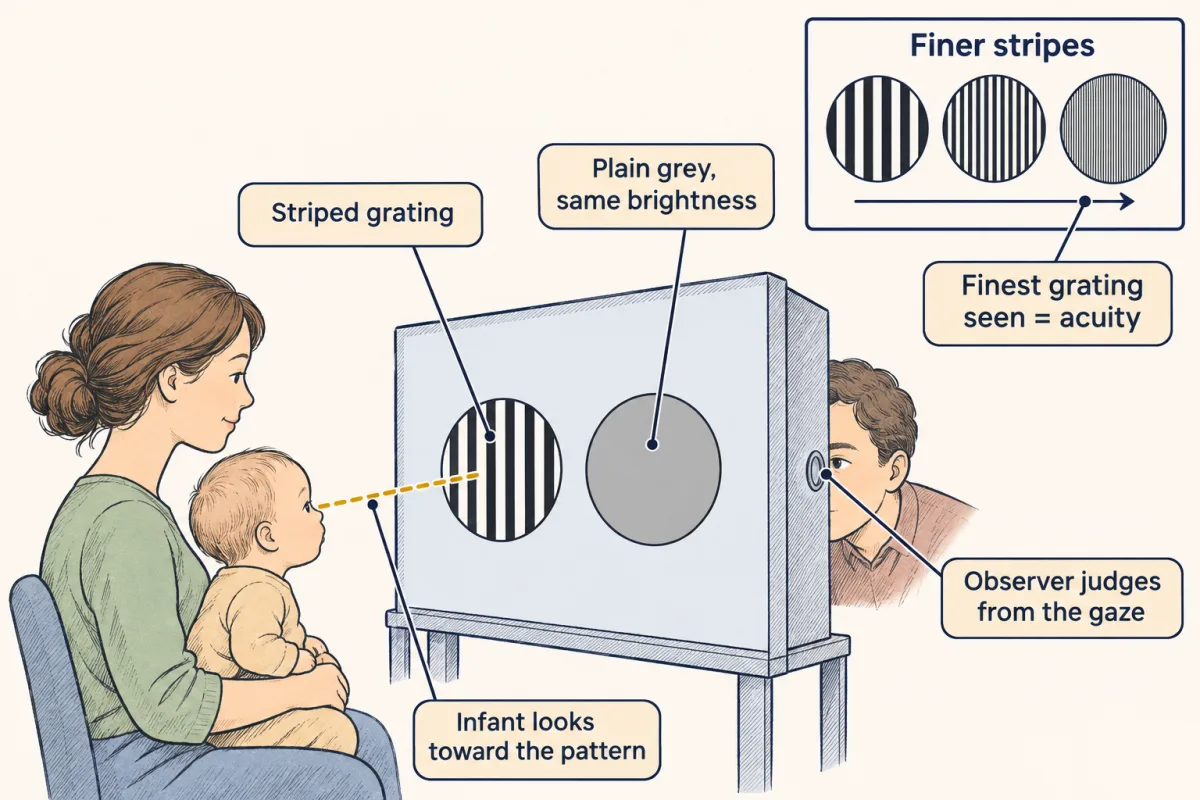
How do you ask a baby what it can see? Watch where it looks, since infants prefer a pattern to a plain field. In forced-choice preferential looking, a striped grating appears on one side and a gray field of equal brightness on the other; an observer who cannot see which side holds the stripes judges from the infant’s gaze. The finest grating the infant reliably looks at gives its acuity in cycles per degree, one cycle being one dark and one light stripe.
Children born with dense cataracts in one or both eyes show what visual input does. In 1999 Daphne Maurer, Terri Lewis, Henry Brent and Alex Levin reported 28 infants treated between 1 week and 9 months of age. Right after treatment their acuity was no better than a newborn’s, whatever their age, and some improvement appeared after as little as an hour of visual input: improvement needs patterned input, not age alone.
Yet the same group found lasting deficits in some functions, among them fine acuity and processing of the spacing between facial features, even when the cataracts were treated within the first months. Different abilities were affected by deprivation at different ages, so different visual abilities have different sensitive periods. Some are affected by deprivation before the ability itself has appeared, which Maurer and colleagues call a sleeper effect. Processing of facial spacing is an example: it keeps developing for years after infancy, yet deprivation only in the first months left it impaired. The cortical mechanisms behind such windows are taken up in ocular dominance and critical period control.
Putting it together
| Case | Design | Measured outcome | What it shows | What it does not establish |
|---|---|---|---|---|
| Tape tutoring, white-crowned sparrow (Marler) | recorded song at chosen ages, or none | adult song | good copies only from early tapes; abnormal song with none: an early window | where the memory is kept |
| Deafening before practice (Konishi) | deafened after tutoring, before practice | adult song | practice needs the bird to hear itself | when the window closes |
| Late tutor at the same age, zebra finch (Eales) | same late age, reared with or without adult males | copying of the late tutor | reported: only the deprived birds copy, suggesting hearing a tutor helps close the window (replication mixed) | a window that stays open forever; that tutor exposure alone is the cause |
| LMAN lesions (Bottjer) | lesions in juveniles or adults | song | the anterior forebrain pathway matters while song is learned | where the tutor memory is stored |
| AP5 during tutoring (Basham) | AP5 at chosen times and places | copying of the tutor | NMDA receptors in the anterior forebrain are needed during tutoring | where the memory is stored |
| Late first-language signers (Newport, Mayberry) | naturally varying age of first access to sign | sign proficiency in adults (morphology; sentence recall) | progressively lower morphology across three exposure groups; late first language worse than late second | which cause of the age effect; histories were not assigned |
| Second-language grammar (Johnson and Newport) | naturally varying age of arrival | English grammar in adults | scores fall from childhood, then lower and variable: a tide in the outcome | the time course of learning ability |
| Online grammar quiz (Hartshorne) | current age, age at first exposure and years of experience | grammar-test performance | a model estimated high learning ability until about 17, then decline | why learning slows; the rate without the model’s assumptions |
| Dense congenital cataracts (Maurer) | clinical age at treatment | acuity, face processing | acuity begins to improve within an hour of input; some functions stay impaired | the cortical mechanism |
Two reminders from the cases:
- A curve of what lasts is not a curve of learning ability. If learning takes years, the outcome can fall first.
- Separate curves for different functions, species and exposure conditions. Different visual abilities have different curves in the same child, timings differ between species, and rearing history or tutor format can shift the curve within one species. Compare ages within one rearing and tutoring protocol.
Design problem
You want to know whether a zebra finch has a sensitive period for learning its tutor’s song, and whether experience itself helps to close that window. Design the experiment, and say what result would tell you that hearing a tutor closes the window rather than age alone.
Saved in this browser only.
One way to do it
Raise young males without an adult male, then introduce a tutor at different ages in separate groups (for example from day 20, day 40, day 65 and day 90). Record each bird’s crystallized adult song and score how much of the tutor’s song it copied, syllable by syllable, from spectrograms (plots of frequency against time). Plotting copy score against age at first tutoring defines the window, and a gradual fall would mark it as sensitive rather than critical.
For the second question, use the Eales comparison above: at an age past the usual end of copying, give a new tutor to normally reared birds and to birds kept from adult males. If only the deprived birds copy, the experience is part of what closes the window; if both fail, a clock tied to age alone is the simpler explanation. Eales’s 1985 results were of the first kind; some later studies supported them and others did not.
Going deeper
Other uses of the terms critical and sensitive period
A classic definition says a critical period is a time during which a behavior is especially susceptible to, and requires, particular experience in order to develop normally. Many researchers draw the line another way: in a critical period the experience is essential and its effects are permanent, while in a sensitive period experience only has an unusually strong effect. Some use the two terms interchangeably.
Early movements that do not need experience
The earliest behaviors come from simple circuits that run on their own, without experience. In chick embryos, leg movements continue after the sensory input to the lumbar spinal cord is removed, so they are generated within the cord. Early movements do different jobs. Some, such as yawning and smiling in the fetus, come before patterns used for life. Others serve only the current stage, such as fetal breathing movements that help the lungs develop, or the movements a chick uses to hatch. Spontaneous activity, sensory feedback and learning then work together as behavior develops.
Live tutors versus tapes
Marler’s late tapes had little effect, but a tape is not the only kind of input: in white-crowned sparrows, live tutors have been reported to extend learning past the age at which tapes stop working (Baptista and Petrinovich, 1984). The kind of input, not only its timing, can shape the window.
Where the slowdown in grammar learning begins
Hartshorne and colleagues read their own data as a sharply defined critical period that ends late. In their model, “sharply defined” describes the age, about 17, at which learning begins to slow, not a sudden collapse in ability; whether the decline after it is a sharp break or a gradual slope is still argued. A later reanalysis of the same data by van der Slik and colleagues (2022) argued that they fit a steady decline from earlier ages instead.
Do NMDA receptor changes set the song window?
Developmental changes in N-methyl-D-aspartate (NMDA) receptor subunit composition in the anterior forebrain have been proposed as one mechanism that closes the song window. Experiments in songbirds have challenged the idea that NMDA receptor changes alone set it.
Names of the song nuclei
HVC is now used as a proper name rather than an abbreviation. RA is the robust nucleus of the arcopallium, and LMAN is the lateral magnocellular nucleus of the anterior nidopallium. In Bottjer’s 1984 paper LMAN is called by its older name, the magnocellular nucleus of the anterior neostriatum.
Converting a grating to a Snellen fraction
Snellen denominator ≈ 20 × (30 ÷ finest grating in cycles per degree)
By this method a newborn’s acuity is often near 1 to 2 cycles per degree, roughly 20/600 to 20/300. Numbers depend on the method: recordings of visual evoked potentials from the scalp give better values at the same age than looking tests do.
Your notes
Select any text in the lesson to highlight it or add a note to it. Your highlights and notes are saved in this browser and collected in your notebook.
This browser is not letting the site save anything (a private window or strict privacy settings), so highlights and notes will be lost when you leave the page.
How we measure it
Tutor-controlled rearing of songbirds
Young birds are raised in sound-isolated chambers and exposed to recorded or live song at chosen ages. The adult song is recorded and compared with the tutor song syllable by syllable on a sound spectrogram, a plot of frequency against time. The age at which tutoring still yields a good copy marks the window.
Local drug infusion into a brain nucleus
A fine cannula delivers a drug, such as the NMDA receptor blocker AP5, into one nucleus at a chosen time. Comparing infusions given on tutoring days, on other days and into a control region shows whether receptors in that place are needed for that step of learning.
Grammaticality judgment testing
Listeners hear sentences, some grammatical and some with a single error, and say which are correct. Scores across many sentences and structure types give a measure of grammar that can be compared across groups defined by age of first exposure.
Forced-choice preferential looking
An infant is shown a striped grating on one side and a plain gray field of equal mean brightness on the other. An observer who cannot see which side holds the stripes judges where they are from where the infant looks. The finest stripes the infant reliably looks at give an estimate of grating acuity.
Practice questions on this lesson (3) → MCAT-style, original, each with an explanation
Where this lesson fits
Before thisReview first
- Ocular Dominance and the Critical PeriodThis course · Lesson 39
You need the kitten monocular-deprivation results and the critical period idea from there, which this lesson extends to song, language and sight.
- Opening and Closing a Critical PeriodThis course · Lesson 40
It explains the cortical brakes that close windows, which this lesson compares with the song window and its NMDA-receptor evidence.
- Activity Before Experience: Spontaneous Retinal WavesThis course · Lesson 38
It shows how activity before experience prepares the circuit that later input refines, which this lesson assumes.
After thisStudy next
- Where Glia Come FromThis course · Lesson 43
It starts the next unit, but only loosely continues this lesson's themes.
Suggested by an AI model from the lessons themselves, then checked. How we use AI
Finish line
Test yourself
8 questions
Practice and MCAT-style, with explained answers.
Next · Lesson 43
Where Glia Come From
Astrocytes and oligodendrocytes come mostly from the same pool of radial glia that made the neurons, yet the brain's own immune cells were born outside the embryo, in the yolk sac.
Continue →