Sensory Systems · Skim version
Nociceptors and the Sodium Channels of Pain
Read the full lesson → Skim the whole course →
The guiding idea
Three families in which nobody could feel pain pointed to one sodium channel. Twenty years later, the drug that reached patients blocks a different one.
A sodium-channel change can alter a nociceptor's spike initiation, so what the neuron does depends on how many channels are available at rest, not only on how easily they open.
From the film: Three Families, One Gene
- Three consanguineous families in northern Pakistan had members who never experienced pain, and the mutant SCN9A channels passed no current above background in cultured cells.
- Linkage says a variant travels with a phenotype, and only a recording can say whether the channel conducts.
- People with the same loss of function also cannot smell, and the blocker that reached patients targets a different channel.
From the film: Three Channels and the Availability Budget
- Nav1.7 and Nav1.8 contribute to the spike itself, while Nav1.9 mainly sets the resting potential and subthreshold excitability.
- Availability is the fraction of sodium channels not already inactivated, and it falls as the resting potential becomes more depolarized.
- Depolarization closes the gap to threshold but costs availability, so ask what happened to the channel, then to rest and availability, then to firing.
From the film: The Same Gene, Too Much Pain
- Variants in the same gene that alter gating can cause too much pain, as in primary erythermalgia.
- Pain-associated variants can open too easily, close too slowly, or fail to inactivate.
- The gating measurements came from channels in cultured cells, so a gating change still has to pass through the neuron before it reaches behaviour.
From the film: Where More Current Breaks
- More sodium current does not always mean more pain, because Nav1.9 carries a standing inward current near rest that depolarizes the neuron.
- Gain-of-function Nav1.9 variants raised firing in one study and impaired it in another, so the current alone cannot predict what the neuron does.
- The outcome depends on the size and time course of the depolarization, subtype-specific availability, channel densities, other conductances and the stimulation.
From the film: Strong Nav1.8 Block, Still Firing
- Strong Nav1.8 block generally reduced but did not eliminate repetitive firing in adult human sensory neurons recorded at 37 °C.
- A channel-current calculation is not neuronal silence, and it is not a dose.
- Suzetrigine beat placebo in two surgical trials, but neither showed superiority over the opioid comparator, and a failed superiority test is not equivalence.
From the film: Labels, Classes and States
- A molecular label, a conduction class and a functional state are different kinds of measurement, so nociceptor categories overlap.
- In mice, removing one labelled population in adults raised mechanical thresholds while sparing heat and cold in the ranges tested, and a TRPV1-positive lesion did the opposite.
- Deleting the same neurons from birth showed no detectable mechanical deficit, so a germline deletion is a developmental experiment.
-
What a sodium-channel result can and cannot predict
-
Three channels, one spike
-
People who cannot feel pain, and people who feel too much
-
Where more current breaks: Nav1.9
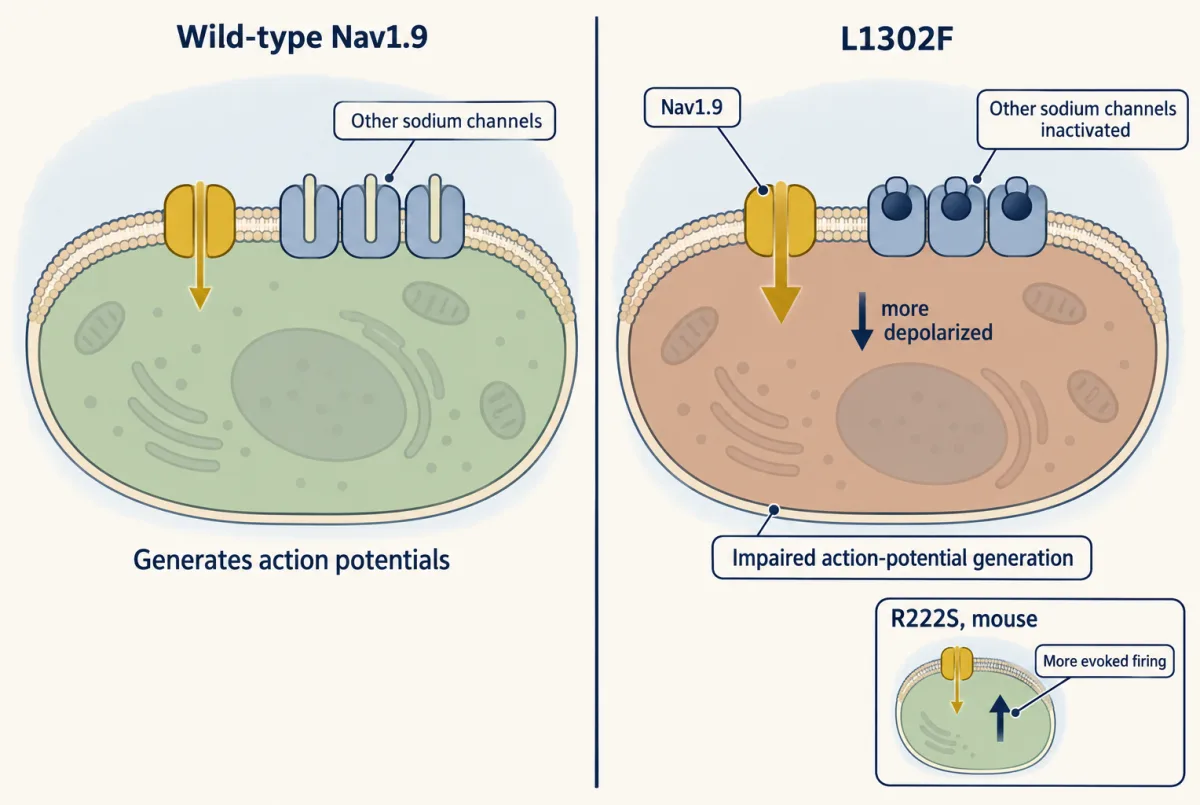
Human Nav1.9 L1302F expressed in rat dorsal root ganglion neurons depolarized the resting membrane potential and impaired action-potential generation. Strong sustained depolarization reduces the availability of other sodium channels; only the most depolarized cells stopped firing altogether. Separately, dorsal root ganglion neurons from R222S knock-in mice showed increased evoked firing. Nav1.9 gain of function can therefore raise or lower neuronal excitability, depending on the extent of depolarization. Channel symbols and arrows are qualitative and do not represent measured proportions or current ratios. AI-generated illustration -
Blocking Nav1.8: from a fitted curve to a spike
-
Which nociceptors? Labels, classes and states
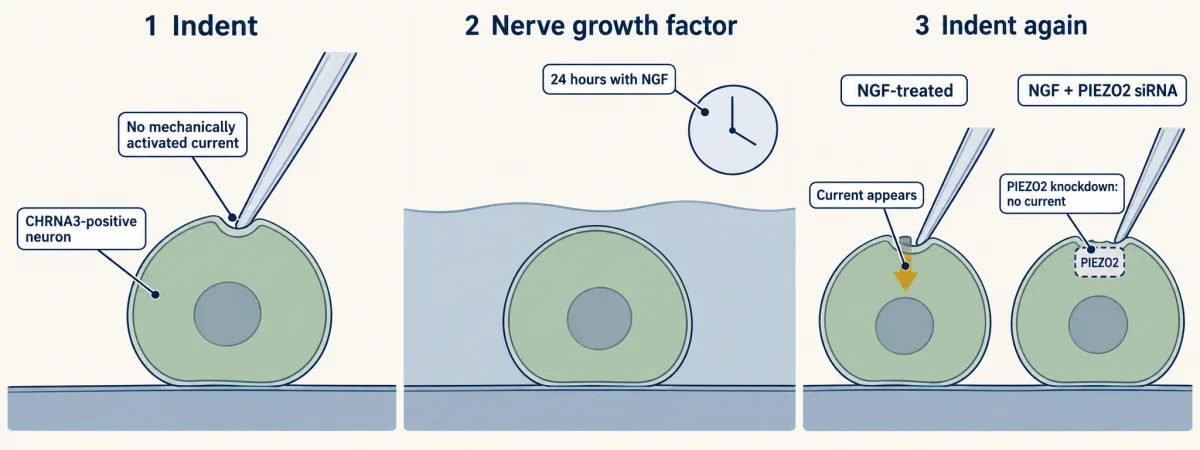
Soma-indentation experiments in cultured mouse dorsal root ganglion neurons show that mechanical silence can change. CHRNA3-positive peptidergic neurons were almost unresponsive before treatment; one of fifteen tested cells showed a tiny inward current. After 24 hours with nerve growth factor, mechanically activated currents appeared, and siRNA knockdown of PIEZO2 prevented their appearance. CHRNA3 marks a nicotinic receptor subunit and serves only as an identifying label for the population; these experiments establish a requirement for PIEZO2 in the induced current, not a mechanism demonstrated in intact nerve endings. AI-generated illustration -
Ablate one population, lesion another
-
Going deeper
Where this lesson fits
Before thisReview first
- Five Ways to Turn a Stimulus into a CurrentThis course · Lesson 1
It sets out how channels turn a stimulus into current, which this lesson uses when reading channel results.
- Sensory Neurons by Their Genes: the Atlas EraThis course · Lesson 3
Its molecular classes of sensory neurons are the labels this lesson separates from conduction class and functional state.
- Hot, Warm, Cool and ColdThis course · Lesson 10
It covers TRPV1 and the heat channels that the TRPV1-lesion experiment here relies on.
After thisStudy next
- Spinal Circuits That Gate PainThis course · Lesson 12
It follows pain signals from nociceptor central terminals into the spinal gates, the second route from channel to behaviour here.
- When Pain PersistsThis course · Lesson 14
It takes sodium-channel gain-of-function and nociceptor sensitization further, into pain that persists after injury.
- Itch: A Sense of Its OwnThis course · Lesson 13
It uses the same Mrgpr-labelled nociceptor populations and ablation logic to ask what each population does.
Elsewhere on the siteFilms, simulations and method films in other courses
- Run the 1952 equationsSimulation · Neuroscience
It lets you run the squid-axon model to see how sodium channel availability and threshold shape a spike.
- Cut half the cordSimulation · Neuroscience
It covers the nociceptor channels that code noxious heat and chemical stimuli.
- Nernst calculatorSimulation · Cell Signaling
It gives a Nernst calculator for working out how channel openings move a cell's membrane potential.
Suggested by an AI model from the lessons themselves, then checked. How we use AI