Ecology and Evolution · Skim version
Mutualism, Parasitism and Coevolution
Read the full lesson → Skim the whole course →
The guiding idea
The same root fungus can help a plant in poor soil and cost it in rich soil. Is it a mutualist or a parasite?
An interaction's sign is set by each partner's net of benefit minus cost, so it can shift when conditions or the partner's own evolution push a net across zero.
From the film: The Net Decides the Sign
- An interaction is scored by its net effect on each partner: benefit minus cost, compared with life without the partner.
- The sign follows the net, so the same root fungus can help a plant in poor soil and cost it in rich soil.
- A net of zero can hide a large benefit and a large cost that cancel.
- A partner that takes the reward and skips the service can be held back if the host cuts its reproduction enough, a host sanction.
- Coevolution means each partner evolves in response to the other; a good fit alone does not show it.
From the film: Reading Evolution Across Time
- A time-shift assay pairs parasites with hosts from the past, the same time and the future; if neither partner's heritable traits changed, every pairing should give about the same infection rate.
- In an arms race, a parasite infects past hosts best and future hosts worst, and the difference grows with the time gap: a one-way trend points to escalation.
- In fluctuating selection, parasites do best on hosts of about their own time, and infection rises and falls as the gap grows: a wave points to tracking. Both shapes are evidence, not proof: coevolution also needs heritable change in both partners.
- In rotifer-alga chemostats, algae able to evolve gave long cycles with predator and prey peaks largely out of step, and defended algae were poorer competitors for nutrients.
- Those runs showed prey evolution changing population cycles, not coevolution: predator evolution was not tested.
-
Signs are measured nets
-
Keeping a mutualism honest
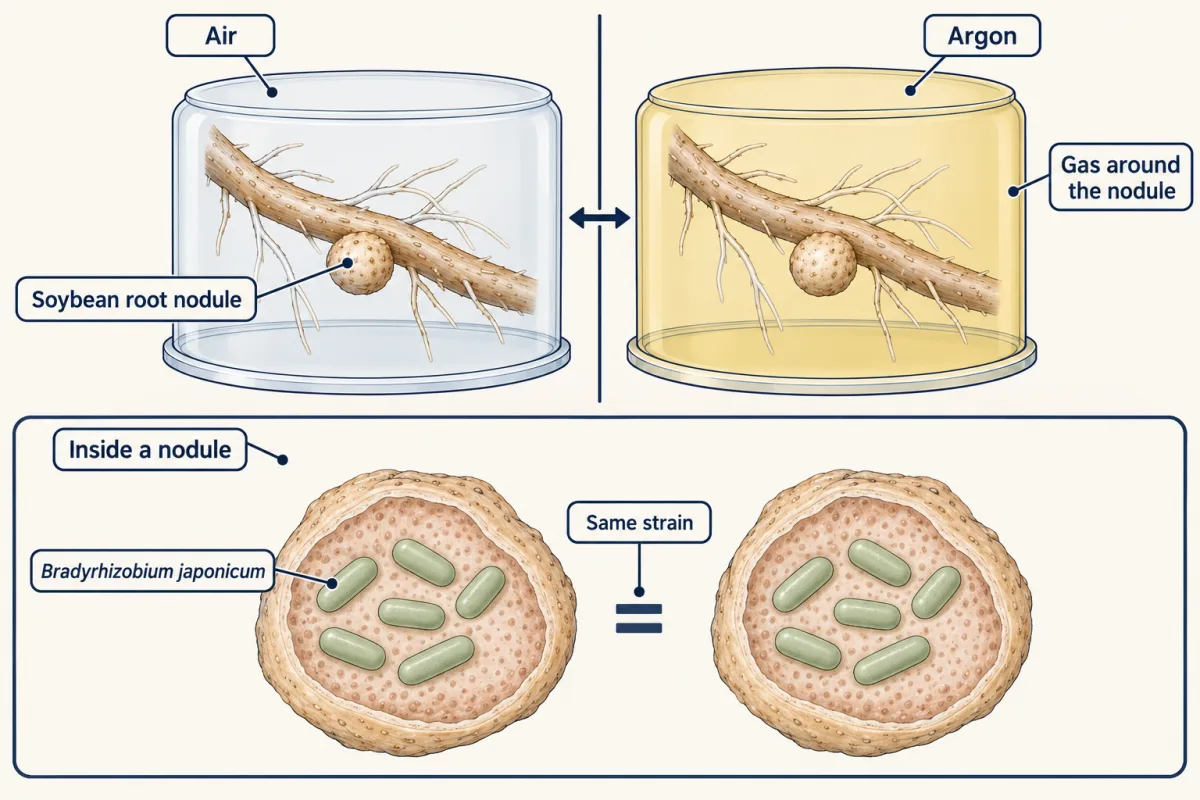
Kiers and colleagues kept one Bradyrhizobium strain and removed only its service with argon; rhizobia in nodules that could not fix reproduced about half as well. AI-generated illustration -
When is it coevolution?
-
Arms races, cycles and the length of the record
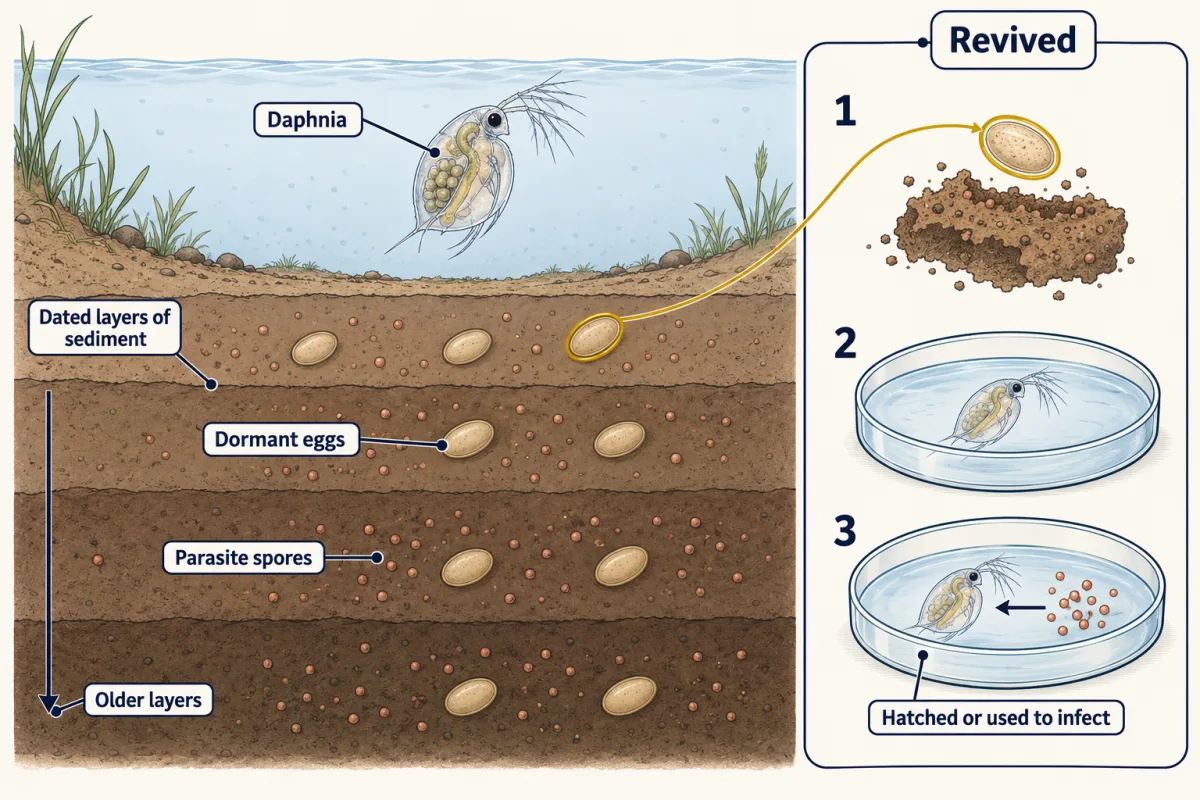
Pond sediment keeps dated layers of dormant Daphnia eggs and parasite spores, so hosts and parasites from different years can be revived and tested against each other. AI-generated illustration -
Rotifers and algae: evolution inside a population cycle
-
Going deeper
Where this lesson fits
Before thisReview first
- How to Test an Evolutionary ExplanationThis course · Lesson 1
You need its test of whether a change counts as evolution before judging time-shift results here.
- Natural Selection in Ecological ContextThis course · Lesson 3
Its trade-offs and frequency-dependent selection are used here to explain tracking and defended-versus-fast-growing prey.
- Predation and Community EffectsThis course · Lesson 17
You need its predator-prey cycles and phase lags to read the rotifer-alga chemostat results.
After thisStudy next
- Nutrient CyclingThis course · Lesson 22
Root fungi and rhizobia supply plant nutrients, and this lesson shows how those nutrient flows move through ecosystems.
- Biodiversity and Ecosystem FunctionThis course · Lesson 23
Complementary species benefits, like partner exchanges here, help explain why diverse plots out-grow single-species plots.
Elsewhere on the siteFilms, simulations and method films in other courses
- Switch off a microbe groupSimulation · Biology
Switching off a microbe group shows what a plant loses without its root bacteria.
- Who Unlocks the Matter?Film · Biology
Soybean root nodules show bacteria that give the plant usable nitrogen, the mutualism tested here.
- Pair up two speciesSimulation · Life Science
Pairing species by what each partner gains or loses practises scoring an interaction's sign.
Suggested by an AI model from the lessons themselves, then checked. How we use AI