Cell Biology · Skim version
Molecular Motors and Cargo
Read the full lesson → Skim the whole course →
The guiding idea
A motor protein turns ATP into steps along a track, and every track has a direction. Which motors walk which way, and how do we know?
Myosins, kinesins and dyneins are enzymes that turn ATP into steps along actin filaments or microtubules.
From the film: Grip, Swing, Let Go
- In an axon, microtubules have a direction: kinesin-1 walks to the plus end, outward, and dynein to the minus end, back toward the cell body.
- Each foot of a motor repeats one ATP-driven cycle: grip, swing, let go, re-cock.
- Kinesin-1 walks hand over hand: its cargo moves 8 nm per step while each foot moves about 16 nm.
- One kinesin foot is nearly always holding on, so one motor can take about 100 steps before letting go.
- Myosin II feet spend most of the cycle off the track, so it works in crowds, as in muscle.
From the film: Turning Motion Into a Measurement
- In a gliding assay, fixed motors drive a loose filament opposite to their walking direction.
- Marking the filament ends lets its leading end reveal motor direction.
- A bead carried by one motor can reveal discrete steps in its position record.
- In an optical trap, calibrated bead displacement reports force.
- Motor numbers should be compared only under matched ATP and loading conditions.
-
Tracks with a direction, and three families of walkers
-
One cycle, seen in one myosin head
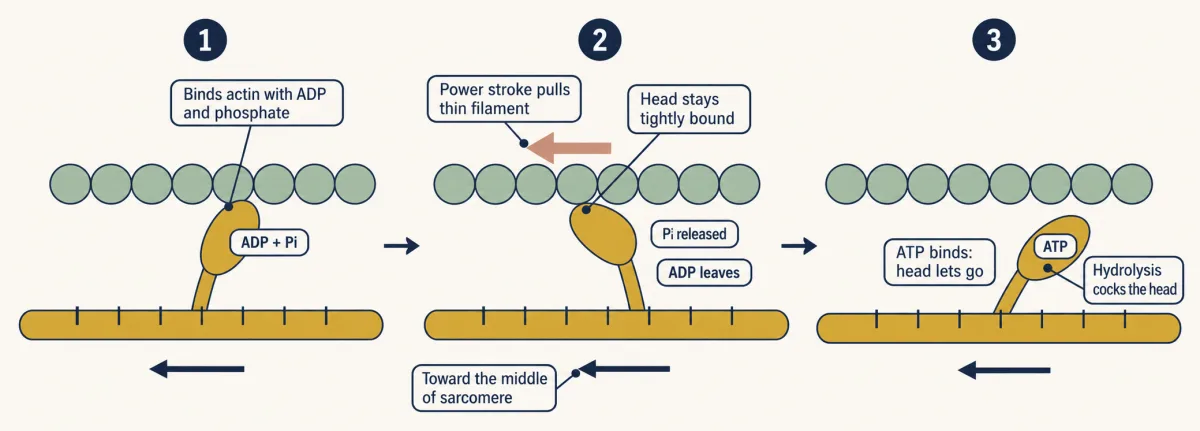
One myosin II head cycles on a thin filament: it binds actin carrying ADP and phosphate, the power stroke pulls the thin filament toward the middle, and ATP binding releases it and, once split, cocks the head again. With no ATP, heads stay locked on (rigor). AI-generated illustration -
Walking alone versus working in a crowd
-
How we know: gliding assays and optical traps
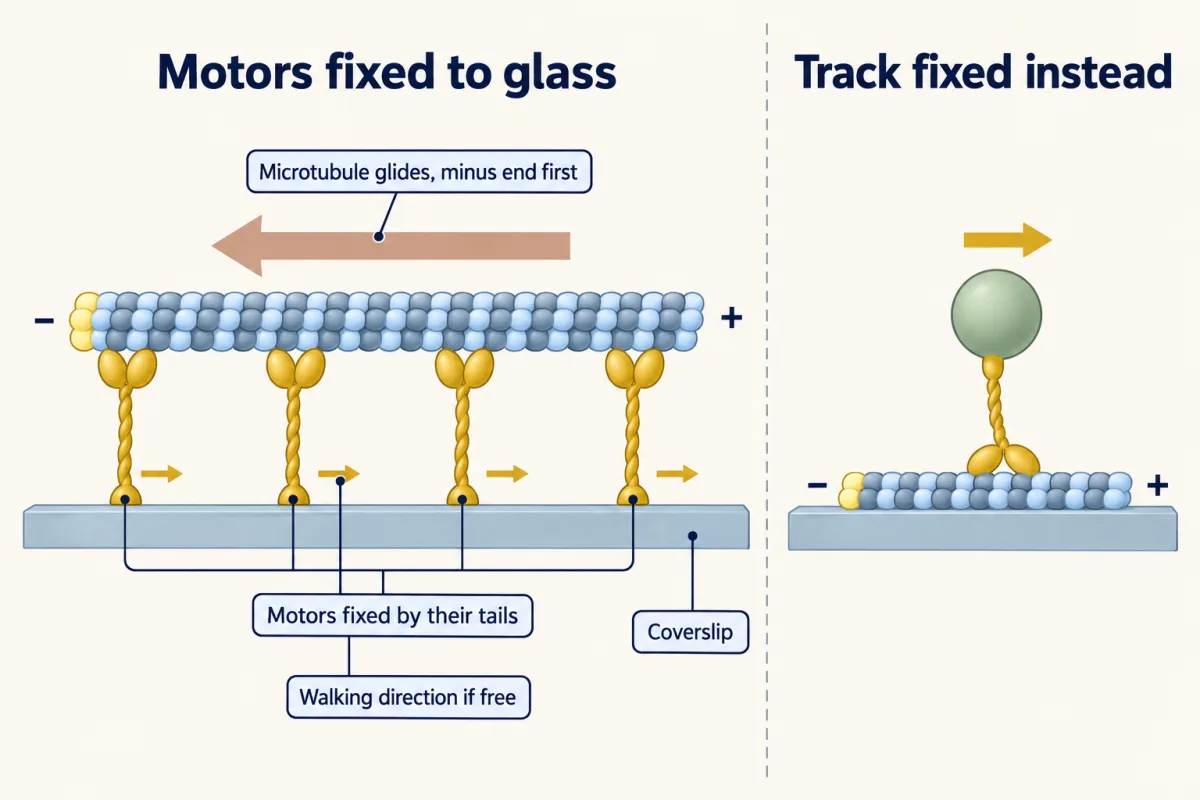
In a gliding assay the motors are stuck to glass and cannot move, so the filament does. A plus-end motor fixed to glass drives its microtubule minus end first; the same motor free on a fixed track walks toward the plus end. AI-generated illustration 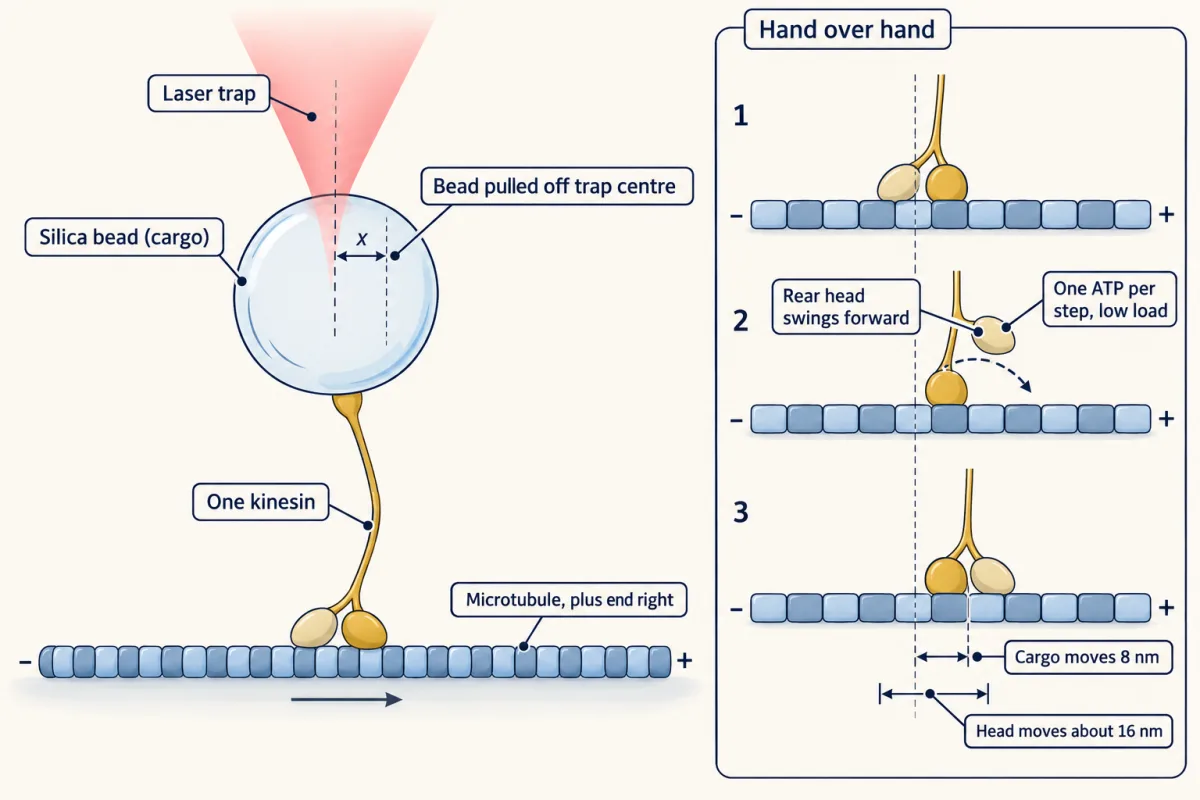
An optical trap holds a bead carried by one kinesin. Hand over hand, each head passes its partner, so a head travels about 16 nm while the cargo advances 8 nm, with one ATP per step at low load. AI-generated illustration -
What sets direction and step: the swing
-
Crowds I: muscle, where filaments slide and do not shrink
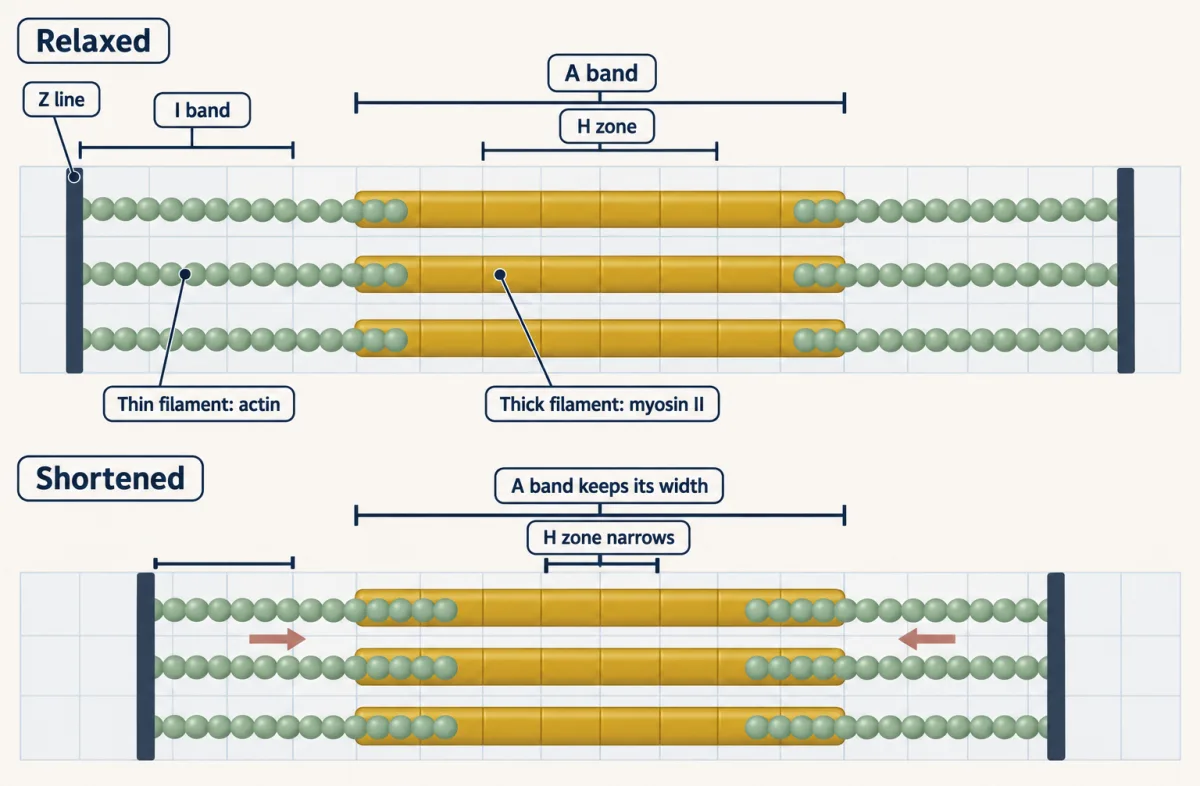
As a sarcomere shortens, the A band keeps its width while the I band and H zone narrow and the Z lines come together. The thick filaments do not shorten; the thin filaments slide in between them. Lengths here are schematic. AI-generated illustration -
Crowds II: dynein teams
-
Going deeper
Where this lesson fits
Before thisReview first
- Cytoskeletal Polymers and DynamicsThis course · Lesson 14
You need actin and microtubule polarity, plus and minus ends, from there, since every motor's direction is defined against them.
- Vesicle Budding, Targeting and FusionThis course · Lesson 11
This lesson's motors are what carry the vesicles whose budding, targeting and fusion are taught there.
- Microscopy and Quantitative ImagesThis course · Lesson 2
Gliding assays and single-bead tracking rely on fluorescence imaging and resolution limits explained there.
After thisStudy next
- Cell Shape, Migration and CiliaThis course · Lesson 16
Actin and microtubule motors drive cell crawling and ciliary beating, including dynein arms that bend cilia.
- Mitosis and Chromosome SegregationThis course · Lesson 19
Kinesins and dyneins build the spindle and move chromosomes, using the direction rules learned here.
- Cytokinesis and Organelle InheritanceThis course · Lesson 20
Myosin II pulls on actin to contract the furrow, as it does in muscle.
Elsewhere on the siteFilms, simulations and method films in other courses
- Sliding, Not ShrinkingFilm · Organismal Biology
Muscle fibre shortening by sliding filaments is shown there with myosin and actin overlap.
- Power Peaks at a Middle LoadFilm · Physiology
Length, load and speed of muscle follow from the cross-bridge cycle and length-tension curve met here.
Suggested by an AI model from the lessons themselves, then checked. How we use AI