Biology Together · Unit 1: Alive and growing
Like Their Parents, Not the Same
Rewritten on : new text and film. Your notes and highlights stay, but the text around them may have moved.
Are all the peas in a pod the same? A ruler and a few vegetables help a child find out how offspring compare.
Three real-life stories behind this activity, about 2 minutes aloud, or read them below.
The film, 4 minutes, and the safety notes, for the grown-up to look at before the activity.
The hands-on part, done with a child: about 30 minutes.
Pause when the reading reaches a film, and offer to play it. Saved on this device.
Watch the film now, or keep listening
That is the end of the reading
This idea at other levels
An activity for ages 5 to 10 about inheritance of traits. Next, for an older child: Reproduction and Meiosis (grade 7).
See every levelHide the levels
This lesson also teaches one more idea; its ladder is below.
Inheritance of traits
Offspring get their traits from their parents, in patterns you can predict but not guarantee.
Taught at four levels: ages 5 to 10, grade 7, high school and college core.
College, the core · the level you chose
Mendel's Peas: Segregation and Independent Assortment
How Mendel reasoned from 5,474 round and 1,850 wrinkled seeds to a law.
Genetics and Molecular Biology · about 26 min · film 3:15 · 3 practice questions
Probability, Crosses and the Chi-Square Test
Three genes without a Punnett square: multiply 3/4 and 1/4 along branches.
Genetics and Molecular Biology · about 25 min · film 3:09 · 3 practice questions
Extending Mendel: Dominance, Multiple Alleles and Gene Interaction
Pink snapdragons, ABO's three alleles and yellow mice's 2:1 ratio relabel Mendel's boxes.
Genetics and Molecular Biology · about 29 min · film 3:15 · 3 practice questions
Grade 7 · the level you chose
Predicting Traits with Punnett Squares
A Punnett square gives the chances, and shows where a hidden trait waits.
Life Science · about 40 min · film 3:21 · Virginia LS.10 c
Weismann cut mouse tails for five generations; the young still had tails.
Life Science · about 40 min · film 3:12 · Virginia LS.10 c, LS.11 c
Reproduction and Meiosis · also at this level, picked for this lesson
Life Science · about 40 min · Virginia LS.10 b, LS.2 d
Ages 5 to 10 · the level you chose
Like Their Parents, Not the Same · this lesson
Measure peas from one pod: alike, but never quite the same.
Biology Together · about 30 min · film 3:46 · Virginia K.7 c, K.7 b, 2.4 a
Play the ladder · 7 films, about 23 min, from grade 7 to college core. Each film waits for you to press play.
Next door to inheritance of traits
- MeiosisThe cell division that deals out one allele of each pair.Nearest lesson: Reproduction and Meiosis (grade 7)
- DNA, the molecule of heredityWhat an allele is made of.Nearest lesson: DNA: The Code of Life (grade 7)
Variation within a population
Members of one kind of living thing differ in many traits, because of their genes, their surroundings and chance.
Taught at three levels: ages 5 to 10, grade 7 and high school.
High school · the level you chose
Mutation makes new alleles, gene flow moves them, sexual reproduction reshuffles them.
Biology · about 40 min · film 3:49 · Virginia BIO.7b
Grade 7 · the level you chose
Ten oak leaves from one tree and 12-year-old heights: two sources plus chance.
Life Science · about 40 min · film 3:36 · Virginia LS.11 a, LS.11 c
Chestnuts with little blight resistance: variation helps only if the trait is already there.
Life Science · about 40 min · film 3:28 · Virginia LS.11 a, LS.11 c
Ages 5 to 10 · the level you chose
Like Their Parents, Not the Same · this lesson
Peas from one pod, lined up by a ruler, are not the same.
Biology Together · about 30 min · Virginia K.7 c, K.7 b, 2.4 a
Play the ladder · 3 films, about 11 min, from grade 7 to high school. Each film waits for you to press play.
Next door to variation
- MutationNew gene versions start as changes in DNA, which is where a population's differences come from.Nearest lesson: Mutations and Variation (grade 7)
- MeiosisEggs and sperm are made with shuffled chromosomes, so children differ from their parents and from each other.Nearest lesson: Reproduction and Meiosis (grade 7)
Short versions inside this lesson
The grade 7 version · about 1 minute to read
In grade 7 Life Science, students learn why brothers and sisters differ. In two-parent reproduction, each parent passes on half of its chromosomes through sex cells, and each sex cell can carry a different mix. That is why each kitten in a litter is a new combination. Students also learn that mutations, changes in DNA, sometimes appear by chance, can create new variations and can be passed on.
The plainest version · about 1 minute to read
Baby plants and animals are a lot like their parents, but usually not exactly the same. Peas from one pod are all peas, but some are bigger and some are smaller. Kittens from one mother cat can have different colors. Some babies, like caterpillars and tadpoles, look very different from their parents at first. They change a lot as they grow.
Find an idea: every idea, searchable
Which lessons teach an idea, and the notes on each level, were written by AI models from the lessons and checked by a second model. A person has not yet read every one. How we use AI
About this activity what is in it
Rewritten on : new text and film. Notes and highlights stay, but the text around them may have moved.
Before you start
- Hands-on time
- About 30 minutes
- Where
- Indoors
- Ages
- 5 to 10, with an easier and a harder version below
- Grown-up
- Stay with your child the whole time. You do all the cutting, and you keep peas and seeds away from children under 4.
What you need
- 3 or 4 fresh pea pods from the grocery store (garden peas, sugar snap peas or snow peas)
- 1 apple and 1 sweet bell pepper
- 5 or 6 leaves picked from one tree or shrub you know is safe to touch (not poison ivy, poison oak, poison sumac, oleander, yew, azalea or rhododendron, and not a dieffenbachia or philodendron houseplant, whose sap irritates skin and eyes)
- A ruler marked in centimeters, or a piece of string and scissors
- A cutting board and a knife (adult only)
- A paper plate and a pencil
- Pictures of animal families from a library book: a litter of puppies or kittens, and a caterpillar with a butterfly or a tadpole with a frog
Virginia science standards SOL K.7 cSOL K.7 bSOL 2.4 a
In this activity. You and your child open pea pods, cut an apple and a pepper, and collect leaves from one plant.
The film
 ▶ Watch Like Their Parents, Not the Same: Parent Guide · 3:46
Read the transcript of “Like Their Parents, Not the Same: Parent Guide”
Film transcript: Like Their Parents, Not the Same: Parent Guide
Are all the peas in a pod the same size? They can look like a row of twins. A ruler can help your child look for differences. Here is the idea your child will find. Offspring, the young a living thing makes, are like their parents, but not identical. Along the way, your child practices looking closely, measuring, and sorting. It takes about thirty minutes. Set out three or four pea pods from the store, an apple, and a sweet bell pepper. Add a ruler, paper plate, pencil, cutting board, knife, and animal family pictures. Set out five or six leaves from one tree or shrub you know is safe to touch. Stay with your child throughout. You do all the cutting.
Peas and seeds are choking hazards for children under four. Keep them out of reach, and call nine one one if a child is choking. Keep leaves and seeds out of mouths. Check for pea, peanut, apple, or pepper allergies first. A child with an allergy can watch while you handle the samples. Use a sweet bell pepper. Skip hot peppers. Wash the produce and everyone's hands. Keep activity samples out of mouths. Start before you open anything. Hold up a closed pod and ask, 'Will the peas inside all be the same?' Write down your child's guess. You will check it together soon. Let your child split each pod with their thumbs. Line up the peas from one pod on the plate, in the order they sat.
Count those peas, then count the peas in another pod. The numbers often differ. Now a question for you. The peas look like twins. When you lay them next to a ruler, what do you expect to see? Measure each pea across. Most garden peas are about one centimeter, or a little smaller. Your child finds the biggest, the smallest, and any that are paler or flat. Then go back to the guess. Ask, 'What did the ruler show?' All these peas came from one plant. A bigger pea from this pod had the same parent plant as a smaller one. Much of the difference comes from how much food reached each pea as it grew. Cut the apple across its middle to reveal a star of seed pockets.
Cut the pepper from top to bottom. Line up five seeds from each and compare their sizes and shapes. Compare the leaves, then measure the longest and shortest. Show kittens with their mother and ask, 'How are they alike?' Then show a caterpillar and a butterfly.
Sort the pictures together. Put babies that look like their parents in one group and babies that look different at first in another. Keep the talk to plants and animals. Do not ask which parent your child looks like. Many children are adopted, fostered, or live in blended families, and the question can hurt. Return to your child's guess and have them show you what they noticed. Count the peas and seeds and clear the table. Wash everyone's hands again. Peas from one pod can be alike in some ways and differ in others.
Before you start
- Hands-on time
- About 30 minutes
- Where
- Indoors
- Ages
- 5 to 10, with an easier and a harder version below
- Grown-up
- Stay with your child the whole time. You do all the cutting, and you keep peas and seeds away from children under 4.
What you need
- 3 or 4 fresh pea pods from the grocery store (garden peas, sugar snap peas or snow peas)
- 1 apple and 1 sweet bell pepper
- 5 or 6 leaves picked from one tree or shrub you know is safe to touch (not poison ivy, poison oak, poison sumac, oleander, yew, azalea or rhododendron, and not a dieffenbachia or philodendron houseplant, whose sap irritates skin and eyes)
- A ruler marked in centimeters, or a piece of string and scissors
- A cutting board and a knife (adult only)
- A paper plate and a pencil
- Pictures of animal families from a library book: a litter of puppies or kittens, and a caterpillar with a butterfly or a tadpole with a frog
Virginia science standards SOL K.7 cSOL K.7 bSOL 2.4 a
The big idea
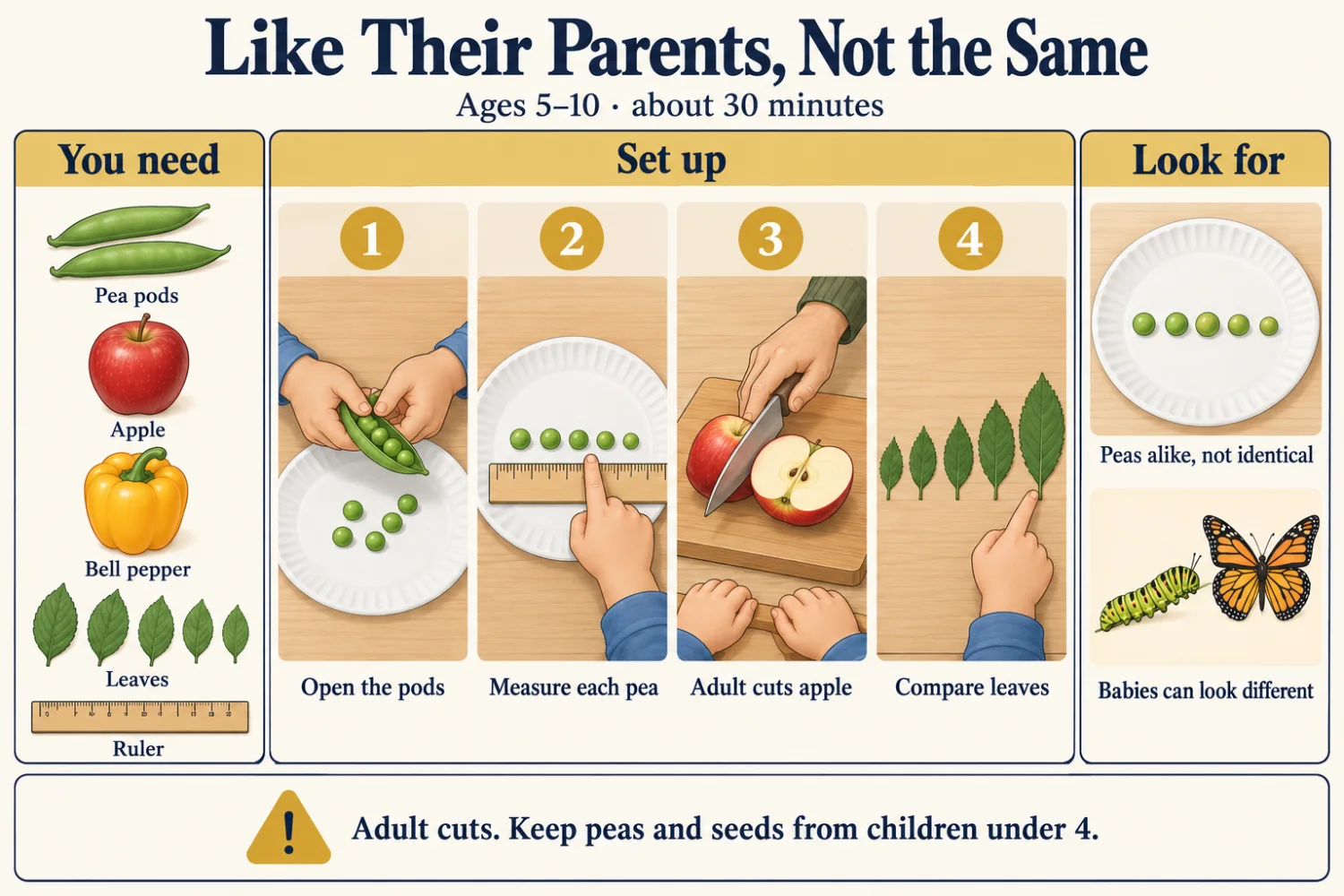
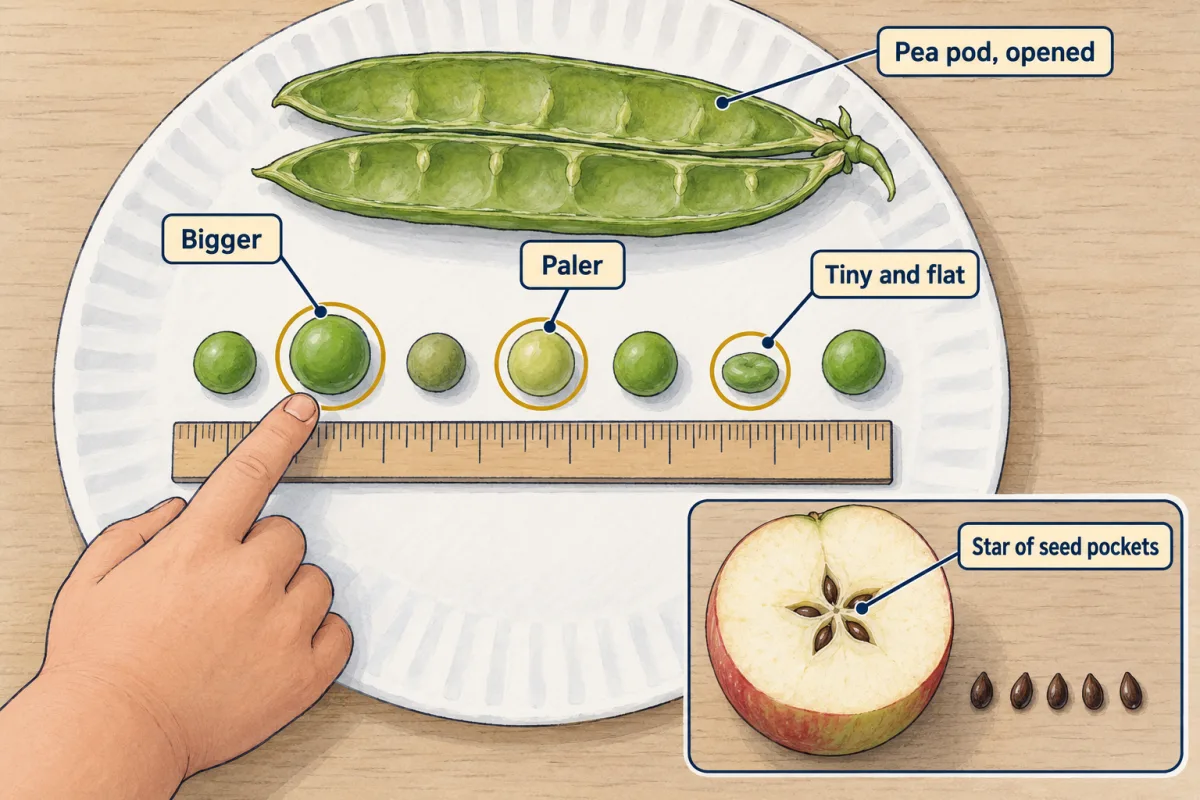
Your child gets to test a guess with a ruler. Open a pea pod and the peas look like a row of twins. Line them up next to a ruler, though, and they are not the same. One is bigger. One is paler. One is tiny and flat. Along the way your child practices looking closely, measuring, and sorting things into “same” and “different.”
Say it together (read aloud): “Babies are a lot like their parents, but not exactly the same. Peas from one pod are all peas. Some may be bigger or paler than others.”
All the peas in a pod came from the same parent plant. They are its offspring, the young that a living thing makes. Offspring are like their parents, and like each other, but not identical. Seeds from one apple or one pepper show the same thing. Leaves are parts of a plant, not offspring, but leaves from one plant are never exactly alike either.
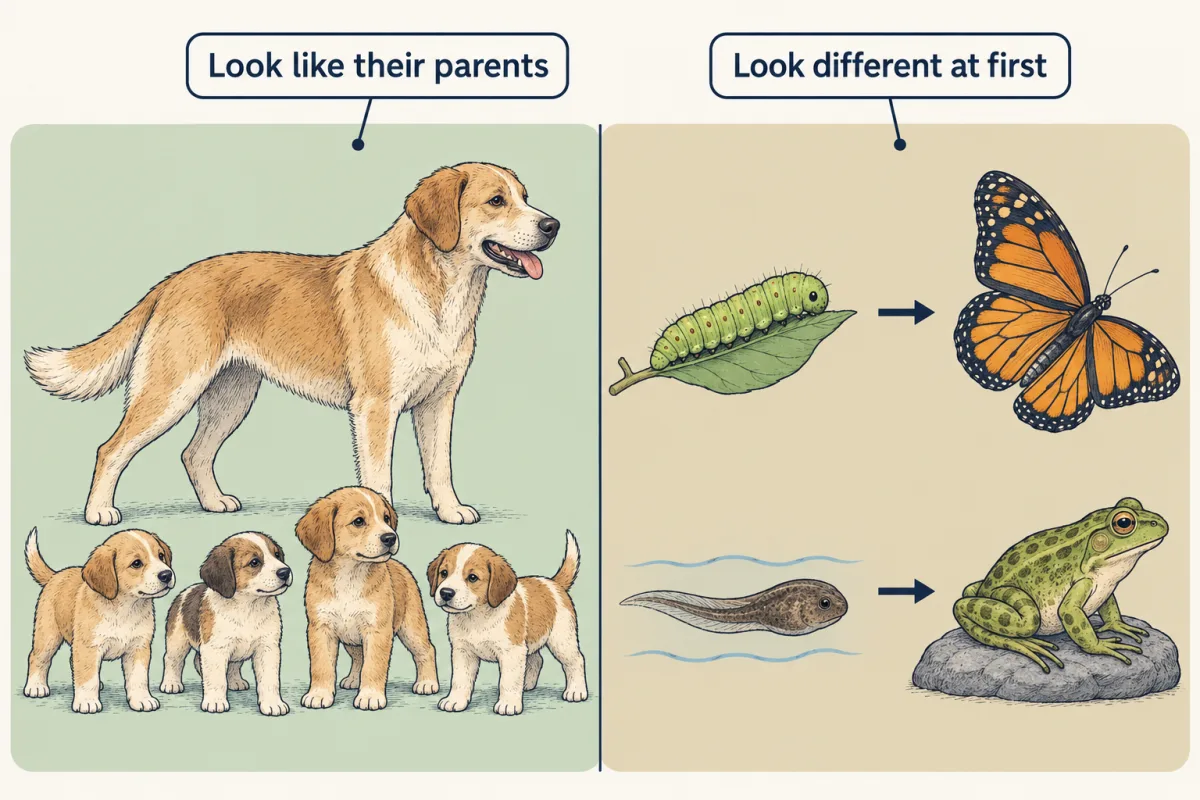
Animals work the same way. Puppies in one litter share many features, yet each one is a little different. Some babies look like small versions of their parents from the start. Others, like caterpillars and tadpoles, look very different at first and change as they grow.
This activity keeps to plants and animals on purpose. It does not compare children with their own parents.
For teachers (Virginia standards)
Virginia’s kindergarten standard asks children to notice that offspring are similar but not identical. Grade 2 adds the idea that some animals go through stages.
What to do
- Predict. Hold up a closed pea pod. Ask, “What will the peas inside look like? Will they all be the same?” Write down your child’s guess. You will check it in step 3.
- Open the pods. Let your child split each pod with their thumbs. Line up the peas from one pod on a paper plate, in the order they sat in the pod. Count them, then count the peas in another pod. Pods from the same bag often hold different numbers. Ask, “Did both pods have the same number?”
- Measure and check the guess. Measure each pea across with a ruler. Without a ruler, wrap string around each pea, mark the length and compare the marks; that length is about three times the pea’s width. Most garden peas are about 1 cm across or a little smaller. Ask your child to find the biggest, the smallest, and any that are a different shade or shape. Return to your child’s recorded guess. Ask, “What did we find? How does that compare with your guess?”
- Cut the apple and pepper. Lay the apple on its side on a board that does not slide, hold it steady with your fingers curled away from the blade, and cut it across its middle to show a star of seed pockets. Cut the pepper in half from top to bottom. Have your child pick out 5 seeds from each and line them up. Ask, “How are they the same? How are they different?”
- Compare leaves from one plant. Lay out 5 or 6 leaves from the same plant. Look at shape, size, color, edges and veins. Measure the longest and the shortest. They all clearly come from one kind of plant, yet no two match exactly.
- Look at animal families. Find a picture of a litter of puppies or kittens with their mother. Ask, “How do the babies look like the mother? How are they different from her and from each other?” Look for coat color, spots, ear shape and size. Keep the talk to the animals. Do not ask a child which parent they look like: many children are adopted, fostered, donor-conceived or live in blended families, and the question can hurt.
- Babies that look different. Show a caterpillar and a butterfly, or a tadpole and a frog. Ask, “Could this baby belong to that grown-up?” Then sort your animal pictures into two groups: babies that look like their parents, and babies that look different at first.
- Debrief. Ask two closing questions:
- “Were all the peas from one pod exactly the same? How do you know?”
- “Does every baby animal look like its parent right away?” Read Say it together aloud again.
With a class, give each table of four one pod, one apple half and one set of leaves, and share the animal pictures.
Questions to ask while you do it
Ask your child to guess first, then check.
- “I wonder if all the peas in this pod are the same size. Which one do you think is biggest?”
- “What do you think we will find if we open another pod? The same number of peas?”
- “These seeds all came from one apple. Do you think they will look exactly alike?”
- “I wonder what a kitten from this mother cat will look like. What will be the same?”
- “What do you think a tadpole turns into? How could we find out?”
- “If we planted two peas from this pod, do you think the plants would be twins?”
What children often think
-
A child might say “Babies are exact copies of their mom and dad.”
You could try Look at the kitten picture together and ask, "Are all the kittens the same? Are they the same as their mother?" Count the differences you can find. Babies are like their parents but not identical, and brothers and sisters differ from each other too.
-
A child might say “All the peas in a pod are the same.”
You could try Ask your child to prove it with the ruler. Line the peas up from biggest to smallest. Many pods have at least one pea that is smaller, paler or a different shape. They are alike in many ways, but not the same.
-
A child might say “A caterpillar is a different animal from a butterfly.”
You could try That makes sense from how they look. Ask, "Where do caterpillars come from? What do they become?" A butterfly lays eggs, a caterpillar hatches, and later it turns into a butterfly. It is the same animal at a younger stage.
-
A child might say “The biggest pea came from the biggest parent.”
You could try Ask, "Where did all the peas in this pod come from?" They all came from the same plant, yet they are different sizes. So the size of a pea does not come from the size of the parent. Much of it comes from how much food reached each pea as it grew.
Why it works
A trait is a feature such as color, shape or size. Parents pass many traits on to their offspring, which is why peas make peas and cats make cats. In most animals and many plants, each offspring starts from two parents’ contributions, and each one usually gets a different mix. That is one reason brothers and sisters differ. How and where each one grows matters too.
Pea plants mostly pollinate themselves. After many generations of this, the peas in a store-bought pod share nearly the same inheritance. They still differ. Some differences likely come from how each pea grew, such as how much food and water reached it. Seeing a difference does not tell you whether it was inherited.
Apples show the opposite case. Most apple trees need pollen from a different apple variety. A seed from a Red Delicious apple does not grow into a Red Delicious tree, so growers copy favorite trees by grafting. Animals such as butterflies and frogs go through metamorphosis, a big change in body form as they grow.
Easier and harder
Ages 5 to 7
Use one pea pod and the animal pictures only. Skip the ruler: have your child line peas up from biggest to smallest and say what is the same and what is different. Ask for two “same” and two “different” ideas each time. Your child can draw instead of write. Kindergartners do not need to name the stages of a life cycle. Just notice that some babies look different from their parents.
Ages 8 to 10
Measure every pea from three pods in millimeters and record them in a table. Make a bar graph of how many peas fall in each size group. You cut two more apples of the same kind, and your child compares the seed counts. Then have your child build a simple key: write yes-or-no questions that split five leaves from the same plant into smaller groups until each leaf is on its own. Talk about which differences might be inherited and which might come from growing conditions.
If it doesn’t go as planned
If the pods are flat with tiny peas, try sugar snap peas or a different store. Snow peas hold very small peas, so look closely or use a magnifying glass. If every pea looks the same, measure more carefully or compare color under bright light. If your child steers toward their own family, bring the talk gently back to the peas and the kittens.
Observation sheet
Here is what two filled-in rows can look like:
| Pea | Size (cm) | Color | Same or different? |
|---|---|---|---|
| 1 | about 1 | green | about the same size as most |
| 2 | smaller than 1 | pale green | different: smaller and paler |
Observation sheet
Like their parents, not the same
NameDate
Look closely. Write or draw how they are the same and how they are different.
| Pea | Size (cm) | Color | Same or different? |
|---|---|---|---|
Two ways my peas were the same:
Two ways my peas were different:
stemhop.com · Biology Together
The three stories, told aloud Side Hops: three stories that go with this lesson Side Hops
Three playful ways to talk about living things that are alike, not identical
1:35 · Narration: an AI narrator voice (Kokoro, af_heart).
Read the transcript
Hey there! Before you open the pea pods and line up the leaves, here are three playful ways to keep the big idea going all week. First, a catchphrase: "Same herd, different stripes!" Grown-up zebras are usually black and white, and each zebra's stripe pattern is its own, kind of like a fingerprint. A Grevy's zebra has about eighty stripes in all. Save the phrase for after your child has measured the peas, then pull it out whenever two puppies in a storybook, or two peas from one pod, match in big ways and differ in small ones. Next, a tree to stand under. On your next walk, stop with your child beside one leafy tree you know is safe. Look closely at the leaves tucked deep in the shady lower branches, then at the leaves out in the bright sun. On the very same tree, shade leaves often grow larger and thinner, while sun leaves stay smaller and thicker. Same tree, different leaves, partly from how much light they got. Finally, a wonder question for the car. Tell your child that flamingo chicks hatch with fluffy white-gray feathers and straight bills, then ask, "How do you think they turn pink like their parents?" Kids come up with wonderful guesses, from sunshine to paint to magic. Enjoy every answer before you share the twist: flamingos turn pink over several years, from natural pigments in the algae and brine shrimp they eat. Have fun spotting surprises together!
The idea underneath them. You and your child open pea pods, cut an apple and a pepper, and collect leaves from one plant.
Your notes
Select any text in the lesson to highlight it or add a note to it. Your highlights and notes are saved in this browser and collected in your notebook.
This browser is not letting the site save anything (a private window or strict privacy settings), so highlights and notes will be lost when you leave the page.
Where this lesson fits
After thisStudy next
- Mealworms to BeetlesThis course · Lesson 14
Raising mealworms lets your child watch a baby that looks nothing like its adult, which this activity only showed in pictures.
- The Camouflage HuntThis course · Lesson 18
The small differences between offspring now matter: some colours stay hidden from a hungry bird and some do not.
Elsewhere on the siteFilms, simulations and method films in other courses
- What Can Cross a Generation?Film · Life Science
It shows which traits pass from parent to young and which do not, taking the idea of like parents further.
- Beetles and new coloursSimulation · Life Science
It lets students see why offspring of one parent plant still differ in size and shape.
Suggested by an AI model from the lessons themselves, then checked. How we use AI
Those are the stories. The idea under them is the one the lesson builds.
That is the film. The rest of the activity is the fun part.
The rest of the activity is here when you want it.
Finish line
Test yourself
4 questions
Questions to talk over together.
Next · Lesson 4
The Mystery Feely Bag
Can you tell what something is without looking? A bag of hidden objects lets a child find out what skin can sense.
Continue →Rewritten on : new text and film. Notes and highlights stay, but the text around them may have moved.