Where Can White Flowers Hide?
Read the transcript of “Where Can White Flowers Hide?”
Film transcript: Where Can White Flowers Hide?
How can two purple-flowered pea plants have a white-flowered offspring? Picture two purple-flowered parents, and between them, one offspring with white flowers. Nothing about the parents’ visible color seems to explain it. The answer is hidden inside what each parent carries.
Look inside one parent. Its flower-color gene comes in versions called alleles. This plant carries a purple allele and a white allele. P is dominant, so purple shows. p is recessive. It is hidden from view, not damaged or erased. The allele pair a plant carries is its genotype. The flower color that shows is its phenotype. This parent’s genotype is Pp. Its phenotype is purple. A purple plant can carry a hidden p allele, so appearance alone cannot reveal its pair. Carried information and the visible trait can differ. Carried information and the visible trait can differ. Before offspring form, the pair separates. Each sex cell carries one allele from the parent.
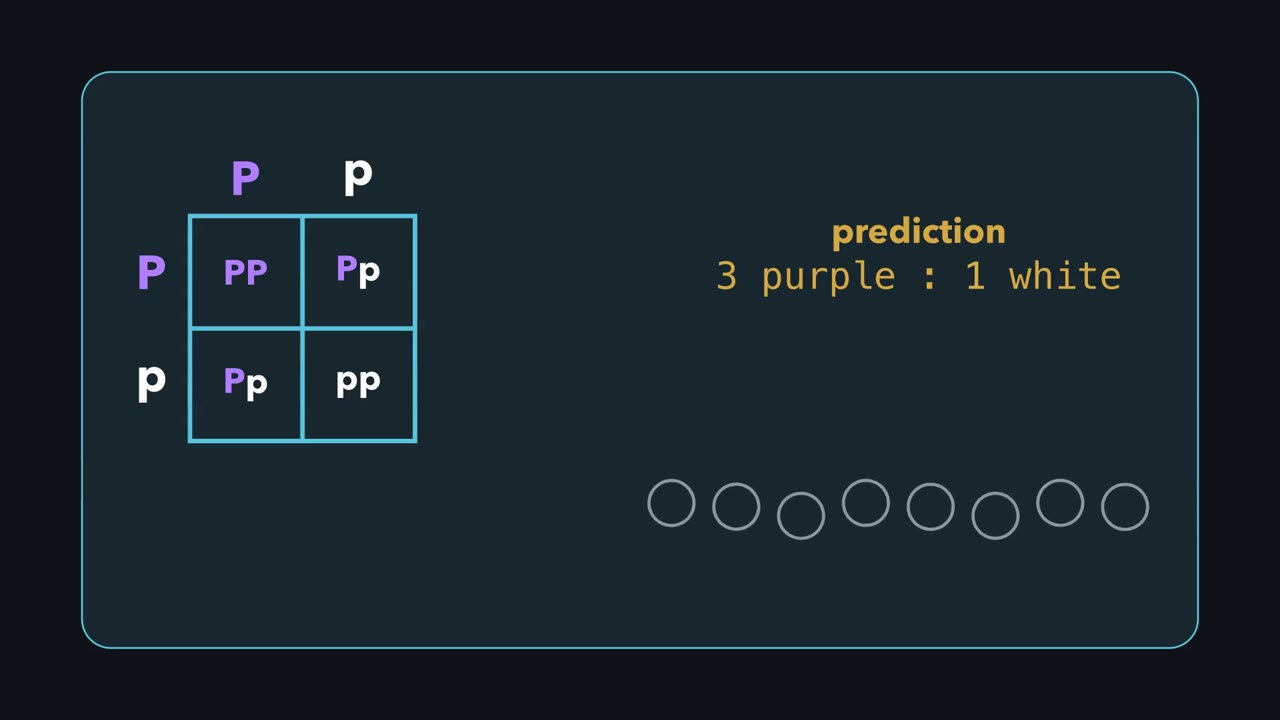
Watch P enter one teal path and p enter another. The other parent does the same. Either parent can pass the hidden p onward. A Punnett square organizes those possible meetings. One parent’s sex cells settle across the top. The other’s settle down the side. Follow a teal path from each edge into a box. The two arriving alleles become one possible genotype for an offspring. Both parents’ contributions stay separate and easy to trace. Three boxes now hold possible allele pairs. The last box receives p from each parent. What genotype and flower color should appear there? Keep your answer in mind while the paths move.
Both p alleles meet. The genotype is pp, so the white phenotype appears. The white color never showed in the parents’ flowers. It was carried as a hidden allele in each parent, then joined in this offspring. Now read the whole grid. The allele pairs predict genotypes. The flowers translate them into phenotypes. Most boxes show purple, while one shows white. Each box describes a possible outcome for a new offspring. The grid does not schedule what must happen next. This model has a boundary. It follows one gene, two alleles, one of them dominant, and known parent genotypes. Within that scope, it links what parents carry to what offspring may inherit.
Real groups can still vary. For one-gene crosses, Punnett squares predict chances, not exact offspring counts.
How can two purple-flowered pea plants have a white-flowered offspring?
Continue in the lesson: Predicting Traits with Punnett Squares →
3:21 · Free, with captions and a transcript. The lesson has the full text, the questions and the sources.
More films from this lesson
How this film was made. Narration: written from this lesson's text and read by an AI narrator voice (Kokoro, af_heart). Animation: AI-generated in code (Manim) by Claude, a schematic with no drawn molecular structures. Captions come from the narration script. See something wrong? Report it.